
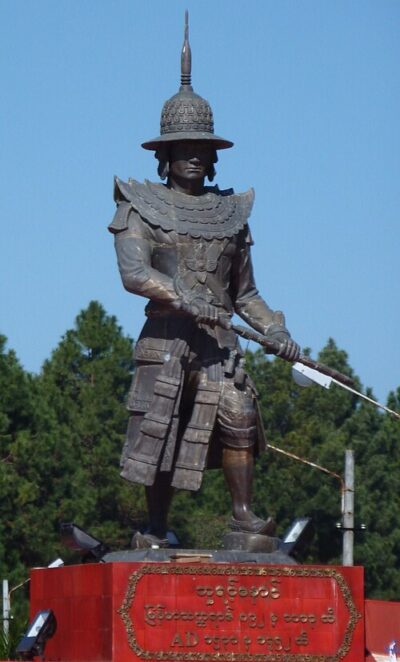
Bayinnaung
Bayinnaung was a King of Burma. Born January 16, 1516, in Taungoo. Died November 10, 1581, in Bago. Positions held include King of Burma (1550–1581).
Facts
27 facts · 1 confirmed by two sources · 0 cited · 25 from one source · 1 where the sources disagree
What’s different
- Died: we show November 10, 1581 (Sources disagree). Wikipedia says October 10, 1581
Where this comes from
Papalocal keeps its own record. It started from these sources; what each one said is kept here as it was copied, so a change on their side never changes this page by itself. Tap one to read its version.
What Wikidata says · copied November 16, 2026 · revision 2545067672
- Described as
- King of Burma
- Other names
- King Bayinnong, Bayinnaung Kyawhtin Nawrahta
- Born
- January 16, 1516
- Died
- November 10, 1581
- Born in
- Taungoo
- Died in
- Bago
- Buried in
- Kanbawzathadi Palace · 1 reference
- Citizen of
- First Toungoo Empire
- Occupation
- military leader
- Positions held
- King of Burma (1550–1581)
- Spouse
- Atula Thiri Maha Yaza Dewi; Yaza Dewi of Pegu · 1 reference; Khin Pyezon · 1 reference; Suphankanlaya
- Children
- Nanda Bayin; Nyaungyan Min; Nawrahta Minsaw · 1 reference; Yaza Datu Kalaya · 1 reference; Inwa Mibaya · 1 reference; Thiri Thudhamma Yaza of Martaban · 1 reference; Min Khin Saw; Thiri Maha Dhamma Yaza Dipadi Dewi
- Father
- Mingyi Swe
- Mother
- Shin Myo Myat
- Siblings
- Thado Dhamma Yaza II of Prome; Dhamma Dewi of Toungoo · 1 reference; Minye Sithu · 1 reference
- Religion
- Theravāda
- Military rank
- general
- Wikipedias with a page
- 31
Wikidata item Q470984 (wikidata.org/wiki/Q470984), public domain (CC0). Copied November 16, 2026.
What Wikipedia says · copied November 16, 2026 · revision 1384836341
Bayinnaung Kyawhtin Nawrahta (Burmese: ဘုရင့်နောင် ကျော်ထင်နော်ရထာ; Thai: บุเรงนองกะยอดินนรธา; 16 January 1516 – 10 October 1581) was King of Burma from 30 April 1550 until his death in 1581, during the Toungoo dynasty. His reign is considered one of the most momentous in Burmese history, famously described as "the greatest explosion of human energy ever seen in Burma". During his rule, he assembled the largest empire in Southeast Asian history, which encompassed much of present-day Myanmar, as well as the Shan States, Lan Na, Lan Xang, Manipur, and the Ayutthaya Kingdom.
Though best remembered for his empire-building, Bayinnaung's most enduring legacy was the integration of the Shan States into the Irrawaddy valley administrative system. After conquering the Shan States between 1557 and 1563, he implemented a series of administrative reforms aimed at reducing the power of hereditary rulers, known as saophas, and aligning Shan governance and customs with lowland Burmese norms. These reforms effectively eliminated the persistent threat of Shan raids into Upper Burma, a source of instability since the 13th century. Bayinnaung's integration policy served as a model for successive Burmese monarchs, who continued his approach until 1885.
However, Bayinnaung largely followed the prevailing Mandala administrative model across his vast and culturally diverse empire. His rule over the First Toungoo Empire was described as "an emperor without an empire" holding control through personal allegiance to Bayinnaung as a Chakravartin (Universal Monarch) from it sub-kingdoms, rather than to any institutions. While this loyalty endured during his lifetime, it rapidly unraveled after his death in 1581. Both the kingdoms of Ava and Ayutthaya revolted within just over two years, and by 1599, all vassal states had declared independence, resulting in the complete collapse of the empire.
Bayinnaung is regarded as one of the three greatest Burmese monarchs and is commemorated with major landmarks in his name in modern Myanmar. He is also well known in Thailand, where he is remembered as "Conqueror of the Ten Directions". Despite being a former adversary of Ayutthaya, his influence in Thai historical consciousness stands as a testament to the scale and power of his reign.
- Born, in its opening lines
- January 16, 1516
- Died, in its opening lines
- October 10, 1581
From the Wikipedia article “Bayinnaung” (en.wikipedia.org/wiki/Bayinnaung), by its contributors, under CC BY-SA 4.0 (creativecommons.org/licenses/by-sa/4.0/). Copied November 16, 2026; not changed.
Confirmed Two sources agree. Cited One source, and it names where it got it. One source One source, without a reference of its own. Sources disagree The sources disagree. We show the best-supported value and keep theirs below.
