
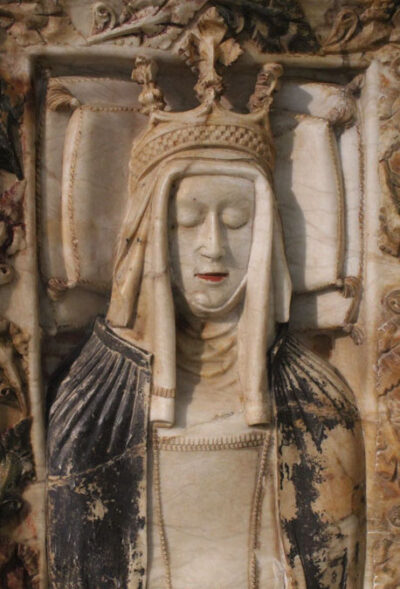
Beatrice of Portugal
Beatrice of Portugal was a Queen of Castile, Pretender Queen of Portugal. Born February 1373, in Coimbra. Died 1409, in Toro. Positions held include royal consort of Castile.
Facts
15 facts · 0 confirmed by two sources · 2 cited · 13 from one source
Where this comes from
Papalocal keeps its own record. It started from these sources; what each one said is kept here as it was copied, so a change on their side never changes this page by itself. Tap one to read its version.
What Wikidata says · copied November 16, 2026 · revision 2559722044
- Described as
- Queen of Castile, Pretender Queen of Portugal
- Born
- February 1373
- Died
- 1409 · 1 reference
- Born in
- Coimbra
- Died in
- Toro
- Buried in
- Monastery of Sancti Spiritus of Toro
- Citizen of
- Kingdom of Portugal
- Occupation
- monarch
- Positions held
- royal consort of Castile
- Spouse
- John I of Castile and Leon (1383–) · 2 references
- Children
- Miguel, Crown Prince of Portugal · 1 reference
- Father
- Ferdinand I of Portugal
- Mother
- Leonor Teles de Menezes
- Siblings
- Álvaro da Cunha, senhor de Pombeiro; Isabella of Portugal, Lady of Viseu
- Religion
- Catholicism
- Wikipedias with a page
- 37
Wikidata item Q233745 (wikidata.org/wiki/Q233745), public domain (CC0). Copied November 16, 2026.
What Wikipedia says · copied November 16, 2026 · revision 1383693358
Beatrice (Portuguese: Beatriz, pronounced [bi.ɐˈtɾiʃ]; 7–13 February 1373 – c. 1420) was the only surviving legitimate child of King Ferdinand I of Portugal and Leonor Teles. She became Queen consort of Castile by marriage to King John I of Castile. Following her father's death without a legitimate male heir, she claimed the Portuguese throne but lost her claim to her uncle, who became King John I of Portugal, founder of the House of Aviz.
During her early years, Beatrice was a pawn in the changing politics of foreign alliances of her father, who negotiated successive marriages for her. She would eventually marry King John I of Castile, by whom Beatrice became Queen Consort of Castile. At the death of her father, she was proclaimed Queen regnant of Portugal and her mother assumed the regency in her name. Opposition to the regency, fear of the Castilian domination and loss of Portuguese independence led to a popular rebellion and civil war between the late King Ferdinand I's illegitimate brother, John of Aviz, who wrested control of the regency from the dowager queen, and the supporters of Beatrice and her husband, John I of Castile, who claimed the throne of Portugal by right of his wife. In 1385, John of Aviz was proclaimed King of Portugal, and the King of Castile was definitively defeated in the Battle of Aljubarrota, effectively ending any prospects for Beatrice and her husband to assert their rights to the Portuguese crown.
From that time, Queen Beatrice took a special interest in the welfare of the Portuguese exiles in Castile who had been faithful to her dynastic claim to the Portuguese throne. After the death of her husband, she was relegated to a secondary level in the Castilian court. However, the dynastic strife continued to represent a challenge to the normalization of relations between Castile and Portugal. From the second decade of the 15th century onwards, her documentary trail became scarce until she completely disappeared about 1420.
From the Wikipedia article “Beatrice of Portugal” (en.wikipedia.org/wiki/Beatrice_of_Portugal), by its contributors, under CC BY-SA 4.0 (creativecommons.org/licenses/by-sa/4.0/). Copied November 16, 2026; not changed.
Confirmed Two sources agree. Cited One source, and it names where it got it. One source One source, without a reference of its own. Sources disagree The sources disagree. We show the best-supported value and keep theirs below.
