
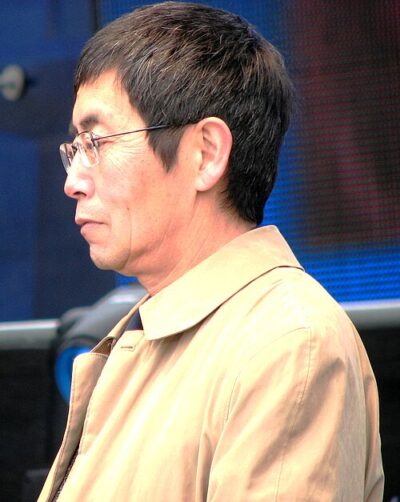
Bei Dao
Bei Dao is a contemporary Chinese (PRC) avant garde poet. Born August 2, 1949, in Beijing. Educated at Beijing No. 4 High School. Awards include PEN Barbara Goldsmith Freedom to Write Award, Kurt Tucholsky Prize and Guggenheim Fellowship.
Facts
16 facts · 1 confirmed by two sources · 9 cited · 6 from one source
Where this comes from
Papalocal keeps its own record. It started from these sources; what each one said is kept here as it was copied, so a change on their side never changes this page by itself. Tap one to read its version.
What Wikidata says · copied November 15, 2026 · revision 2561035392
- Described as
- contemporary Chinese (PRC) avant garde poet
- Other names
- Zhao Zhenkai
- Born
- August 2, 1949 · 5 references
- Born in
- Beijing · 2 references
- Citizen of
- People's Republic of China · 1 reference; United States
- Occupation
- writer · 1 reference; poet · 1 reference
- Worked for
- University of Notre Dame; University of California, Davis
- Education
- Beijing No. 4 High School
- Awards
- PEN Barbara Goldsmith Freedom to Write Award (1990); Kurt Tucholsky Prize (1990) · 1 reference; Guggenheim Fellowship (1998) · 1 reference; Jeanette Schocken Prize (2005) · 1 reference; Golden Wreath (2015) · 1 reference; honorary doctorate of Artois University (2022) · 1 reference
- Spouse
- Gan Qi
- Wikipedias with a page
- 35
Wikidata item Q558744 (wikidata.org/wiki/Q558744), public domain (CC0). Copied November 15, 2026.
What Wikipedia says · copied November 15, 2026 · revision 1381713321
Bei Dao (simplified Chinese: 北岛; traditional Chinese: 北島; pinyin: Běi Dǎo; lit. 'Northern Island', born August 2, 1949) is the pen name of the Chinese-American writer Zhao Zhenkai (simplified Chinese: 赵振开; traditional Chinese: 趙振開; pinyin: Zhào Zhènkāi). Among the most acclaimed Chinese-language poets of his generation, he is often regarded as a candidate for the Nobel Prize in Literature. In addition to poetry, he is the author of short fiction, essays, and a memoir. Known as a dissident, he is a prominent representative of a school of poetry known variously in the West as "Misty" or "Obscure" Poetry.
Born in Beijing before the establishment of the People's Republic of China, Bei Dao served as a member of the Red Guards in his youth. However, disillusioned by the Cultural Revolution, he participated in the 1976 Tiananmen Incident and co-founded an influential literary journal, called Jintian (Today), that came to be officially banned in China. After his poetry and activism were an inspiration to the 1989 Tiananmen Square protests, Bei Dao was banned from China and entered a period of exile in the West, living and teaching in numerous countries before settling in the United States. He has been allowed to return to mainland China since 2006, but has not done so except for brief visits. In 2007, he joined the faculty of the Chinese University of Hong Kong. In 2009, he became an American citizen.
Bei Dao has been described as having played a significant role in creating a new form of poetry in Chinese literature, one that is often viewed as a reaction to the artistic strictures of the Mao era. In particular, his poetry is known for linguistic experimentation and an embrace of complexity, even paradox, in its exploration of individuality.
Currently, Bei Dao resides in Hong Kong, where he is an Honorary Professor of Humanities at the Chinese University of Hong Kong.
- Born, in its opening lines
- August 2, 1949
From the Wikipedia article “Bei Dao” (en.wikipedia.org/wiki/Bei_Dao), by its contributors, under CC BY-SA 4.0 (creativecommons.org/licenses/by-sa/4.0/). Copied November 15, 2026; not changed.
Confirmed Two sources agree. Cited One source, and it names where it got it. One source One source, without a reference of its own. Sources disagree The sources disagree. We show the best-supported value and keep theirs below.
