
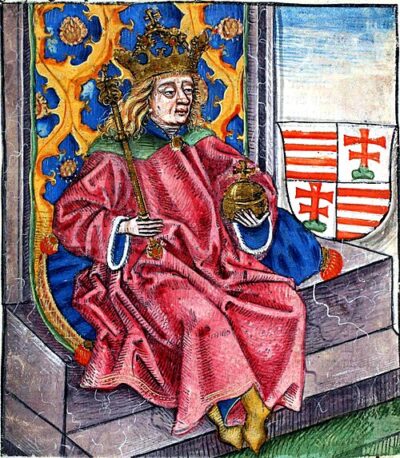
Béla IV of Hungary
Béla IV of Hungary was a King of Hungary. Born November 29, 1206, in Transylvania. Died May 3, 1270, in Buda. Positions held include Apostolic King of Hungary (1235–1270).
Facts
28 facts · 2 confirmed by two sources · 5 cited · 21 from one source
Where this comes from
Papalocal keeps its own record. It started from these sources; what each one said is kept here as it was copied, so a change on their side never changes this page by itself. Tap one to read its version.
What Wikidata says · copied November 16, 2026 · revision 2557825237
- Described as
- King of Hungary (1206-1270)
- Other names
- Bela IV of Hungary, Bela IV
- Born
- November 29, 1206 · 1 reference
- Died
- May 3, 1270 · 1 reference
- Born in
- Transylvania
- Died in
- Buda
- Buried in
- Székesfehérvár
- Citizen of
- Hungary
- Occupation
- politician; monarch
- Positions held
- Apostolic King of Hungary (1235–1270) · 1 reference
- Political party
- politician before the emergence of political parties
- Field
- history · 1 reference
- Spouse
- Maria Laskarina (1218–) · 1 reference
- Children
- Kinga of Poland · 1 reference; Anna of Hungary · 1 reference; Yolanda of Poland; Elizabeth of Hungary, Duchess of Bavaria; Stephen V of Hungary; Margaret of Hungary; Constance of Hungary, Queen of Galicia; Béla, Duke of Slavonia · 1 reference
- Father
- Andrew II of Hungary
- Mother
- Gertrude of Merania
- Siblings
- Violant of Hungary; Anna Maria of Hungary; Elizabeth of Hungary; Stephen the Posthumous; Coloman of Galicia-Lodomeria; Andrew of Hungary
- Wikipedias with a page
- 52
Wikidata item Q152370 (wikidata.org/wiki/Q152370), public domain (CC0). Copied November 16, 2026.
What Wikipedia says · copied November 16, 2026 · revision 1376968429
Béla IV (1206 – 3 May 1270) was King of Hungary and Croatia between 1235 and 1270, and Duke of Styria from 1254 to 1258. As the oldest son of King Andrew II, he was crowned upon the initiative of a group of influential noblemen in his father's lifetime in 1214. His father, who strongly opposed Béla's coronation, refused to give him a province to rule until 1220. In this year, Béla was appointed Duke of Slavonia, also with jurisdiction in Croatia and Dalmatia. Around the same time, Béla married Maria, a daughter of Theodore I Laskaris, Emperor of Nicaea. From 1226, he governed Transylvania as duke. He supported Christian missions among the pagan Cumans who dwelled in the plains to the east of his province. Some Cuman chieftains acknowledged his suzerainty and he adopted the title of King of Cumania in 1233. King Andrew died on 21 September 1235 and Béla succeeded him. He attempted to restore royal authority, which had diminished under his father. For this purpose, he revised his predecessors' land grants and reclaimed former royal estates, causing discontent among the noblemen and the prelates.
The Mongols invaded Hungary and annihilated Béla's army in the Battle of Mohi on 11 April 1241. He escaped from the battlefield, but a Mongol detachment chased him from town to town as far as Trogir on the coast of the Adriatic Sea. Although he survived the invasion, the Mongols devastated the country before their unexpected withdrawal in March 1242. Béla introduced radical reforms in order to prepare his kingdom for a second Mongol invasion. He allowed the barons and the prelates to erect stone fortresses and to set up their private armed forces. He promoted the development of fortified towns. During his reign, thousands of colonists arrived from the Holy Roman Empire, Poland and other neighboring regions to settle in the depopulated lands. Béla's efforts to rebuild his devastated country won him the epithet of "second founder of the state" (Hungarian: második honalapító).
He set up a defensive alliance against the Mongols, which included Daniil Romanovich, Prince of Halych, Boleslaw the Chaste, Duke of Cracow and other Ruthenian and Polish princes. His allies supported him in occupying the Duchy of Styria in 1254, but it was lost to King Ottokar II of Bohemia six years later. During Béla's reign, a wide buffer zone—which included Bosnia, Barancs (Braničevo, Serbia) and other newly conquered regions—was established along the southern frontier of Hungary in the 1250s.
Béla's relationship with his oldest son and heir, Stephen, became tense in the early 1260s, because the elderly king favored his daughter Anna and his youngest child, Béla, Duke of Slavonia. He was forced to cede the territories of the Kingdom of Hungary east of the river Danube to Stephen, which caused a civil war lasting until 1266.
Nevertheless, Béla's family was notable for its piety: he died as a Franciscan tertiary, as had been his sister, the famed Elizabeth of Hungary. Later the veneration of his three saintly daughters—Kunigunda, Yolanda, and Margaret—as well as of his great-niece, Elizabeth of Portugal, was confirmed by the Holy See.
- Born, in its opening lines
- 1206
- Died, in its opening lines
- May 3, 1270
From the Wikipedia article “Béla IV of Hungary” (en.wikipedia.org/wiki/Béla_IV_of_Hungary), by its contributors, under CC BY-SA 4.0 (creativecommons.org/licenses/by-sa/4.0/). Copied November 16, 2026; not changed.
Confirmed Two sources agree. Cited One source, and it names where it got it. One source One source, without a reference of its own. Sources disagree The sources disagree. We show the best-supported value and keep theirs below.
