
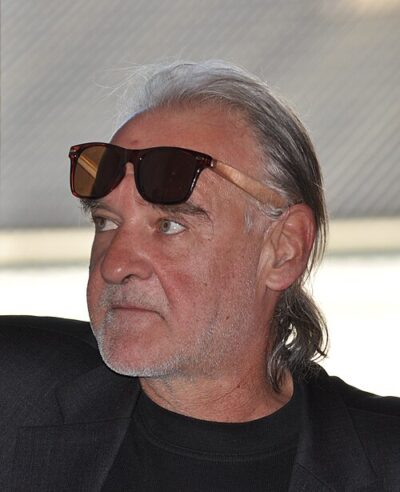
Béla Tarr
Béla Tarr was a Hungarian filmmaker and anarchist. Born July 21, 1955, in Pécs. Died January 6, 2026, in Budapest. Positions held include chairperson (2022–2026). Known for Family Nest, The Turin Horse and Sátántangó. Educated at University of Theatre and Film Arts. Awards include Béla Balázs Award, Gundel Art Award and Kossuth Prize.
Facts
43 facts · 2 confirmed by two sources · 27 cited · 14 from one source
Where this comes from
Papalocal keeps its own record. It started from these sources; what each one said is kept here as it was copied, so a change on their side never changes this page by itself. Tap one to read its version.
What Wikidata says · copied November 16, 2026 · revision 2553189262
- Described as
- Hungarian filmmaker and anarchist (1955–2026)
- Other names
- Bela Tarr, Tarr Béla
- Born
- July 21, 1955 · 6 references
- Died
- January 6, 2026 · 2 references
- Born in
- Pécs · 4 references
- Died in
- Budapest · 2 references
- Buried in
- Fiume Road Graveyard · 2 references
- Cause of death
- disease · 1 reference
- Citizen of
- Hungary · 1 reference
- Occupation
- screenwriter · 1 reference; film director · 1 reference; film producer · 2 references; director · 2 references; anarchist · 1 reference; film screenwriter · 1 reference
- Positions held
- chairperson (2022–2026) · 1 reference
- Worked for
- Film.factory (2013–2016)
- Education
- University of Theatre and Film Arts (1977–1981)
- Member of
- European Film Academy (1997–2026) · 1 reference; Széchenyi Academy of Literature and Arts (2014–2026) · 1 reference
- Known for
- Family Nest; The Turin Horse; Sátántangó; Werckmeister Harmonies; The Prefab People; Damnation; The Man from London; Autumn Almanac
- Awards
- Béla Balázs Award (1983) · 1 reference; Gundel Art Award (2001) · 1 reference; Kossuth Prize (2003) · 1 reference; Commander Cross of the Order of Merit of the Hungarian Republic (2005) · 1 reference; Annual award ACFK (2010) · 1 reference; Konrad Wolf Prize (2011); Silver Bear Grand Jury Prize (2011) · 1 reference; FIPRESCI Prize of the Festival de Cannes (2011) · 1 reference; lifetime achievement award (3 times) (2011, 2016, 2017) · 1 reference; Hungarian Film Critics Awards (2014) · 1 reference; European Film Academy Honorary Award (2023) · 1 reference; honorary citizen of Budapest (2025) · 1 reference
- Field
- film direction · 1 reference; film screenwriting · 1 reference
- Father
- Béla Tarr
- Mother
- Mari Tarr
- Siblings
- György Tarr
- Wikipedias with a page
- 50
Wikidata item Q312944 (wikidata.org/wiki/Q312944), public domain (CC0). Copied November 16, 2026.
What Wikipedia says · copied November 16, 2026 · revision 1378444431
Béla Tarr (21 July 1955 – 6 January 2026) was a Hungarian film director, screenwriter and producer. His films are distinguished by their stark black-and-white visuals, extended long takes, languid pacing, and an absence of traditional plotting. They explore existential themes and often focus on marginalized, desperate characters in bleak landscapes. He became known as a founding figure of the slow cinema genre, most notably with his influential 1994 film Sátántangó. That film is often in scholarly polls of the greatest films ever made.
Debuting with the film Family Nest (1979), Tarr began his directorial career with a brief period of what he refers to as "social cinema", aimed at telling everyday stories about ordinary people, often in the style of cinema vérité. Almanac of Fall (1984) follows the inhabitants of a run-down apartment as they struggle to live together while sharing their hostilities. The drama Damnation (1988) was lauded for its languid and controlled camera movement, which Tarr would become known for internationally. Sátántangó (1994) and Werckmeister Harmonies (2000) continued his bleak and desolate representations of reality, while incorporating apocalyptic overtones. Tarr would later compete at the 2007 Cannes Film Festival with his film The Man from London, which opened to moderately positive reviews.
After the release of the critically acclaimed A torinói ló (The Turin Horse) (2011), Tarr announced his retirement from feature-length film direction and turned increasingly toward film education. In Sarajevo, he founded the international film school known as film.factory, which officially began its work in February 2013 within the Sarajevo School of Science and Technology. Tarr served as the programme's designer, head and professor until 2016; the film.factory project at the Sarajevo Film Academy was completed in September 2017.
In his last decades, he continued to explore media beyond traditional film form. In 2017, at Eye Filmmuseum in Amsterdam, he developed an exhibition entitled Till the End of the World - a cross between a film, a theatre set, and an installation, which attracted over 40,000 visitors. Commissioned by the Wiener Festwochen, in 2019, he authored Missing People, a site-specific project created at the intersection between performance, installation, and motion picture, involving 250 Viennese homeless people.
Tarr's films were shaped by a recurring creative team. Editor and co-director Ágnes Hranitzky first worked with Tarr as editor of The Outsider (1981) and remained his longest-standing creative and directorial collaborator. Beginning with Werckmeister Harmonies, she was also credited as co-director on Tarr's later feature films, including The Man from London and The Turin Horse. From Kárhozat (Damnation) onwards, his key collaborators included Nobel Prize-winning László Krasznahorkai, composer Mihály Víg, cinematographer Gábor Medvigy, and artist, set and costume designer Gyula Pauer. Víg’s contribution extended beyond music: he also played Irimiás, the central returning figure in Sátántangó. Cinematographer Fred Kelemen became an important later collaborator, shooting A Londoni férfi (The Man from London) and A torinói ló (The Turin Horse). Regular performers in Tarr’s later films included János Derzsi, Erika Bók, Mihály Kormos, Éva Almássy Albert, and László feLugossy.
- Born, in its opening lines
- July 21, 1955
- Died, in its opening lines
- January 6, 2026
From the Wikipedia article “Béla Tarr” (en.wikipedia.org/wiki/Béla_Tarr), by its contributors, under CC BY-SA 4.0 (creativecommons.org/licenses/by-sa/4.0/). Copied November 16, 2026; not changed.
Confirmed Two sources agree. Cited One source, and it names where it got it. One source One source, without a reference of its own. Sources disagree The sources disagree. We show the best-supported value and keep theirs below.
