
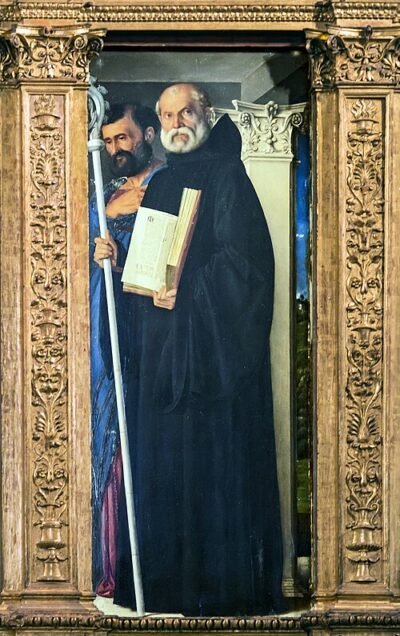
Benedict of Nursia
Benedict of Nursia was a founder of Christian monasticism, founder of the Benedictine order. Born March 3, 480, in Norcia. Died March 23, 547, in Abbey of Monte Cassino. Positions held include abbot of Monte Cassino (–547) and founder of Catholic religious community.
Facts
13 facts · 0 confirmed by two sources · 4 cited · 7 from one source · 2 where the sources disagree
What’s different
- Born: we show March 3, 480 (Sources disagree). Wikipedia says March 2, 480
- Died: we show March 23, 547 (Sources disagree). Wikipedia says March 21, 547
Where this comes from
Papalocal keeps its own record. It started from these sources; what each one said is kept here as it was copied, so a change on their side never changes this page by itself. Tap one to read its version.
What Wikidata says · copied November 16, 2026 · revision 2568852989
- Described as
- founder of Christian monasticism, founder of the Benedictine order (480–547)
- Other names
- St. Benedict, Saint Benedict of Nursia, Saint Benedict, Bengt
- Born
- March 3, 480 · 1 reference
- Died
- March 23, 547 · 1 reference
- Born in
- Norcia
- Died in
- Abbey of Monte Cassino
- Occupation
- writer; theologian · 1 reference; religious · 1 reference
- Positions held
- abbot of Monte Cassino (–547); founder of Catholic religious community
- Field
- theology · 1 reference; monkish life · 1 reference
- Siblings
- Scholastica
- Religion
- Christianity
- Wikipedias with a page
- 92
Wikidata item Q44265 (wikidata.org/wiki/Q44265), public domain (CC0). Copied November 16, 2026.
What Wikipedia says · copied November 16, 2026 · revision 1385557633
Benedict of Nursia (Latin: Benedictus Nursiensis; Italian: Benedetto da Norcia; 2 March 480 – 21 March 547), often known as Saint Benedict, was an Italian monk and the founder of the Order of Saint Benedict. He is famed in the Catholic Church, the Eastern Orthodox Church, the Lutheran Churches, the Anglican Communion, and Old Catholic Churches. In 1964, Pope Paul VI declared Benedict a patron saint of Europe.
Benedict founded twelve communities for monks at Subiaco in present-day Lazio, Italy (about 65 kilometres (40 mi) to the east of Rome), before moving southeast to Monte Cassino in the mountains of central Italy. The present-day Order of Saint Benedict emerged later and, moreover, is not an "order" as the term is commonly understood, but a confederation of autonomous congregations.
Benedict's main achievement, the Rule of Saint Benedict, contains a set of rules for his monks to follow. Heavily influenced by the writings of John Cassian (c. 360 – c. 435), it shows strong affinity with the earlier Rule of the Master, but it also has a unique spirit of balance, moderation and reasonableness (ἐπιείκεια, epieíkeia), which persuaded most religious orders and communities founded throughout the Middle Ages to adopt it. As a result, Benedict's monastic rule became one of the most influential in Western Christendom. For this reason, Giuseppe Carletti regarded Benedict as the founder of Western Christian monasticism.
- Born, in its opening lines
- March 2, 480
- Died, in its opening lines
- March 21, 547
From the Wikipedia article “Benedict of Nursia” (en.wikipedia.org/wiki/Benedict_of_Nursia), by its contributors, under CC BY-SA 4.0 (creativecommons.org/licenses/by-sa/4.0/). Copied November 16, 2026; not changed.
Confirmed Two sources agree. Cited One source, and it names where it got it. One source One source, without a reference of its own. Sources disagree The sources disagree. We show the best-supported value and keep theirs below.
