
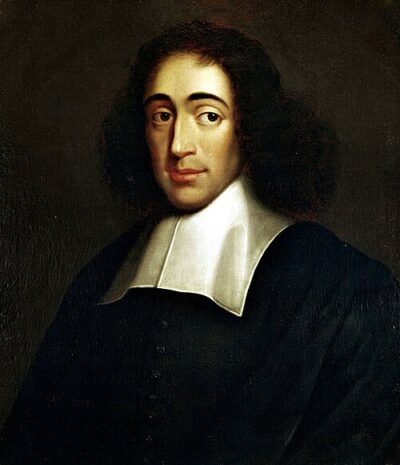
Benedictus de Spinoza
Benedictus de Spinoza was a Dutch philosopher. Born November 24, 1632, in Amsterdam. Died February 21, 1677, in The Hague. Known for Ethics and conatus. Educated at Leiden University.
Facts
24 facts · 2 confirmed by two sources · 7 cited · 15 from one source
Where this comes from
Papalocal keeps its own record. It started from these sources; what each one said is kept here as it was copied, so a change on their side never changes this page by itself. Tap one to read its version.
What Wikidata says · copied November 16, 2026 · revision 2568299812
- Described as
- Dutch philosopher (1632–1677)
- Other names
- Sbīnūzā, Baruch Benedictus de Spinoza, Bento de Espinosa, Benedictus De Spinoza, Benoit de Spinoza, Shpinozah, Ispīnūzā, Baruch d' Espinoza, Benoît de Spinoza, Baruch de Espinosa, Barukh Shpinozah, Barukh Spinoza
- Born
- November 24, 1632 · 12 references
- Died
- February 21, 1677 · 12 references
- Born in
- Amsterdam · 4 references
- Died in
- The Hague · 4 references
- Buried in
- Nieuwe Kerk · 1 reference
- Cause of death
- tuberculosis
- Citizen of
- Dutch Republic
- Occupation
- philosopher · 3 references; Bible translator; grinder of lenses · 2 references; political scientist; grammarian · 1 reference; theologian; optician · 1 reference
- Education
- Leiden University
- Member of
- Collegiants (1660–1663)
- Known for
- Ethics; conatus · 1 reference
- Field
- philosophy; ethics · 1 reference; epistemology · 1 reference; metaphysics · 1 reference
- Father
- Miguel de Espinoza
- Mother
- Hanna Debora d'Espinoza
- Wikipedias with a page
- 178
Wikidata item Q35802 (wikidata.org/wiki/Q35802), public domain (CC0). Copied November 16, 2026.
What Wikipedia says · copied November 16, 2026 · revision 1385873686
Baruch (de) Spinoza (24 November 1632 – 21 February 1677), also known under his Latinized pen name Benedictus de Spinoza, was a philosopher of Portuguese-Jewish origin who was born and lived in the Dutch Republic. A forerunner of the Enlightenment, Spinoza significantly influenced modern biblical criticism, 17th-century rationalism, and Dutch intellectual culture, establishing himself as one of the most important and radical philosophers of the early modern period. Influenced by Stoicism, Thomas Hobbes, René Descartes, and heterodox Christians, Spinoza was a leading philosopher of the Dutch Golden Age.
Spinoza was born in Amsterdam to a marrano family that fled Portugal for the more tolerant Dutch Republic. He received a traditional Jewish education, learning Hebrew and studying sacred texts within the Portuguese-Jewish community, where his father was a prominent merchant. As a young man, Spinoza challenged rabbinic authority and questioned Jewish doctrines, leading to his permanent expulsion from his Jewish community in 1656. Following that expulsion, he distanced himself from all religious affiliations and devoted himself to philosophical inquiry, supporting himself by lens grinding. Spinoza attracted a dedicated circle of followers who gathered to discuss his writings and joined him in the intellectual pursuit of truth.
Spinoza published sparingly during his lifetime to circumvent persecution and the suppression of his works. In his Tractatus Theologico-Politicus, described by Steven Nadler as "one of the most important books of Western thought", Spinoza questioned the divine origin of the Hebrew Bible and the nature of God while arguing that ecclesiastic authority should have no role in a secular, democratic state. Ethics equates God with nature, arguing for a view of God that scholars interpret variously as pantheistic, panentheistic, or atheistic, and it explores the place of human freedom in a world devoid of theological, cosmological, and political moorings. Rejecting messianism and the emphasis on the afterlife, Spinoza emphasized appreciating and valuing life for oneself and others. By advocating for individual liberty in its moral, psychological, and metaphysical dimensions, Spinoza helped establish the genre of political writing called secular theology.
Spinoza's philosophy addresses multiple areas of philosophical discourse, including metaphysics, epistemology, political philosophy, ethics, philosophy of mind, and philosophy of science. His works were published posthumously by his friends and influenced philosophers for the next two centuries. Spinoza is celebrated as one of the most original and influential thinkers of the seventeenth century. Rebecca Goldstein described him as "the renegade Jew who gave us modernity".
- Born, in its opening lines
- November 24, 1632
- Died, in its opening lines
- February 21, 1677
From the Wikipedia article “Baruch Spinoza” (en.wikipedia.org/wiki/Baruch_Spinoza), by its contributors, under CC BY-SA 4.0 (creativecommons.org/licenses/by-sa/4.0/). Copied November 16, 2026; not changed.
Confirmed Two sources agree. Cited One source, and it names where it got it. One source One source, without a reference of its own. Sources disagree The sources disagree. We show the best-supported value and keep theirs below.
