
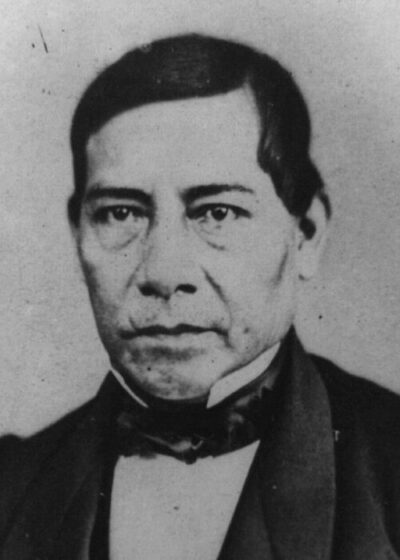
Benito Juárez
Benito Juárez was a President of Mexico from 1858 to 1872. Born March 21, 1806, in San Pablo Guelatao. Died July 18, 1872, in Mexico City. Positions held include President of Mexico (1858–1872), Governor of Oaxaca (2 times) (1847–1857) and President of the Supreme Court of Justice of the Nation (1857–1858). Educated at Instituto de Ciencias y Artes de Oaxaca.
Facts
19 facts · 1 confirmed by two sources · 5 cited · 12 from one source · 1 where the sources disagree
What’s different
- Died: we show July 18, 1872 (Sources disagree). Wikipedia says July 16, 1872
Where this comes from
Papalocal keeps its own record. It started from these sources; what each one said is kept here as it was copied, so a change on their side never changes this page by itself. Tap one to read its version.
What Wikidata says · copied November 16, 2026 · revision 2563045282
- Described as
- President of Mexico from 1858 to 1872
- Other names
- Benito Pablo Juarez García, Benito Pablo Juárez García, Benito Juárez García, Benito Juarez
- Born
- March 21, 1806 · 9 references
- Died
- July 18, 1872 · 7 references
- Born in
- San Pablo Guelatao
- Died in
- Mexico City · 2 references
- Buried in
- Panteón de San Fernando
- Cause of death
- myocardial infarction
- Citizen of
- Mexico · 1 reference; New Spain
- Occupation
- lawyer; judge; politician · 1 reference
- Positions held
- President of Mexico (1858–1872) · 1 reference; Governor of Oaxaca (2 times) (1847–1857); President of the Supreme Court of Justice of the Nation (1857–1858)
- Political party
- Liberal Party
- Education
- Instituto de Ciencias y Artes de Oaxaca (–1833)
- Spouse
- Margarita Maza (1843–1871)
- Children
- Benito Juárez Maza
- Religion
- Catholicism · 1 reference
- Wikipedias with a page
- 86
Wikidata item Q182276 (wikidata.org/wiki/Q182276), public domain (CC0). Copied November 16, 2026.
What Wikipedia says · copied November 16, 2026 · revision 1385612761
Benito Pablo Juárez García (Latin American Spanish: [beˈnito ˈpaβlo ˈxwaɾes ɣaɾˈsi.a] ; 21 March 1806 – 16 July 1872) was a Mexican politician, military officer, and lawyer who served as the 26th president of Mexico from 1858 until his death in 1872. A Zapotec, he was the first Indigenous president of Mexico and the first democratically elected Indigenous president in postcolonial America. A member of the Liberal Party, he previously held a number of offices, including the governorship of Oaxaca and the presidency of the Supreme Court. During his presidency, he led the Liberals to victory in the Reform War and in the Second French intervention in Mexico.
Born in Oaxaca to a poor rural Indigenous family and orphaned as a child, Juárez passed into the care of his uncle, eventually moving to Oaxaca City at the age of 12, where he found work as a domestic servant. Sponsored by his employer, who was also a lay Franciscan, Juárez temporarily enrolled in a seminary and studied to become a priest, but later switched his studies to law at the Institute of Sciences and Arts, where he became active in liberal politics. He began to practice law and was eventually appointed as a judge, after which he married Margarita Maza, a woman from a socially distinguished family in Oaxaca City.
Juárez was eventually elected governor of Oaxaca and became involved in national politics following the ousting and exile of Antonio López de Santa Anna in the Plan of Ayutla. The new president, Juan Álvarez, appointed a liberal cabinet that included Juárez as Minister of Justice.
He was instrumental in passing the Juárez Law as part of the broader program of constitutional reforms known as La Reforma (The Reform). Later, as the head of the Supreme Court, he succeeded to the presidency upon the resignation of the Liberal president Ignacio Comonfort in the early weeks of the Reform War between the Liberal Party and the Conservative Party, and led the Liberal Party to victory after three years of warfare.
Almost immediately after the Reform War had ended, President Juárez was faced with a French invasion, the Second French Intervention aimed at overthrowing the government of the Mexican Republic and replacing it with a French-aligned monarchy, the Second Mexican Empire. The French soon gained the collaboration of the Conservative Party, which aimed at returning themselves to power after their defeat in the Reform War, but Juárez continued to lead the government and armed forces of the Mexican Republic, even as he was forced by the advances of the French to flee to the north of the country. The Second Mexican Empire would finally collapse in 1867 after the departure of the last French troops two months previously and President Juárez returned to Mexico City, where he continued as president, but with growing opposition from fellow Liberals who believed he was becoming autocratic, until his death due to a heart attack in 1872.
During his presidency, he supported many controversial measures, including his negotiation of the McLane–Ocampo Treaty, which would have granted the United States perpetual extraterritorial rights across the Isthmus of Tehuantepec; a decree extending his presidential term for the duration of French Intervention; his proposal to revise the liberal Constitution of 1857 to strengthen the power of the federal government; and his decision to run for reelection in 1871. His opponent, liberal general and fellow Oaxacan Porfirio Díaz, opposed his re-election and rebelled against Juárez in the Plan de la Noria.
After his death, the city of Oaxaca added "de Juárez" to its name in his honor, and numerous other places and institutions have been named after him. He is the only individual whose birthday (21 March) is celebrated as a national public and patriotic holiday in Mexico. Many cities (most notably Ciudad Juárez), streets, institutions, and other locations are named after him. He is considered the most popular Mexican president of the 19th century.
- Born, in its opening lines
- March 21, 1806
- Died, in its opening lines
- July 16, 1872
From the Wikipedia article “Benito Juárez” (en.wikipedia.org/wiki/Benito_Juárez), by its contributors, under CC BY-SA 4.0 (creativecommons.org/licenses/by-sa/4.0/). Copied November 16, 2026; not changed.
Confirmed Two sources agree. Cited One source, and it names where it got it. One source One source, without a reference of its own. Sources disagree The sources disagree. We show the best-supported value and keep theirs below.
