
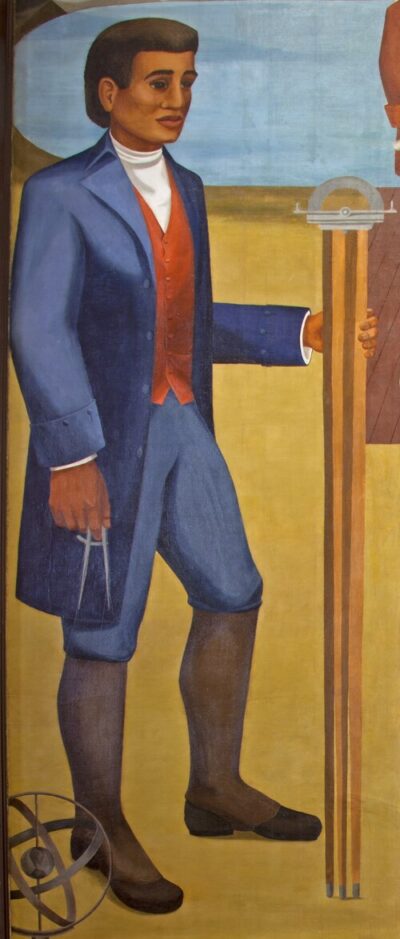
Benjamin Banneker
Benjamin Banneker was a free African American scientist, surveyor, almanac author and farmer. Born November 9, 1731, in Baltimore County. Died October 19, 1806, in Oella.
Facts
14 facts · 2 confirmed by two sources · 5 cited · 7 from one source
Where this comes from
Papalocal keeps its own record. It started from these sources; what each one said is kept here as it was copied, so a change on their side never changes this page by itself. Tap one to read its version.
What Wikidata says · copied November 15, 2026 · revision 2521030997
- Described as
- free African American scientist, surveyor, almanac author and farmer (1731–1806)
- Other names
- Benjamin Bannaker
- Born
- November 9, 1731 · 4 references
- Died
- October 19, 1806 · 1 reference
- Born in
- Baltimore County · 1 reference
- Died in
- Oella · 1 reference
- Buried in
- Mount Gilboa Chapel · 1 reference
- Name at birth
- Benjamin Banneker · 1 reference
- Citizen of
- United States
- Occupation
- mathematician · 1 reference; astronomer; watchmaker; editor; farmer; inventor · 1 reference; naturalist · 1 reference
- Wikipedias with a page
- 34
Wikidata item Q557600 (wikidata.org/wiki/Q557600), public domain (CC0). Copied November 15, 2026.
What Wikipedia says · copied November 15, 2026 · revision 1385151580
Benjamin Banneker (November 9, 1731 – October 19, 1806) was an American naturalist, mathematician, astronomer and almanac author. A landowner, he also worked as a surveyor and farmer.
Born in Baltimore County, Maryland, to a free African-American mother and a father who had formerly been enslaved, Banneker had little or no formal education and was largely self-taught. He became known for assisting Major Andrew Ellicott in a survey that established the original borders of the District of Columbia, the federal capital district of the United States.
Banneker's knowledge of astronomy helped him author a commercially successful series of almanacs. He corresponded with Thomas Jefferson on the topics of slavery and racial equality. Abolitionists and advocates of racial equality promoted and praised Banneker's works. Although a fire on the day of Banneker's funeral destroyed many of his papers and belongings, one of his journals and several of his remaining artifacts survived.
Banneker became a folk-hero after his death, leading to many accounts of his life being exaggerated or embellished. The names of parks, schools and streets commemorate him and his works, as do other tributes.
- Born, in its opening lines
- November 9, 1731
- Died, in its opening lines
- October 19, 1806
From the Wikipedia article “Benjamin Banneker” (en.wikipedia.org/wiki/Benjamin_Banneker), by its contributors, under CC BY-SA 4.0 (creativecommons.org/licenses/by-sa/4.0/). Copied November 15, 2026; not changed.
Confirmed Two sources agree. Cited One source, and it names where it got it. One source One source, without a reference of its own. Sources disagree The sources disagree. We show the best-supported value and keep theirs below.
