
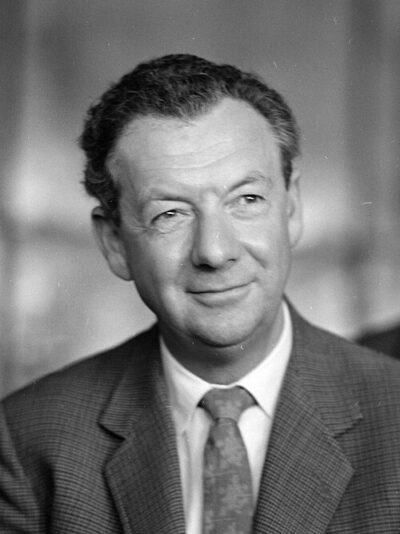
Benjamin Britten
Benjamin Britten was an English composer, conductor, and pianist. Born November 22, 1913, in Lowestoft. Died December 4, 1976, in Aldeburgh. Positions held include member of the House of Lords (1976). Known for A Midsummer Night's Dream, The Turn of the Screw and Peter Grimes. Educated at Royal College of Music and Gresham's School. Awards include Léonie Sonning Music Prize, Royal Philharmonic Society Gold Medal and Wihuri Sibelius Prize.
Facts
45 facts · 2 confirmed by two sources · 13 cited · 30 from one source
Where this comes from
Papalocal keeps its own record. It started from these sources; what each one said is kept here as it was copied, so a change on their side never changes this page by itself. Tap one to read its version.
What Wikidata says · copied November 16, 2026 · revision 2563859758
- Described as
- English composer, conductor, and pianist (1913-1976)
- Other names
- Edward Benjamin Britten, Edward Benjamin Britten, Baron Britten of Aldeburgh OM CH
- Born
- November 22, 1913 · 17 references
- Died
- December 4, 1976 · 15 references
- Born in
- Lowestoft · 4 references
- Died in
- Aldeburgh · 3 references
- Buried in
- St Peter and St Paul's Church, Aldeburgh
- Cause of death
- heart failure
- Name at birth
- Edward Benjamin Britten
- Citizen of
- United Kingdom · 1 reference
- Occupation
- conductor · 2 references; composer · 1 reference; pianist · 2 references; politician · 1 reference; choreographer
- Positions held
- member of the House of Lords (1976)
- Education
- Royal College of Music; Gresham's School; Old Buckenham Hall School
- Member of
- Serbian Academy of Sciences and Arts; Academy of Arts of the GDR; Royal Swedish Academy of Music; American Academy of Arts and Sciences; Bavarian Academy of Fine Arts; Académie des beaux-arts
- Genre
- opera; symphony; classical music
- Instrument
- piano
- Record label
- Decca
- Known for
- A Midsummer Night's Dream; The Turn of the Screw; Peter Grimes; The Rape of Lucretia; Albert Herring; The Young Person's Guide to the Orchestra
- Awards
- Léonie Sonning Music Prize (1968); Royal Philharmonic Society Gold Medal (1964); Wihuri Sibelius Prize (1965) · 1 reference; Ernst von Siemens Music Prize (1974) · 1 reference; Johann Heinrich Merck Honour (1972); Companion of Honour (1953) · 1 reference; Order of Merit (1965) · 1 reference; Maurice Ravel Prize (1974)
- Father
- Robert Victor Britten · 1 reference
- Mother
- Edith Rhoda Hockey · 1 reference
- Website
- https://www.brittenpears.org/
- Wikipedias with a page
- 68
Wikidata item Q150767 (wikidata.org/wiki/Q150767), public domain (CC0). Copied November 16, 2026.
What Wikipedia says · copied November 16, 2026 · revision 1385516329
Edward Benjamin Britten, Baron Britten (22 November 1913 – 4 December 1976) was an English composer, conductor, and pianist. He was a central figure of 20th-century British music, with a range of works including opera, other vocal music, orchestral and chamber pieces. His best-known works include the opera Peter Grimes (1945), the War Requiem (1962) and the orchestral showpiece The Young Person's Guide to the Orchestra (1945).
Britten was born in Lowestoft, Suffolk, the son of a dentist. He showed talent from an early age. He studied at the Royal College of Music in London and privately with the composer Frank Bridge. Britten first came to public attention with the a cappella choral work A Boy Was Born in 1934. With the premiere of Peter Grimes in 1945, he leapt to international fame. Over the next 28 years, he wrote 14 more operas, establishing himself as one of the leading 20th-century composers in the genre. In addition to large-scale operas for Sadler's Wells and Covent Garden, he wrote chamber operas for small forces; among the best known of these is The Turn of the Screw (1954). Recurring themes in his operas include the struggle of an outsider against a hostile society and the corruption of innocence.
Britten's other works range from orchestral to choral, solo vocal, chamber and instrumental as well as film music. He took a great interest in writing music for children and amateur performers, including the opera Noye's Fludde, a Missa Brevis, and the song collection Friday Afternoons. He often composed with particular performers in mind. His most frequent and important muse was his personal and professional partner, the tenor Peter Pears; others included Kathleen Ferrier, Jennifer Vyvyan, Janet Baker, Dennis Brain, Julian Bream, Dietrich Fischer-Dieskau, Osian Ellis and Mstislav Rostropovich. Britten was a celebrated pianist and conductor, performing many of his own works in concert and on record. He also performed and recorded works by others, such as Bach's Brandenburg Concertos, Mozart symphonies, and song cycles by Schubert and Schumann.
Together with Pears and the librettist and producer Eric Crozier, Britten founded the annual Aldeburgh Festival in 1948, and he was responsible for the creation of Snape Maltings concert hall in 1967. In 1976, he was the first composer to be given a life peerage. He died shortly afterwards, aged 63.
- Born, in its opening lines
- November 22, 1913
- Died, in its opening lines
- December 4, 1976
From the Wikipedia article “Benjamin Britten” (en.wikipedia.org/wiki/Benjamin_Britten), by its contributors, under CC BY-SA 4.0 (creativecommons.org/licenses/by-sa/4.0/). Copied November 16, 2026; not changed.
Confirmed Two sources agree. Cited One source, and it names where it got it. One source One source, without a reference of its own. Sources disagree The sources disagree. We show the best-supported value and keep theirs below.
