
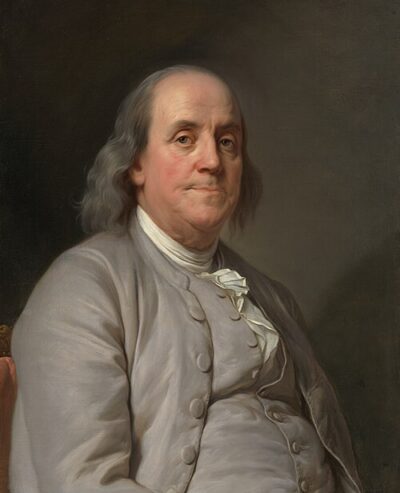
Benjamin Franklin
Benjamin Franklin was an American polymath and statesman. Born January 17, 1706, in Boston. Died April 17, 1790, in Philadelphia. Positions held include United States Ambassador to France (1778–1785), United States Ambassador to Sweden (1782–1783) and United States Postmaster General (1775–1776). Educated at Boston Latin School. Awards include Copley Medal, honorary doctor of the University of St Andrews and Fellow of the American Academy of Arts and Sciences.
Facts
49 facts · 2 confirmed by two sources · 18 cited · 29 from one source
Where this comes from
Papalocal keeps its own record. It started from these sources; what each one said is kept here as it was copied, so a change on their side never changes this page by itself. Tap one to read its version.
What Wikidata says · copied November 13, 2026 · revision 2568663478
- Described as
- American polymath and statesman (1706–1790)
- Other names
- Poor Richard, The First American, Ben Franklin, Silence Dogood, Richard Saunders, Franklin
- Born
- January 17, 1706 · 19 references
- Died
- April 17, 1790 · 19 references
- Born in
- Boston · 4 references
- Died in
- Philadelphia · 3 references
- Buried in
- Christ Church Burial Ground · 1 reference
- Cause of death
- pleurisy
- Citizen of
- British America; United States
- Occupation
- politician · 4 references; publisher · 2 references; printer · 1 reference; political theorist; inventor · 2 references; political activist; statesperson · 1 reference; diplomat · 3 references
- Positions held
- United States Ambassador to France (1778–1785); United States Ambassador to Sweden (1782–1783); United States Postmaster General (1775–1776); Speaker of the Pennsylvania House of Representatives (1764); President of the Supreme Executive Council of Pennsylvania (1785–1788); member of the Pennsylvania House of Representatives (1764); Delegate to the United States Constitutional Convention (1787) · 1 reference
- Worked for
- University of Pennsylvania
- Education
- Boston Latin School (1714–1716)
- Member of
- Royal Society of London (1756–); American Philosophical Society; Saint Petersburg Academy of Sciences (1789–); French Academy of Sciences; American Academy of Arts and Sciences; Pennsylvania Abolition Society · 1 reference; Société d'agriculture de Paris · 1 reference; Accademia Nazionale delle Scienze detta dei XL (1786–) · 1 reference; Academy of Sciences of Turin (1783–) · 1 reference; Freemasonry · 1 reference
- Sport
- chess
- Awards
- Copley Medal (1753) · 2 references; honorary doctor of the University of St Andrews · 1 reference; Fellow of the American Academy of Arts and Sciences (1781–) · 1 reference
- Field
- physics · 1 reference
- Spouse
- Deborah Read Franklin
- Children
- William Franklin; Francis Folger Franklin; Sarah Franklin Bache
- Father
- Josiah Franklin
- Mother
- Abiah Folger
- Siblings
- Jane Franklin Mecom; James Franklin
- Religion
- deism · 2 references
- Wikipedias with a page
- 218
Wikidata item Q34969 (wikidata.org/wiki/Q34969), public domain (CC0). Copied November 13, 2026.
What Wikipedia says · copied November 13, 2026 · revision 1385429221
Benjamin Franklin (January 17, 1706 [O.S. January 6, 1705] – April 17, 1790) was an American polymath active as a physicist, philosopher, statesman and inventor who was one of the Founding Fathers of the United States. He was a drafter and signer of the Declaration of Independence, and the first postmaster general.
Born in the Province of Massachusetts Bay, Franklin became a successful newspaper editor and printer in Philadelphia, the leading city in the colonies, publishing The Pennsylvania Gazette at age 23. He became wealthy publishing this and Poor Richard's Almanack, which he wrote under the pseudonym "Richard Saunders". After 1767, he was associated with the Pennsylvania Chronicle, a newspaper known for its revolutionary sentiments and criticisms of the policies of the British Parliament and the Crown. He pioneered and was the first president of the Academy and College of Philadelphia, which opened in 1751 and later became the University of Pennsylvania. He organized and was the first secretary of the American Philosophical Society and was elected its president in 1769. He was appointed as deputy postmaster-general for the British colonies of North America, in 1753, which enabled him to set up the first national communications network.
Franklin was active in community affairs and colonial and state politics, as well as national and international affairs. He became a hero in North America when, as an agent in London for several colonies, he spearheaded the repeal of the unpopular Stamp Act by the British Parliament. An accomplished diplomat, he was widely admired as the first U.S. ambassador to France. Franklin used referent power to develop positive Franco–American relations and successfully secured vital French support for the American Revolutionary War. From 1785 to 1788, he served as President of Pennsylvania. From at least as early as 1735 through the following decades, Franklin owned at least seven slaves and ran "for sale" ads for slaves in his newspaper, but by the late 1750s, he had begun arguing against slavery, became an active abolitionist, and promoted the education and integration of African Americans into U.S. society.
As a scientist, Franklin's studies of electricity made him a major figure in the American Enlightenment and the history of physics. He also charted and named the Gulf Stream current. His numerous important inventions include the lightning rod, bifocals, glass harmonica and the Franklin stove. He founded many civic organizations, including the Library Company, the University of Pennsylvania, and Philadelphia's first fire department.
Franklin earned the title of "The First American" for his early and indefatigable campaigning for colonial unity. He was the only person to sign the Declaration of Independence, the Treaty of Paris peace with Britain, and the Constitution. Foundational in defining the American ethos, Franklin has been called "the most accomplished American of his age and the most influential in inventing the type of society America would become".
Franklin's life and legacy of scientific and political achievement, and his status as one of America's most influential Founding Fathers, have seen him honored for more than two centuries after his death, by appearing on the $100 bill and in being the namesake of many towns and counties, educational institutions and corporations, as well as being in numerous cultural references and with having a portrait in the Oval Office. His more than 30,000 letters and documents have been collected in The Papers of Benjamin Franklin.
- Born, in its opening lines
- January 17, 1706
- Died, in its opening lines
- April 17, 1790
From the Wikipedia article “Benjamin Franklin” (en.wikipedia.org/wiki/Benjamin_Franklin), by its contributors, under CC BY-SA 4.0 (creativecommons.org/licenses/by-sa/4.0/). Copied November 13, 2026; not changed.
Confirmed Two sources agree. Cited One source, and it names where it got it. One source One source, without a reference of its own. Sources disagree The sources disagree. We show the best-supported value and keep theirs below.
