
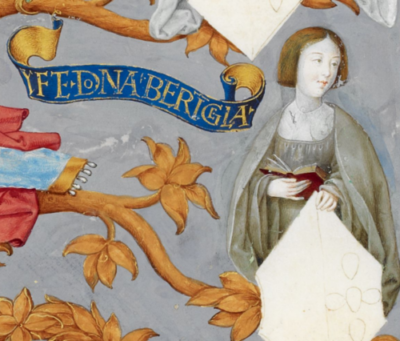
Berengaria of Portugal was a Queen of Denmark. Born 1198, in Coimbra. Died March 27, 1221, in Ringsted.
Facts
26 facts · 2 confirmed by two sources · 0 cited · 24 from one source
Where this comes from
Papalocal keeps its own record. It started from these sources; what each one said is kept here as it was copied, so a change on their side never changes this page by itself. Tap one to read its version.
What Wikidata says · copied November 16, 2026 · revision 2557809818
- Described as
- Queen of Denmark (1198-1221)
- Born
- 1198
- Died
- March 27, 1221 · 1 reference
- Born in
- Coimbra
- Died in
- Ringsted
- Buried in
- St. Bendt's Church
- Cause of death
- plague
- Citizen of
- Kingdom of Denmark; Kingdom of Portugal
- Occupation
- aristocrat
- Spouse
- Valdemar II of Denmark (1214–1221) · 1 reference
- Children
- Eric IV of Denmark; Abel of Denmark; Christopher I of Denmark; Sophia of Denmark
- Father
- Sancho I of Portugal
- Mother
- Dulce of Aragon
- Siblings
- Sancha of Portugal; Branca of Portugal; Theresa of Portugal; Mafalda of Portugal; Ferdinand of Portugal; Afonso II of Portugal; Peter of Portugal; Constance of Portugal I; Raymond of Portugal; Pedro Moniz
- Wikipedias with a page
- 29
Wikidata item Q253571 (wikidata.org/wiki/Q253571), public domain (CC0). Copied November 16, 2026.
What Wikipedia says · copied November 16, 2026 · revision 1382880616
Berengaria of Portugal (Portuguese: Berengária, Danish: Bengjerd; c. 1198 – 27 March 1221) was a Portuguese infanta (princess), who became Queen of Denmark, as the second wife of Valdemar II, from 1214 until her death.
Born into the Portuguese House of Burgundy, she was the daughter of King Sancho I of Portugal and Dulce of Aragon. Likely the youngest of her siblings, she may have been the twin of Branca, and their mother died shortly after their birth. Following the death of her father in 1211, Berengaria became an orphan, and her brother, now King Afonso II, soon sought to curtail his siblings' bequeathed estates. In the ensuing conflicts, Berengaria was initially entrusted to the care of her elder sister Theresa, formerly Queen of León, then a nun at the convent of Lorvão in Penacova. Another brother Ferdinand fled to France, becoming Count of Flanders in 1212, and Berengaria seems to have followed him there or to the court of his overlord, Philip II of France, a cousin of theirs. Seeking to consolidate an anti-French North Sea alliance with King John of England, Emperor Otto IV and others, Ferdinand arranged her marriage to Valdemar II of Denmark, likely facilitated through Valdemar’s sister Ingeborg, the estranged queen of Philip II. The later marriage of Berengaria’s niece Eleanor of Portugal to Valdemar’s eldest son, Valdemar the Young, in 1229 further tightened the dynastic links between the Portuguese and Danish royal houses.
In May 1214, she married Valdemar II "the Victorious" as his second wife, his first consort, Dagmar of Bohemia, having died in childbirth in 1212. Exceedingly little is recorded of her queenship, although she was described as "exceptionally beautiful", and made several donations to churches and monasteries. She is also the earliest Danish queen known to have worn a crown. Her children with Valdemar included the future Danish kings Eric IV, Abel and Christopher I, as well as a daughter, Sophie, who married John I, Margrave of Brandenburg. Berengaria died in 1221 in her early twenties, probably in childbirth, and was buried in St. Bendt's Church, Ringsted.
In later Danish ballads and chronicles, recorded from the sixteenth century, she appears under the name “Bengerd” as the hard and selfish counterpart to her idealised predecessor Queen Dagmar, and early narrative historians often repeated this hostile image. Her name came to be used proverbially for an ill-natured woman. Modern historians, however, stress that there is no contemporary source basis for this negative portrayal, and regard the “Bengerd” figure as legendary rather than based on contemporary evidence.
- Born, in its opening lines
- c. 1198
- Died, in its opening lines
- March 27, 1221
From the Wikipedia article “Berengaria of Portugal” (en.wikipedia.org/wiki/Berengaria_of_Portugal), by its contributors, under CC BY-SA 4.0 (creativecommons.org/licenses/by-sa/4.0/). Copied November 16, 2026; not changed.
Confirmed Two sources agree. Cited One source, and it names where it got it. One source One source, without a reference of its own. Sources disagree The sources disagree. We show the best-supported value and keep theirs below.
