
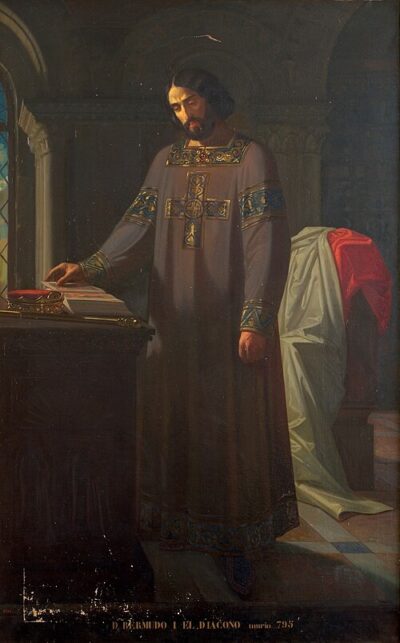
Bermudo I of Asturias
Bermudo I of Asturias was a King of Asturias. Born 750. Died 797, in Oviedo. Positions held include Monarch of the Kingdom of Asturias (788–791).
Facts
13 facts · 2 confirmed by two sources · 0 cited · 10 from one source · 1 where the sources disagree
What’s different
- Buried in: we show Pantheon of Asturian Kings (Sources disagree). Wikidata also lists San Juan Bautista de Corias
Where this comes from
Papalocal keeps its own record. It started from these sources; what each one said is kept here as it was copied, so a change on their side never changes this page by itself. Tap one to read its version.
What Wikidata says · copied November 16, 2026 · revision 2553927810
- Described as
- King of Asturias
- Born
- 750
- Died
- 797
- Died in
- Oviedo
- Buried in
- Pantheon of Asturian Kings; San Juan Bautista de Corias
- Citizen of
- Kingdom of Asturias
- Occupation
- cleric; ruler
- Positions held
- Monarch of the Kingdom of Asturias (788–791)
- Spouse
- Nunilona
- Children
- Ramiro I of Asturias; Pedro Theon
- Father
- Fruela of Cantabria
- Siblings
- Aurelius of Asturias · 1 reference
- Wikipedias with a page
- 30
Wikidata item Q379783 (wikidata.org/wiki/Q379783), public domain (CC0). Copied November 16, 2026.
What Wikipedia says · copied November 16, 2026 · revision 1358617806
Bermudo I (also Vermudo or Veremund), called the Deacon or the Monk (c. 750 – 797), was the King of Asturias from 788 or 789 until his abdication in 791. He was a son of Fruela of Cantabria, a nephew of Alfonso I, and a brother of Aurelius. The nature of the end of his reign ushered in a new period in Asturian-Arab relations.
Bermudo was elected by the palatine officials (the nobility of the royal palace) to replace Mauregatus, who had died of natural causes in 788. Since Mauregatus had ascended the throne in a coup d'état with regional support in 783 and the succession of Bermudo proceeded without incident, it is probable that Mauregatus had procured a change in the ranks of the palatine nobility and that Bermudo was thus put forward as the candidate to, like Mauregatus, prevent the succession of Alfonso II, the son and heir of Fruela I. Though the Chronicle of Alfonso III in both its extant versions makes Bermudo out to be a deacon at his succession, this fact would only reinforce the notion that his election was a determined move to oppose Alfonso.
In any case, he did not reign long. He was forced to defend against an Arab-Berber invasion of Álava and Galicia and was defeated at the Battle of the Burbia River, probably the Bierzo, in 791. Though the closest Christian sources do not name his opponents, the battle can be linked with the first major engagement of a series of aggressive campaigns launched against the Asturian kingdom in the 790s. The Muslim commander at Burbia is named in Ibn al-Athir as Yūsuf ibn Bukht and the battle is likewise recorded in al-Maqqarī. Bermudo abdicated his throne after his defeat, though whether volitionally (as the Chronicle of Alfonso III states, "because he was [or remembered he was] a deacon") or under duress is unknown. Historically in Spain under the Visigoths, a king of proven military inadequacy was often forced to abdicate. Nevertheless, he was considered a generous and illustrious man in his time, "merciful and pious" in the words of the Chronicle of Albelda.
Bermudo was succeeded by Alfonso II and he left behind a son, who later reigned as Ramiro I, by an anonymous wife. He reportedly lived for a long time after his abdication, perhaps as a monk, and on good terms with his successor.
- Born, in its opening lines
- 750
- Died, in its opening lines
- 797
From the Wikipedia article “Bermudo I of Asturias” (en.wikipedia.org/wiki/Bermudo_I_of_Asturias), by its contributors, under CC BY-SA 4.0 (creativecommons.org/licenses/by-sa/4.0/). Copied November 16, 2026; not changed.
Confirmed Two sources agree. Cited One source, and it names where it got it. One source One source, without a reference of its own. Sources disagree The sources disagree. We show the best-supported value and keep theirs below.
