
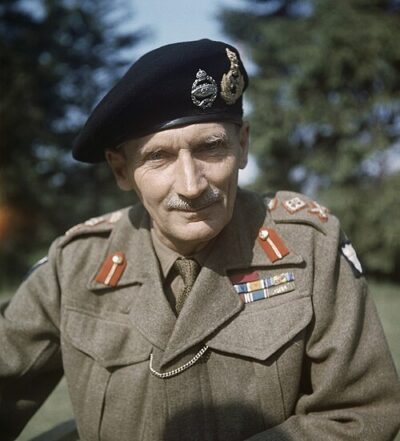
Bernard Montgomery
Bernard Montgomery was a British Army officer. Born November 17, 1887, in Kennington. Died March 24, 1976, in Alton. Positions held include member of the House of Lords, Member of the Privy Council of the United Kingdom and Chief of the General Staff (United Kingdom) (1946–1948). Educated at Royal Military College, Sandhurst and Command and Staff College. Awards include Grand Cross of the Legion of Honour, Croix de guerre 1914–1918 and Grand Officer of the Order of Leopold II.
Facts
41 facts · 2 confirmed by two sources · 19 cited · 20 from one source
Where this comes from
Papalocal keeps its own record. It started from these sources; what each one said is kept here as it was copied, so a change on their side never changes this page by itself. Tap one to read its version.
What Wikidata says · copied November 16, 2026 · revision 2555111416
- Described as
- British Army officer (1887–1976)
- Other names
- Bernard Law Montgomery, Bernard L. Montgomery, General Montgomery, Field Marshal Montgomery, Bernard Law Montgomery, 1st Viscount Montgomery, Lord Montgomery, Bernard Law, 1st Viscount Montgomery of Al 'Alamayn Montgomery, Montgomery, Bernard Law, 1st Viscount Montgomery of Al 'Alamayn, Field Marshal Bernard Law Montgomery, Field Marshall Montgomery, Bernard Law Montgomery, 1st Viscount Montgomery of Alamein, Field Marshal Montgomery, Viscount of Alamein
- Born
- November 17, 1887 · 9 references
- Died
- March 24, 1976 · 7 references
- Born in
- Kennington
- Died in
- Alton
- Buried in
- Beaulieu Abbey
- Cause of death
- disease
- Citizen of
- United Kingdom · 1 reference
- Occupation
- military officer; writer; politician · 1 reference; Generalfeldmarschall · 1 reference
- Positions held
- member of the House of Lords; Member of the Privy Council of the United Kingdom; Chief of the General Staff (United Kingdom) (1946–1948)
- Education
- Royal Military College, Sandhurst; Command and Staff College
- Member of
- Académie des beaux-arts
- Awards
- Grand Cross of the Legion of Honour (1944) · 1 reference; Croix de guerre 1914–1918 (1919) · 1 reference; Grand Officer of the Order of Leopold II (1947) · 1 reference; Knight Grand Cross of the Order of the Bath (1945) · 1 reference; Chief Commander of the Legion of Merit (1943) · 1 reference; Distinguished Service Order (1914) · 1 reference; Grand cross of the Order of the White Lion; Silver Cross of the Virtuti Militari; Order of Victory (1945) · 1 reference; Order of Suvorov, 1st class (1944) · 1 reference; Médaille militaire; Knight of the Garter (1946) · 1 reference; Knight of the Order of the Elephant (1945) · 1 reference; Czechoslovak War Cross 1939–1945; Czechoslovak Military Order for Freedom
- Spouse
- Elizabeth Carver (1927–1937) · 2 references
- Children
- David Montgomery, 2nd Viscount Montgomery of Alamein · 2 references
- Father
- Henry Montgomery · 2 references
- Mother
- Maud Farrar · 2 references
- Siblings
- Brian Frederick Montgomery · 1 reference
- Military branch
- British Army
- Military rank
- field marshal; general · 1 reference
- Nickname
- Monthy
- Wikipedias with a page
- 85
Wikidata item Q152025 (wikidata.org/wiki/Q152025), public domain (CC0). Copied November 16, 2026.
What Wikipedia says · copied November 16, 2026 · revision 1385708296
Field Marshal Bernard Law Montgomery, 1st Viscount Montgomery of Alamein (17 November 1887 – 24 March 1976), was a senior British Army officer who served in the First World War, the Irish War of Independence, and the Second World War.
Montgomery first saw action in the First World War as a junior officer of the Royal Warwickshire Regiment. At Méteren, near the Belgian border at Bailleul, he was shot through the right lung by a sniper during the First Battle of Ypres. On returning to the Western Front as a general staff officer, he took part in the Battle of Arras in April–May 1917. He also took part in the Battle of Passchendaele in late 1917 before finishing the war as chief of staff of the 47th (2nd London) Division. In the inter-war years he commanded the 17th (Service) Battalion, Royal Fusiliers and, later, the 1st Battalion, Royal Warwickshire Regiment before becoming commander of the 9th Infantry Brigade and then general officer commanding (GOC), 8th Infantry Division.
During the Western Desert campaign of the Second World War, Montgomery commanded the Eighth Army from August 1942. He subsequently commanded the Eighth Army during the Allied invasion of Sicily and the Allied invasion of Italy. During the Normandy campaign, he was in command of all Allied ground forces from 6 June 1944 until 1 September 1944. He then continued in command of the 21st Army Group for the rest of the North West Europe campaign, including the failed attempt to cross the Rhine during Operation Market Garden.
When German armoured forces broke through the US lines in Belgium during the Battle of the Bulge, Montgomery received command of the northern shoulder of the Bulge. Montgomery's 21st Army Group, including the US Ninth Army and the First Allied Airborne Army, crossed the Rhine in Operation Plunder in March 1945. By the end of the war, troops under Montgomery's command had taken part in the encirclement of the Ruhr Pocket, liberated the Netherlands, and captured much of north-west Germany. On 4 May 1945, Montgomery accepted the surrender of the German forces in north-western Europe at Lüneburg Heath, south of Hamburg, after the surrender of Berlin to the USSR on 2 May.
After the war he became commander-in-chief of the British Army of the Rhine (BAOR) in Germany and then Chief of the Imperial General Staff (1946–1948). From 1948 to 1951, he served as chairman of the Commanders-in-Chief Committee of the Western Union. He then served as NATO's Deputy Supreme Allied Commander Europe until his retirement in 1958.
- Born, in its opening lines
- November 17, 1887
- Died, in its opening lines
- March 24, 1976
From the Wikipedia article “Bernard Montgomery” (en.wikipedia.org/wiki/Bernard_Montgomery), by its contributors, under CC BY-SA 4.0 (creativecommons.org/licenses/by-sa/4.0/). Copied November 16, 2026; not changed.
Confirmed Two sources agree. Cited One source, and it names where it got it. One source One source, without a reference of its own. Sources disagree The sources disagree. We show the best-supported value and keep theirs below.
