
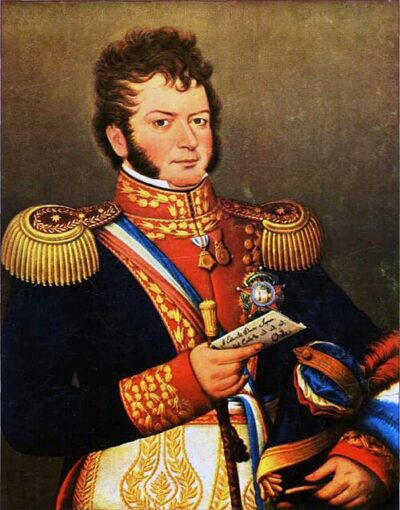
Bernardo O'Higgins
Bernardo O'Higgins was a Chilean independence leader. Born August 20, 1778, in Chillán. Died October 24, 1842, in Lima. Positions held include deputy of Chile and Supreme Director of Chile (1817–1823). Educated at Colegio San Buenaventura and National University of San Marcos.
Facts
22 facts · 2 confirmed by two sources · 6 cited · 14 from one source
Where this comes from
Papalocal keeps its own record. It started from these sources; what each one said is kept here as it was copied, so a change on their side never changes this page by itself. Tap one to read its version.
What Wikidata says · copied November 16, 2026 · revision 2567408631
- Described as
- Chilean independence leader (1778–1842)
- Other names
- O'Higgins, Bernardo O'Higgins Riquelme, O 'Higgins
- Born
- August 20, 1778 · 2 references
- Died
- October 24, 1842 · 4 references
- Born in
- Chillán · 1 reference
- Died in
- Lima · 1 reference
- Cause of death
- cardiovascular disease
- Citizen of
- Chile; Peru; Peru–Bolivian Confederation
- Occupation
- politician · 1 reference; military personnel; military officer; writer
- Positions held
- deputy of Chile; Supreme Director of Chile (1817–1823)
- Education
- Colegio San Buenaventura; National University of San Marcos · 1 reference
- Children
- Pedro Demetrio O'Higgins; Petronila Riquelme · 1 reference
- Father
- Ambrosio O'Higgins, 1st Marquis of Osorno · 2 references
- Mother
- Isabel Riquelme
- Religion
- Catholicism
- Military rank
- general · 1 reference
- Wikipedias with a page
- 60
Wikidata item Q28930 (wikidata.org/wiki/Q28930), public domain (CC0). Copied November 16, 2026.
What Wikipedia says · copied November 16, 2026 · revision 1385569388
Bernardo O'Higgins Riquelme (Spanish: [beɾˈnaɾðo oˈ(x)iɣins] ; 20 August 1778 – 24 October 1842) was a Chilean military officer, statesman and a major leader of Chile's successful struggle for independence from the Spanish Empire. He was the second Supreme Director of Chile from 1817 to 1823, the first holder of the title to head a fully independent Chilean state, and is considered one of Chile's founding fathers.
Born in Chillán, O'Higgins was of Irish and Basque-Spanish descent and the illegitimate son of Ambrosio O'Higgins, 1st Marquess of Osorno, who would later become the Governor of Chile and subsequently Viceroy of Peru. While studying in London, he became acquainted with Francisco de Miranda, developed a sense of nationalist pride, and became a member of the revolutionary Lautaro Lodge. Returning to Chile in 1802 following his father's death, he inherited a large estate and settled down as a wealthy landowner.
In 1810, a national junta was established following the deposition of King Ferdinand VII of Spain by Napoleon. O'Higgins was elected to the first National Congress of Chile a year later. He soon became embroiled in a conflict with José Miguel Carrera, who espoused a more specifically Chilean brand of nationalism. Their divide ultimately contributed to O'Higgins' disastrous defeat at Rancagua at the hands of the Royalists, leading to the fall of the Patria Vieja.
Following the reassertion of Spanish rule, O'Higgins went into exile in the newly independent Argentina, where he met General José de San Martín and helped assemble the Army of the Andes. In 1817, San Martín and O'Higgins crossed the Andes into Chile and achieved a decisive victory over the royalists at the Battle of Chacabuco. They then re-entered Santiago, where O'Higgins was proclaimed Supreme Director after San Martín declined the post. A year later, Chile formally proclaimed itself an independent republic, and independence was all but assured with the patriot victory at Maipú.
As Supreme Director, O'Higgins sought to create working institutions for the newly independent nation and improve its agriculture. He founded the modern Chilean Navy, and supported San Martín's forces in the liberation of Peru. His push for radical reforms on the other hand antagonized the aristocracy, the church and ultimately the business community. Widespread discontent forced his resignation in 1823, after which he went into exile in Peru, where he died in 1842.
- Born, in its opening lines
- August 20, 1778
- Died, in its opening lines
- October 24, 1842
From the Wikipedia article “Bernardo O'Higgins” (en.wikipedia.org/wiki/Bernardo_O'Higgins), by its contributors, under CC BY-SA 4.0 (creativecommons.org/licenses/by-sa/4.0/). Copied November 16, 2026; not changed.
Confirmed Two sources agree. Cited One source, and it names where it got it. One source One source, without a reference of its own. Sources disagree The sources disagree. We show the best-supported value and keep theirs below.
