
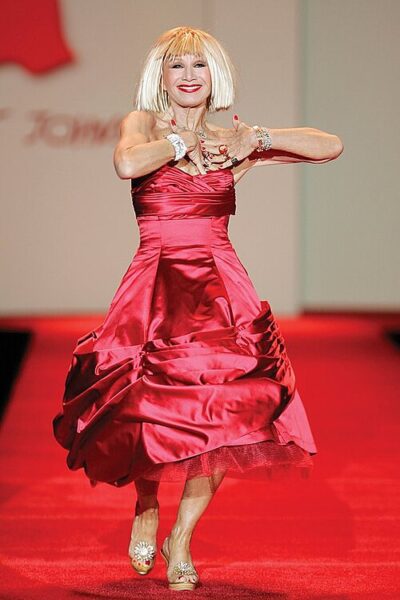
Betsey Johnson
Betsey Johnson is an American fashion designer. Born August 10, 1942, in Wethersfield. Educated at Syracuse University and Pratt Institute. Awards include CFDA Lifetime Achievement Award.
Facts
13 facts · 1 confirmed by two sources · 4 cited · 8 from one source
Where this comes from
Papalocal keeps its own record. It started from these sources; what each one said is kept here as it was copied, so a change on their side never changes this page by itself. Tap one to read its version.
What Wikidata says · copied November 15, 2026 · revision 2566686099
- Described as
- American fashion designer (born 1942)
- Born
- August 10, 1942 · 3 references
- Born in
- Wethersfield
- Citizen of
- United States
- Occupation
- costume designer; fashion designer · 2 references; visual artist · 1 reference
- Education
- Syracuse University; Pratt Institute; Wethersfield High School · 1 reference
- Awards
- CFDA Lifetime Achievement Award (2015) · 1 reference
- Spouse
- John Cale (1968–1971) · 1 reference
- Children
- Lulu Johnson
- Website
- http://www.betseyjohnson.com/
- Wikipedias with a page
- 25
Wikidata item Q467665 (wikidata.org/wiki/Q467665), public domain (CC0). Copied November 15, 2026.
What Wikipedia says · copied November 15, 2026 · revision 1370510950
Betsey Johnson (born August 10, 1942) is an American fashion designer best known for her colorful, cute, and whimsical designs. Many of her designs are considered "over the top" and embellished. She is also known for doing a cartwheel ending in a split at the end of her fashion shows. She is a recipient of the 2015 CFDA Geoffrey Beene Lifetime Achievement Award.
Johnson is also an artist.
- Born, in its opening lines
- August 10, 1942
From the Wikipedia article “Betsey Johnson” (en.wikipedia.org/wiki/Betsey_Johnson), by its contributors, under CC BY-SA 4.0 (creativecommons.org/licenses/by-sa/4.0/). Copied November 15, 2026; not changed.
Confirmed Two sources agree. Cited One source, and it names where it got it. One source One source, without a reference of its own. Sources disagree The sources disagree. We show the best-supported value and keep theirs below.
