
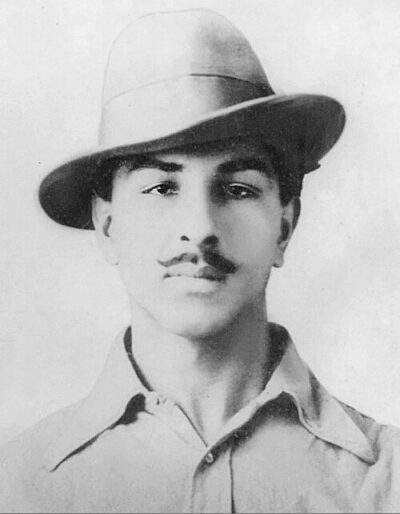
Bhagat Singh
Bhagat Singh was an Indian revolutionary. Born September 27, 1907, in Banga. Died March 23, 1931, in Lahore. Educated at National College of Arts.
Facts
16 facts · 2 confirmed by two sources · 4 cited · 9 from one source · 1 where the sources disagree
What’s different
- Born: we show September 27, 1907 (Confirmed). Wikidata also lists September 28, 1907
- Born in: we show Banga (Sources disagree). Wikidata also lists British Raj
Where this comes from
Papalocal keeps its own record. It started from these sources; what each one said is kept here as it was copied, so a change on their side never changes this page by itself. Tap one to read its version.
What Wikidata says · copied November 16, 2026 · revision 2517678211
- Described as
- Indian revolutionary (1907–1931)
- Other names
- Shaheed Bhagat Singh
- Born
- September 28, 1907; September 27, 1907
- Died
- March 23, 1931 · 2 references
- Born in
- Banga; British Raj
- Died in
- Lahore
- Cause of death
- hanging to death
- Citizen of
- British India · 1 reference; British Raj
- Occupation
- author; freedom fighter · 2 references; revolutionary · 1 reference
- Education
- National College of Arts
- Member of
- Hindustan Socialist Republican Association · 1 reference; Naujawan Bharat Sabha · 1 reference
- Genre
- literature; Jail Notes
- Religion
- atheism
- Wikipedias with a page
- 54
Wikidata item Q377808 (wikidata.org/wiki/Q377808), public domain (CC0). Copied November 16, 2026.
What Wikipedia says · copied November 16, 2026 · revision 1378558168
Bhagat Singh (27 September 1907 – 23 March 1931) was an Indian anti-colonial revolutionary who participated in the mistaken murder of a junior British police officer in December 1928 in what was intended to be retaliation for the death of an Indian nationalist. He later took part in a largely symbolic bombing of the Central Legislative Assembly in Delhi and a hunger strike in jail, which—on the back of sympathetic coverage in Indian-owned newspapers—turned him into a household name in the Punjab region, and, after his execution at age 23, a martyr and folk hero in Northern India. Borrowing ideas from Bolshevism and anarchism, the charismatic Bhagat Singh electrified a growing militancy in India in the 1930s and prompted urgent introspection within the Indian National Congress's nonviolent, and eventually successful, campaign for India's independence.
In December 1928, Bhagat Singh and an associate, Shivaram Rajguru, both members of a small revolutionary group, the Hindustan Socialist Republican Association (also Army, or HSRA), shot dead a 21-year-old British police officer, John P. Saunders, in Lahore, Punjab, in what is today Pakistan, mistaking Saunders, who was still on probation, for the British senior police superintendent, James Scott, whom they had intended to assassinate. They held Scott responsible for the death of a popular Indian nationalist leader Lala Lajpat Rai for having ordered a lathi (baton) charge in which Rai was injured and two weeks thereafter died of a heart attack. As Saunders exited a police station on a motorcycle, he was felled by a single bullet fired from across the street by Rajguru, a marksman. As he lay injured, he was shot at close range several times by Singh, the postmortem report showing eight bullet wounds. Another associate of Singh, Chandra Shekhar Azad, shot dead an Indian police head constable, Channan Singh, who attempted to give chase as Singh and Rajguru fled.
After having escaped, Bhagat Singh and his associates used pseudonyms to publicly announce avenging Lajpat Rai's death, putting up prepared posters that they had altered to show John Saunders as their intended target instead of James Scott. Singh was thereafter on the run for many months, and no convictions resulted at the time. Surfacing again in April 1929, he and another associate, Batukeshwar Dutt, set off two low-intensity homemade bombs among some unoccupied benches of the Central Legislative Assembly in Delhi. They showered leaflets from the gallery on the legislators below, shouted slogans, and allowed the authorities to arrest them. The arrest, and the resulting publicity, brought to light Singh's complicity in the John Saunders case. Awaiting trial, Singh gained public sympathy after he joined fellow defendant Jatin Das in a hunger strike, demanding better prison conditions for Indian prisoners, the strike ending in Das's death from starvation in September 1929.
Bhagat Singh was convicted of the murder of John Saunders and Channan Singh, and hanged in March 1931, aged 23. He became a popular folk hero after his death. Jawaharlal Nehru wrote about him: "Bhagat Singh did not become popular because of his act of terrorism but because he seemed to vindicate, for the moment, the honour of Lala Lajpat Rai, and through him of the nation. He became a symbol; the act was forgotten, the symbol remained, and within a few months each town and village of the Punjab, and to a lesser extent in the rest of northern India, resounded with his name." In still later years, Singh, an atheist and socialist in adulthood, won admirers in India from among a political spectrum that included both communists and right-wing Hindu nationalists. Although many of Singh's associates, as well as many Indian anti-colonial revolutionaries, were also involved in daring acts and were either executed or died violent deaths, few came to be lionised in popular art and literature as did Singh, who is sometimes referred to as the Shaheed-e-Azam ("Great martyr" in Urdu and Punjabi).
- Born, in its opening lines
- September 27, 1907
- Died, in its opening lines
- March 23, 1931
From the Wikipedia article “Bhagat Singh” (en.wikipedia.org/wiki/Bhagat_Singh), by its contributors, under CC BY-SA 4.0 (creativecommons.org/licenses/by-sa/4.0/). Copied November 16, 2026; not changed.
Confirmed Two sources agree. Cited One source, and it names where it got it. One source One source, without a reference of its own. Sources disagree The sources disagree. We show the best-supported value and keep theirs below.
