
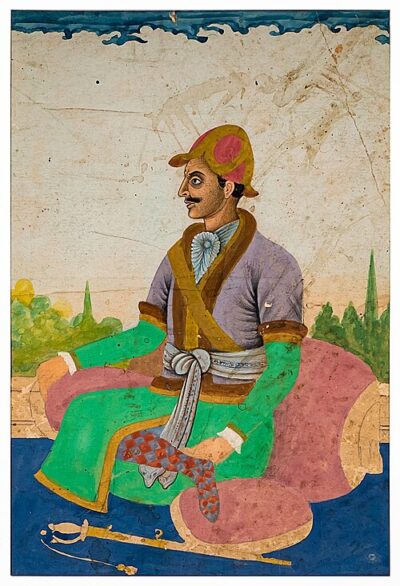
Bhimsen Thapa
Bhimsen Thapa was a Mukhtiyar and de facto ruler of Nepal from 1806 to 1837. Born August 1775, in Gorkha District. Died July 28, 1839, in Kathmandu. Positions held include Prime Minister of Nepal (1806–1837).
Facts
13 facts · 1 confirmed by two sources · 1 cited · 10 from one source · 1 where the sources disagree
What’s different
- Died: we show July 28, 1839 (Sources disagree). Wikipedia says July 29, 1839
Where this comes from
Papalocal keeps its own record. It started from these sources; what each one said is kept here as it was copied, so a change on their side never changes this page by itself. Tap one to read its version.
What Wikidata says · copied November 17, 2026 · revision 2567995691
- Described as
- Mukhtiyar and de facto ruler of Nepal from 1806 to 1837
- Other names
- Mukhtiyar Jarnel Saheb, Bhimsen Kaji, Bhimsen Thapa Chhetri
- Born
- August 1775
- Died
- July 28, 1839
- Born in
- Gorkha District
- Died in
- Kathmandu
- Citizen of
- Nepal
- Occupation
- politician · 1 reference
- Positions held
- Prime Minister of Nepal (1806–1837)
- Father
- Amar Singh Thapa
- Mother
- Satyarupa Maya
- Siblings
- Nain Singh Thapa; Bakhtawar Singh Thapa; Ranabir Singh Thapa
- Religion
- Hinduism
- Wikipedias with a page
- 26
Wikidata item Q4206839 (wikidata.org/wiki/Q4206839), public domain (CC0). Copied November 17, 2026.
What Wikipedia says · copied November 17, 2026 · revision 1386199248
Bhimsen Thapa (born August 1775 – 29 July 1839) was a Nepalese statesman who served as the Mukhtiyar (equivalent to prime minister) and de facto ruler of Nepal from 1806 to 1837. He is widely known as the first and the longest-serving prime minister of Nepal. He was inducted into the "National heroes of Nepal" by King Mahendra Bir Bikram Shah.
Born into an ordinary military family in the Gorkha Kingdom, Bhimsen first came close to the Crown Prince Rana Bahadur Shah at an early age in 1785. In 1798, he was recruited as a bodyguard for the King by his father. Thereafter, he rose to influence after helping the exiled ex-King Rana Bahadur Shah engineer his return to power in 1804. In gratitude, Rana Bahadur made Bhimsen a Kaji (equivalent to a minister) of the newly formed government. Rana Bahadur's assassination by his stepbrother Sher Bahadur Shah in 1806 led Bhimsen to initiate investigations into the context in which he ordered the death penalty for ninety-three people popularly known as the 1806 Bhandarkhal massacre, after which he claimed the title of Mukhtiyar (equivalent to prime minister) himself. The death of King Girvan Yuddha Bikram Shah in 1816 at the immature age of 17, with his heir, King Rajendra Bikram Shah being only 3 years old, along with the support from Queen Tripurasundari (the junior queen of Rana Bahadur Shah) allowed him to remain in power even after Nepal's defeat in the Anglo-Nepalese War. After the death of Queen Tripurasundari in 1832, the intrigues of the newly adult King Rajendra, the conspiracies and infightings with the British envoy Brian Houghton Hodgson, Senior Queen Samrajya Laxmi Devi and the rival courtiers (especially the Kala Pandes, who held Bhimsen Thapa responsible for the death of Damodar Pande in 1804) finally led to his imprisonment on false charges of the murder of an infant prince and ultimately his death by suicide in 1839.
Bhimsen Thapa is remembered for being the first Nepalese statesman to fully comprehend the British system of protectorate in India carried out by Lord Wellesley and his subsequent activities to keep British authorities at bay and prevent the Kingdom of Nepal from being a part of the British Empire through long and persistent anti-British politics during both wartime and peacetime. The territorial expanse of the Gurkha empire had reached its greatest extent from the Sutlej River in the west to the Teesta River in the east during his prime ministership. However, Nepal entered into a disastrous Anglo-Nepalese War with the partially British Empire-owned East India Company lasting from 1814 to 1816, which was concluded with the Treaty of Sugauli, by which Nepal lost almost one-third of its land. He is widely remembered for bringing about a large number of social, religious, economic, and administrative reforms, as well as the modernization of the Nepalese Army on the template of the French military forces. During his lifetime, he commissioned the construction of many temples and monuments including the highly famed Dharahara also known as Bhimsen Stambha ("Bhimsen Tower").
Widely considered one of the 19th century's most significant figures in Nepalese history, Bhimsen is seen as a patriotic, clever, and diplomatic statesman who played an important role in defending his country against then-widespread British colonial imperialism in South Asia. His foreign policy was largely motivated by rational national interest, national sustenance and nationalism. He is also well praised as a reformer and for his efficient systematization and management of the state administration, programmes and policies. However, he has been criticized for instigating an inhumane political massacre in his early political career, the elimination of his political rivals and the consolidation of political and military power within his family.
- Born, in its opening lines
- August 1775
- Died, in its opening lines
- July 29, 1839
From the Wikipedia article “Bhimsen Thapa” (en.wikipedia.org/wiki/Bhimsen_Thapa), by its contributors, under CC BY-SA 4.0 (creativecommons.org/licenses/by-sa/4.0/). Copied November 17, 2026; not changed.
Confirmed Two sources agree. Cited One source, and it names where it got it. One source One source, without a reference of its own. Sources disagree The sources disagree. We show the best-supported value and keep theirs below.
