
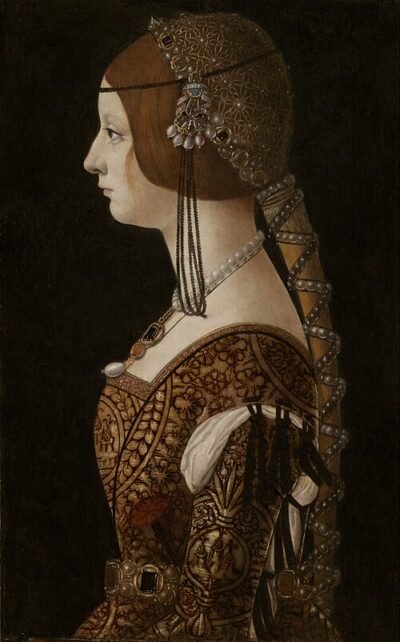
Bianca Maria Sforza
Bianca Maria Sforza was a Holy Roman Empress, Presumptive crown princess of Hungary. Born April 5, 1472, in Milan. Died December 31, 1510, in Innsbruck.
Facts
14 facts · 2 confirmed by two sources · 3 cited · 9 from one source
Where this comes from
Papalocal keeps its own record. It started from these sources; what each one said is kept here as it was copied, so a change on their side never changes this page by itself. Tap one to read its version.
What Wikidata says · copied November 16, 2026 · revision 2569840944
- Described as
- Holy Roman Empress, Presumptive crown princess of Hungary (1472-1510)
- Other names
- Bianca Maria Sforza, Principessa di Milano
- Born
- April 5, 1472
- Died
- December 31, 1510 · 1 reference
- Born in
- Milan
- Died in
- Innsbruck
- Buried in
- Stift Stams Austrian Grave
- Citizen of
- Germany
- Occupation
- empress consort
- Spouse
- Philibert I, Duke of Savoy (1476–1482); Maximilian I (1494–1510) · 2 references
- Father
- Galeazzo Maria Sforza · 1 reference
- Mother
- Bona of Savoy · 1 reference
- Siblings
- Gian Galeazzo Sforza; Caterina Sforza; Anna Sforza · 1 reference
- Wikipedias with a page
- 37
Wikidata item Q161136 (wikidata.org/wiki/Q161136), public domain (CC0). Copied November 16, 2026.
What Wikipedia says · copied November 16, 2026 · revision 1380608503
Bianca Maria Sforza (5 April 1472 – 31 December 1510) was Queen of Germany and Empress of the Holy Roman Empire as the third wife of Maximilian I. She was the eldest legitimate daughter of Duke Galeazzo Maria Sforza of Milan by his second wife, Bona of Savoy.
- Born, in its opening lines
- April 5, 1472
- Died, in its opening lines
- December 31, 1510
From the Wikipedia article “Bianca Maria Sforza” (en.wikipedia.org/wiki/Bianca_Maria_Sforza), by its contributors, under CC BY-SA 4.0 (creativecommons.org/licenses/by-sa/4.0/). Copied November 16, 2026; not changed.
Confirmed Two sources agree. Cited One source, and it names where it got it. One source One source, without a reference of its own. Sources disagree The sources disagree. We show the best-supported value and keep theirs below.
