
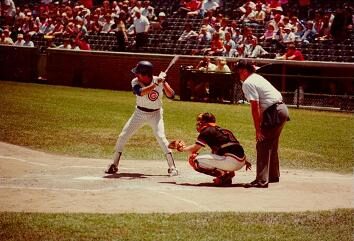
Bill Buckner
Bill Buckner was an American baseball player. Born December 14, 1949, in Vallejo. Died May 27, 2019, in Boise. Teams include Los Angeles Dodgers, Chicago Cubs and Boston Red Sox. Educated at University of Southern California and Napa High School.
Facts
17 facts · 2 confirmed by two sources · 3 cited · 12 from one source
Where this comes from
Papalocal keeps its own record. It started from these sources; what each one said is kept here as it was copied, so a change on their side never changes this page by itself. Tap one to read its version.
What Wikidata says · copied November 18, 2026 · revision 2561367575
- Described as
- American baseball player
- Other names
- William Joseph Buckner, William Joseph "Bill" Buckner
- Born
- December 14, 1949 · 1 reference
- Died
- May 27, 2019 · 1 reference
- Born in
- Vallejo
- Died in
- Boise
- Cause of death
- Lewy body dementia
- Citizen of
- United States
- Occupation
- baseball player · 1 reference
- Education
- University of Southern California; Napa High School · 1 reference
- Teams
- Los Angeles Dodgers; Chicago Cubs; Boston Red Sox; Los Angeles Angels; Kansas City Royals; Tiburones de La Guaira
- Sport
- baseball · 1 reference
- Website
- http://www.billbuckner.net · 1 reference
- Wikipedias with a page
- 15
Wikidata item Q2903144 (wikidata.org/wiki/Q2903144), public domain (CC0). Copied November 18, 2026.
What Wikipedia says · copied November 18, 2026 · revision 1382263651
William Joseph Buckner (December 14, 1949 – May 27, 2019) was an American first baseman and left fielder in Major League Baseball (MLB) who played for five teams from 1969 through 1990, most notably the Chicago Cubs, Los Angeles Dodgers, and Boston Red Sox. Beginning his career as an outfielder with the Dodgers, Buckner helped the team to the 1974 pennant with a .314 batting average, but a serious ankle injury the next year led to his trade to the Cubs before the 1977 season. The Cubs moved him to first base, and he won the National League (NL) batting title with a .324 mark in 1980. He was named to the All-Star team the following year as he led the major leagues in doubles. After setting a major league record for first basemen with 159 assists in 1982, Buckner surpassed that total with 161 in 1983 while again leading the NL in doubles. Feuds with team management over a loss of playing time resulted in him being traded to the Red Sox in the middle of the 1984 season.
During the 1985 season, Buckner started all 162 games and shattered his own record with 184 assists. Toward the end of the 1986 season, he was hobbled by leg injuries and struggled throughout the playoffs. His tenth-inning error in Game 6 of the 1986 World Series against the New York Mets remains one of the most memorable plays in baseball history; it was long considered part of a curse on the Red Sox that kept them from winning the World Series for 86 years, and led to years of fan anger and public mockery that Buckner handled graciously before being embraced by Red Sox fans again after their 2004 World Series victory.
After spending his last few seasons with the California Angels, Kansas City Royals, and Red Sox, Buckner became the 21st player in major league history to play in four decades. He ended his career with 2,715 hits and 498 doubles, having batted over .300 seven times with three seasons of 100 runs batted in (RBI). Buckner led his league in assists four times, with his 1985 mark remaining the American League (AL) record. He retired with the fourth-most assists by a first baseman (1,351) in major league history despite not playing the position regularly until he was 27 years old. After retiring as a player, Buckner became a real estate developer in Idaho. He coached a number of Minor League Baseball (MiLB) teams before leaving baseball in 2014.
- Born, in its opening lines
- December 14, 1949
- Died, in its opening lines
- May 27, 2019
From the Wikipedia article “Bill Buckner” (en.wikipedia.org/wiki/Bill_Buckner), by its contributors, under CC BY-SA 4.0 (creativecommons.org/licenses/by-sa/4.0/). Copied November 18, 2026; not changed.
Confirmed Two sources agree. Cited One source, and it names where it got it. One source One source, without a reference of its own. Sources disagree The sources disagree. We show the best-supported value and keep theirs below.
