
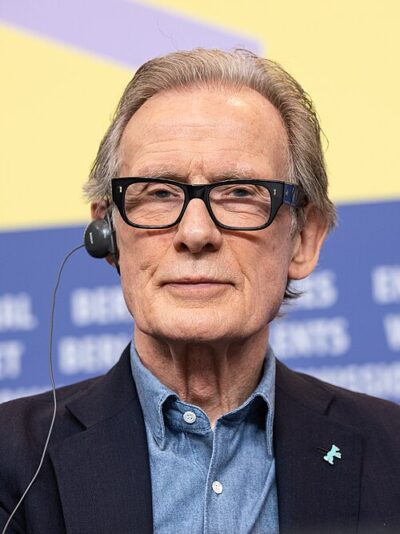
Bill Nighy
Bill Nighy is a British actor. Born December 12, 1949, in Caterham. Known for Love Actually, Underworld and Pirates of the Caribbean: Dead Man's Chest. Educated at Guildford School of Acting and The John Fisher School. Awards include Annie Award for Voice Acting in a Feature Production, Theatre World Award and Golden Globes.
Facts
21 facts · 1 confirmed by two sources · 3 cited · 17 from one source
Where this comes from
Papalocal keeps its own record. It started from these sources; what each one said is kept here as it was copied, so a change on their side never changes this page by itself. Tap one to read its version.
What Wikidata says · copied November 16, 2026 · revision 2569966114
- Described as
- British actor (born 1949)
- Other names
- William Francis "Bill" Nighy, William Francis Nighy
- Born
- December 12, 1949 · 5 references
- Born in
- Caterham · 2 references
- Name at birth
- William Francis Nighy · 1 reference
- Citizen of
- United Kingdom
- Occupation
- television actor; film actor; actor · 1 reference; dub actor; stage actor; voice actor
- Education
- Guildford School of Acting; The John Fisher School
- Genre
- Shakespearean comedy
- Known for
- Love Actually (2003) · 1 reference; Underworld (2003); Pirates of the Caribbean: Dead Man's Chest (2006)
- Awards
- Annie Award for Voice Acting in a Feature Production (2011) · 1 reference; Theatre World Award (2007) · 1 reference; Golden Globes (2007)
- Children
- Mary Nighy
- Lived in
- Pimlico
- Wikipedias with a page
- 53
Wikidata item Q207179 (wikidata.org/wiki/Q207179), public domain (CC0). Copied November 16, 2026.
What Wikipedia says · copied November 16, 2026 · revision 1382092086
William Francis Nighy (; born 12 December 1949) is a British actor. Known for his work on stage and screen, he has received various accolades including two BAFTA Awards and a Golden Globe Award, in addition to nominations for an Academy Award, a Tony Award, a Laurence Olivier Award and two Screen Actors Guild Awards.
Nighy started his career with the Everyman Theatre, Liverpool, and made his London debut with the Royal National Theatre starting with The Illuminatus! in 1977. He gained acclaim for his roles in David Hare's Pravda in 1985, Harold Pinter's Betrayal in 1991, Tom Stoppard's Arcadia in 1993, and Anton Chekhov's The Seagull in 1994. He received a Laurence Olivier Award for Best Actor nomination for his role in Blue/Orange in 2001. He acted on Broadway in the David Hare plays The Vertical Hour (2006) and Skylight (2015), earning a Tony Award for Best Actor in a Play nomination for the latter.
Nighy's early film roles include the comedies Still Crazy (1998), Guest House Paradiso (1999) and Blow Dry (2001). He rose to international stardom with his role in Love Actually (2003), which earned him a BAFTA Award for Best Supporting Actor. He went on to portray Viktor in the Underworld film series (2003–2009) and Davy Jones in the Pirates of the Caribbean film series (2006–2007). His other films include Shaun of the Dead (2004), The Hitchhiker's Guide to the Galaxy (2005), The Constant Gardener (2005), Notes on a Scandal (2006), Hot Fuzz (2007), Valkyrie (2008), Wild Target (2010), Harry Potter and the Deathly Hallows – Part 1 (2010), The Best Exotic Marigold Hotel (2012), About Time (2013), Emma (2020), and Living (2022), the last of which earned him a nomination for the Academy Award for Best Actor.
Nighy has gained acclaim for his roles in television, earning a BAFTA Award for his role in BBC One series State of Play (2003), and a Golden Globe Award for Best Actor for the BBC film Gideon's Daughter (2007). He is also known for his roles in The Girl in the Café (2006), the BBC's Worricker trilogy which includes Page Eight (2012), Turks & Caicos (2014), and Salting the Battlefield (2014), and the BBC's Ordeal by Innocence (2018).
- Born, in its opening lines
- December 12, 1949
From the Wikipedia article “Bill Nighy” (en.wikipedia.org/wiki/Bill_Nighy), by its contributors, under CC BY-SA 4.0 (creativecommons.org/licenses/by-sa/4.0/). Copied November 16, 2026; not changed.
Confirmed Two sources agree. Cited One source, and it names where it got it. One source One source, without a reference of its own. Sources disagree The sources disagree. We show the best-supported value and keep theirs below.
