
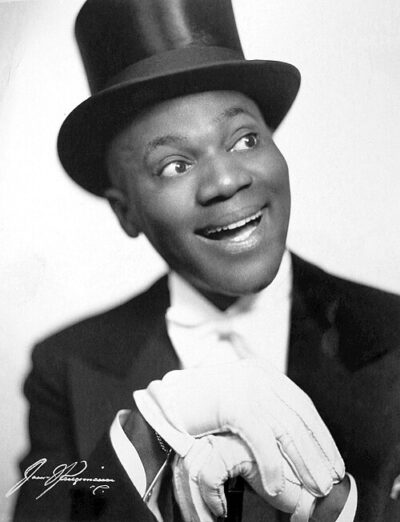
Bill Robinson
Bill Robinson was an American dancer and actor (1877/1878–1949). Born May 25, 1878, in Richmond. Died November 25, 1949, in New York City. Educated at Elizabeth Forward High School.
Facts
18 facts · 2 confirmed by two sources · 3 cited · 13 from one source
Where this comes from
Papalocal keeps its own record. It started from these sources; what each one said is kept here as it was copied, so a change on their side never changes this page by itself. Tap one to read its version.
What Wikidata says · copied November 15, 2026 · revision 2567397413
- Described as
- American dancer and actor (1877/1878–1949)
- Other names
- Bojangles Robinson, Bill Bojangles Robinson, Luther Robinson
- Born
- May 25, 1878 · 3 references
- Died
- November 25, 1949 · 3 references
- Born in
- Richmond · 1 reference
- Died in
- New York City · 1 reference
- Buried in
- The Evergreens Cemetery
- Name at birth
- Luther Robinson
- Citizen of
- United States
- Occupation
- film actor; stage actor; dancer · 2 references; activist; actor
- Education
- Elizabeth Forward High School · 1 reference
- Spouse
- Lena Chase (1907–1922); Fannie S. Clay (1922–1943); Elaine Plaines (1944–1949)
- Military branch
- United States Army
- Nickname
- Bojangles
- Wikipedias with a page
- 24
Wikidata item Q862416 (wikidata.org/wiki/Q862416), public domain (CC0). Copied November 15, 2026.
What Wikipedia says · copied November 15, 2026 · revision 1383608173
Bill "Bojangles" Robinson (born Luther Robinson; May 25, 1878 – November 25, 1949), was an American tap dancer, actor, and singer, the best known and the most highly paid black entertainer in the United States during the first half of the 20th century. His long career mirrored changes in American entertainment tastes and technology. His career began in the age of minstrel shows and moved to vaudeville, Broadway theatre, the recording industry, Hollywood films, radio, and television.
According to dance critic Marshall Stearns, "Robinson's contribution to tap dance is exact and specific. He brought it on its toes, dancing upright and swinging," adding a "hitherto-unknown lightness and presence." His signature routine was the stair dance, in which he would tap up and down a set of stairs in a rhythmically complex sequence of steps, a routine that he unsuccessfully attempted to patent. He is also credited with having popularized the word copacetic through his repeated use of it in vaudeville and radio appearances.
He is famous for his dancing with Shirley Temple in a series of films during the 1930s, and for starring in the musical Stormy Weather (1943), loosely based on his own life and selected for preservation in the National Film Registry. He used his popularity to challenge and overcome numerous racial barriers. Robinson was one of the first minstrel and vaudeville performers to appear as black without the use of blackface makeup, as well as one of the earliest black performers to perform solo, overcoming vaudeville's two-color rule. Additionally, he was an early black headliner in Broadway shows. Robinson was the first black performer to appear in a Hollywood film in an interracial dance team (with Shirley Temple in The Little Colonel, 1935), and the first black performer to headline a mixed-race Broadway production.
Robinson came under heavy criticism for his apparent tacit acceptance of racial stereotypes of the era, with some critics calling him an Uncle Tom. He strongly resented this, and his biographers suggested that critics were underestimating the difficulties faced by black performers engaging with mainstream white culture at the time, and ignoring his many efforts to overcome racial prejudice. In his public life, Robinson led efforts to persuade the Dallas Police Department to hire its first black policeman; lobby President Franklin Delano Roosevelt during World War II for equal treatment of black soldiers; and stage the first integrated public event in Miami, a fundraiser which was attended by both black and white city residents.
Robinson was a popular figure in both black and white entertainment worlds of his era, and is remembered for the support that he gave to fellow performers, including Fred Astaire, Eleanor Powell, Lena Horne, Jesse Owens, and the Nicholas Brothers. Sammy Davis Jr. and Ann Miller credited him as a teacher and mentor, Miller saying that he "changed the course of my life." Gregory Hines produced and starred in a biographical movie about Robinson for which he won the NAACP Best Actor Award.
Despite being the highest-paid black performer of the time, Robinson died penniless in 1949, his funeral paid for by longtime friend Ed Sullivan. In 1989, Congress designated Robinson's birthday of May 25 as National Tap Dance Day.
- Born, in its opening lines
- May 25, 1878
- Died, in its opening lines
- November 25, 1949
From the Wikipedia article “Bill Robinson” (en.wikipedia.org/wiki/Bill_Robinson), by its contributors, under CC BY-SA 4.0 (creativecommons.org/licenses/by-sa/4.0/). Copied November 15, 2026; not changed.
Confirmed Two sources agree. Cited One source, and it names where it got it. One source One source, without a reference of its own. Sources disagree The sources disagree. We show the best-supported value and keep theirs below.
