
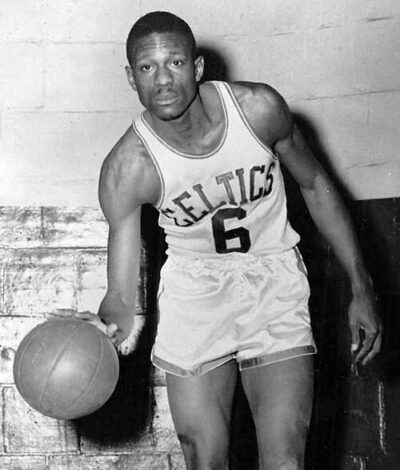
Bill Russell
Bill Russell was an American basketball player. Born February 12, 1934, in Monroe. Died July 31, 2022, in Mercer Island. Teams include San Francisco Dons men's basketball (1953–1956) and Boston Celtics (1956–1969). Educated at University of San Francisco and McClymonds High School. Awards include NBA Most Valuable Player Award (5 times), NBA All-Star Game Kobe Bryant Most Valuable Player Award and Sports Illustrated Sportsperson of the Year.
Facts
28 facts · 2 confirmed by two sources · 13 cited · 13 from one source
Where this comes from
Papalocal keeps its own record. It started from these sources; what each one said is kept here as it was copied, so a change on their side never changes this page by itself. Tap one to read its version.
What Wikidata says · copied November 13, 2026 · revision 2563544679
- Described as
- American basketball player (1934–2022)
- Other names
- William Russell, William Felton "Bill" Russell, William Felton Russell
- Born
- February 12, 1934 · 4 references
- Died
- July 31, 2022 · 5 references
- Born in
- Monroe · 1 reference
- Died in
- Mercer Island · 1 reference
- Buried in
- Lake View Cemetery · 1 reference
- Name at birth
- William Felton Russell
- Citizen of
- United States · 1 reference
- Occupation
- basketball player · 3 references; basketball coach · 1 reference; actor · 3 references; high jumper; athlete · 1 reference
- Education
- University of San Francisco · 1 reference; McClymonds High School · 1 reference
- Member of
- Kappa Alpha Psi
- Teams
- San Francisco Dons men's basketball (1953–1956) · 1 reference; Boston Celtics (1956–1969) · 1 reference
- Sport
- basketball · 1 reference; athletics
- Awards
- NBA Most Valuable Player Award (5 times) (1958, 1961, 1962, 1963, 1965); NBA All-Star Game Kobe Bryant Most Valuable Player Award (1963); Sports Illustrated Sportsperson of the Year (1968); Presidential Medal of Freedom (2011) · 1 reference; honorary doctor of Harvard University (2007) · 1 reference; FIBA Hall of Fame
- Spouse
- Dorothy Anstett (1977–1980)
- Siblings
- Charlie L. Russell
- Height
- 2.08 m (6 ft 10 in)
- Wikipedias with a page
- 68
Wikidata item Q242185 (wikidata.org/wiki/Q242185), public domain (CC0). Copied November 13, 2026.
What Wikipedia says · copied November 13, 2026 · revision 1382430868
William Felton Russell (February 12, 1934 – July 31, 2022) was an American professional basketball player who played center for the Boston Celtics of the National Basketball Association (NBA) from 1956 to 1969. He was the centerpiece of the Celtics dynasty that played for 12 NBA championships and won 11 during his 13-year career. Russell is widely considered one of the greatest basketball players of all time.
Russell played college basketball for the San Francisco Dons, leading them to consecutive NCAA championships in 1955 and 1956. He was named NCAA tournament Most Outstanding Player (MOP), and captained the gold medal-winning U.S. national basketball team at the 1956 Summer Olympics. These victories along with his NBA championships made Russell one of only eight players in the history of men's basketball to achieve the Triple Crown.
After being chosen by the St. Louis Hawks with the second overall pick in the 1956 NBA draft, Russell was traded to the Boston Celtics for Celtics center Ed Macauley and small forward Cliff Hagan. With Russell as their starting center and defensive anchor, the Celtics went on to win their first NBA championship in 1957 and won an NBA record eight consecutive championships from 1959 to 1966. A five-time NBA Most Valuable Player (MVP) and a 12-time NBA All-Star, Russell's rebounding, defense, and leadership made him one of the dominant players of his era. Standing at 6 ft 10 in (2.08 m) tall, with a 7-foot-4-inch (2.24 m) arm span, his shot-blocking and man-to-man defense were major reasons for the Celtics' dominance during his career. Russell also led the NBA in rebounds four times, had a dozen consecutive seasons of 1,000 or more rebounds, and remains second all-time in both total rebounds and rebounds per game. Russell played in the wake of black pioneers Earl Lloyd, Chuck Cooper, and Sweetwater Clifton, and he was the first black player to achieve superstar status in the NBA. During the final three seasons of his career (1966–1969), he served as player-coach of the Celtics, becoming the first black NBA coach to win a championship. Russell ended his playing career and left his position as Celtics coach after helping the Celtics win the 1969 NBA championship.
Russell served as head coach and general manager of the Seattle SuperSonics from 1973 to 1977. He also coached the Sacramento Kings from 1987 to 1988. Russell also worked as a color commentator and authored several books.
Russell was inducted into the Naismith Memorial Basketball Hall of Fame in 1975, was one of the founding inductees into the National Collegiate Basketball Hall of Fame in 2006 and was enshrined in the FIBA Hall of Fame in 2007. He was selected into the NBA 25th Anniversary Team in 1971 and the NBA 35th Anniversary Team in 1980, was named as one of the 50 Greatest Players in NBA History in 1996 (being one of only four players to receive all three honors), and was selected to the NBA 75th Anniversary Team in 2021. In 2009, the NBA renamed the NBA Finals MVP Award in his honor. In 2011, Barack Obama awarded Russell the Presidential Medal of Freedom for his accomplishments on the court and in the civil rights movement. In 2021, Russell was inducted into the Naismith Memorial Basketball Hall of Fame a second time in recognition of his coaching career. Shortly after his death in 2022, the NBA retired Russell's #6 jersey league-wide, making him the only player in NBA history to receive that honor, as well as the third person in North American major professional sports to have their jersey number retired league-wide, after Jackie Robinson and Wayne Gretzky.
- Born, in its opening lines
- February 12, 1934
- Died, in its opening lines
- July 31, 2022
From the Wikipedia article “Bill Russell” (en.wikipedia.org/wiki/Bill_Russell), by its contributors, under CC BY-SA 4.0 (creativecommons.org/licenses/by-sa/4.0/). Copied November 13, 2026; not changed.
Confirmed Two sources agree. Cited One source, and it names where it got it. One source One source, without a reference of its own. Sources disagree The sources disagree. We show the best-supported value and keep theirs below.
