
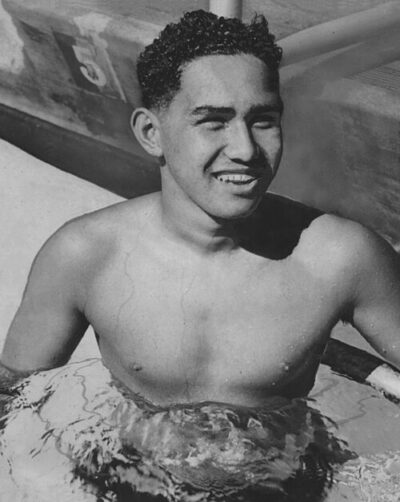
Bill Smith
Bill Smith was an American swimmer. Born May 16, 1924, in Honolulu. Died February 8, 2013, in Honolulu. Teams include Ohio State Buckeyes. Educated at Ohio State University.
Facts
11 facts · 2 confirmed by two sources · 0 cited · 9 from one source
Where this comes from
Papalocal keeps its own record. It started from these sources; what each one said is kept here as it was copied, so a change on their side never changes this page by itself. Tap one to read its version.
What Wikidata says · copied November 16, 2026 · revision 2532426153
- Described as
- American swimmer (1924–2013)
- Other names
- William Melvin Smith, Jr., Billy Smith
- Born
- May 16, 1924 · 1 reference
- Died
- February 8, 2013 · 1 reference
- Born in
- Honolulu
- Died in
- Honolulu
- Buried in
- O'ahu Cemetery · 1 reference
- Name at birth
- William Melvin Smith, Jr.
- Citizen of
- United States
- Occupation
- swimmer · 1 reference
- Education
- Ohio State University
- Teams
- Ohio State Buckeyes
- Sport
- competitive swimming · 1 reference
- Wikipedias with a page
- 22
Wikidata item Q621106 (wikidata.org/wiki/Q621106), public domain (CC0). Copied November 16, 2026.
What Wikipedia says · copied November 16, 2026 · revision 1372677522
William Melvin Smith Jr. (May 16, 1924 – February 8, 2013) was an American competitive swimmer, two-time Olympic champion, and a former world record-holder in four events. He was one of the most successful competitive swimmers in the United States in the first half of the 20th century.
Smith was born in Honolulu, Hawaii, of mixed Irish and Native Hawaiian ancestry. He attended Ohio State University under Hall of Fame Coach Mike Peppe, and competed for the Ohio State Buckeyes swimming and diving team within the National Collegiate Athletic Association (NCAA). As a college swimmer, he was undefeated in three years of dual meet competition, and was a four-time All-American. He set seven world records and won fourteen U.S. national championships: seven NCAA, six AAU indoor and one AAU outdoor.
At the 1948 Summer Olympics in London, England, Smith won gold medals in the 400-meter freestyle and 4×200-meter freestyle relay. At one time, Smith held all of the world records in freestyle swimming events between 200 and 1,000 meters.
At the US Olympic trials of the 1948 4x200-meter freestyle relay, several swimmers who had already qualified in other events slowed down in their heats or swam fast in the prelims and scratched themselves for the final to allow more swimmers to qualify for the US Olympic Team. Smith was one of the instigators of this "conspiracy".
Ultimately, coach Robert Kiphuth did hold a time trial shortly after the actual trials with eleven of the swimmers. This time trial had Jimmy McLane as first overall with a time of 2:11.0, Bill Smith, and Wally Wolf in 2:11.2, and Wally Ris in 2:12.4. This quartet was used for the Olympic final and won the gold medal. The next four-Eugene Rogers in 2:14.2, Edwin Gilbert in 2:15.4, Robert Gibe in 2:15.6, and William Dudley in 2:15.9, were used in the Olympic prelims. The next three swimmers-Joe Verdeur who came in 2:16.3, Alan Ford in 2;16.4 and George Hoogerhyde in 2:17.4 were not used in any capacity in the 4x200 freestyle relay.
After retiring from competitions Smith became captain of the surf guards at Waikiki Beach, coached swimmers at the University of Hawaii, and served as safety director for the Honolulu Department of Parks and Recreation for 25 years. He also coached masters swimmers at the Kamehameha Swim Club.
Smith was inducted into the International Swimming Hall of Fame in 1966. In 2001 he was named Ohio State University's swimmer of the century by the Columbus Touchdown Club. He died February 8, 2013; he was 88 years old.
- Born, in its opening lines
- May 16, 1924
- Died, in its opening lines
- February 8, 2013
From the Wikipedia article “Bill Smith (swimmer)” (en.wikipedia.org/wiki/Bill_Smith_(swimmer)), by its contributors, under CC BY-SA 4.0 (creativecommons.org/licenses/by-sa/4.0/). Copied November 16, 2026; not changed.
Confirmed Two sources agree. Cited One source, and it names where it got it. One source One source, without a reference of its own. Sources disagree The sources disagree. We show the best-supported value and keep theirs below.
