
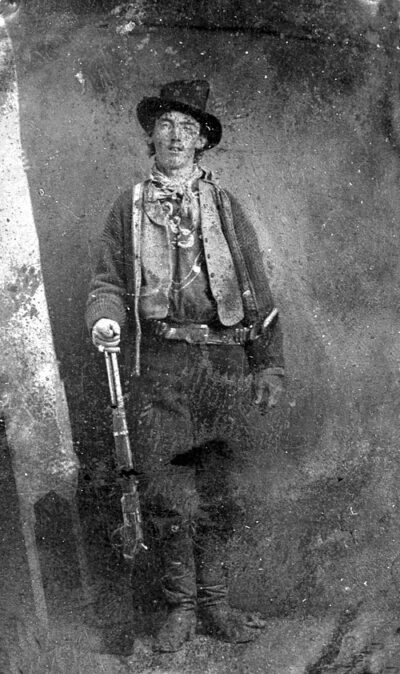
Billy the Kid
Billy the Kid was an American outlaw and gunfighter. Born November 23, 1859, in New York City. Died July 14, 1881, in Fort Sumner.
Facts
15 facts · 2 confirmed by two sources · 2 cited · 11 from one source
What’s different
- Born: we show November 23, 1859 (Confirmed). Wikidata also lists September 17, 1859
Where this comes from
Papalocal keeps its own record. It started from these sources; what each one said is kept here as it was copied, so a change on their side never changes this page by itself. Tap one to read its version.
What Wikidata says · copied November 13, 2026 · revision 2568852907
- Described as
- American outlaw and gunfighter (1859–1881)
- Other names
- Kid Antrim, Henry Antrim, William Bonney, William H. Bonney, William Henry McCarty, Henry McCarty, Patrick Henry McCarthy, William Henry Bonney, William McCarty
- Born
- November 23, 1859 · 3 references; September 17, 1859
- Died
- July 14, 1881 · 6 references
- Born in
- New York City · 1 reference
- Died in
- Fort Sumner · 1 reference
- Buried in
- Old Fort Sumner Cemetery · 1 reference
- Cause of death
- gunshot wound
- Name at birth
- Patrick Henry McCarthy
- Citizen of
- United States
- Occupation
- gunfighter; gambler; cowboy; ranch hand; serial killer · 1 reference; brigand · 1 reference
- Nickname
- Billy the Kid
- Wikipedias with a page
- 69
Wikidata item Q44200 (wikidata.org/wiki/Q44200), public domain (CC0). Copied November 13, 2026.
What Wikipedia says · copied November 13, 2026 · revision 1382646532
Henry McCarty (September 17 or November 23, 1859 – July 14, 1881), alias William H. Bonney, better known as Billy the Kid, was an American outlaw and gunfighter of the Old West who was linked to nine murders. He was solely responsible for four of them, and he may have played a role in five, alongside other men. He is also noted for his involvement in New Mexico's Lincoln County War.
McCarty was orphaned at the age of 15. His first arrest was for stealing food at the age of 16 in 1875. Ten days later, he robbed a Chinese laundry and was arrested again, but escaped shortly afterwards. He fled from New Mexico Territory into neighboring Arizona Territory, making himself both an outlaw and a federal fugitive. In 1877, he began to call himself "William H. Bonney".
After killing a blacksmith during an altercation in August 1877, Bonney became a wanted man in Arizona and returned to New Mexico, where he joined a group of cattle rustlers. He became well known in the region when he joined the Regulators and took part in the Lincoln County War of 1878. He and two other Regulators were later charged with killing three men, including Lincoln County Sheriff William J. Brady and one of his deputies.
Bonney's notoriety grew in December 1880 when the Las Vegas Gazette, in Las Vegas, New Mexico, and The Sun, in New York City, carried stories about his crimes. Sheriff Pat Garrett captured Bonney later that month. In April 1881, Bonney was tried for and convicted of Brady's murder and was sentenced to hang in May of that year. He escaped from jail on April 28, killing two sheriff's deputies in the process, and evaded capture for more than two months. Garrett shot and killed Bonney, by then aged 21, in Fort Sumner on July 14, 1881. During his short career as an outlaw, Bonney was the subject of numerous U.S. newspaper articles, some as far away as New York.
During the decades following his death, stories spread that Bonney had survived, and a number of men claimed to be him. The legend of Billy the Kid endures in American culture, and he remains one of the most notorious figures from the era, whose life and likeness have been frequently dramatized in the Western genre. More than 50 films and several broadcast programs have featured Billy the Kid.
- Born, in its opening lines
- November 23, 1859
- Died, in its opening lines
- July 14, 1881
From the Wikipedia article “Billy the Kid” (en.wikipedia.org/wiki/Billy_the_Kid), by its contributors, under CC BY-SA 4.0 (creativecommons.org/licenses/by-sa/4.0/). Copied November 13, 2026; not changed.
Confirmed Two sources agree. Cited One source, and it names where it got it. One source One source, without a reference of its own. Sources disagree The sources disagree. We show the best-supported value and keep theirs below.
