
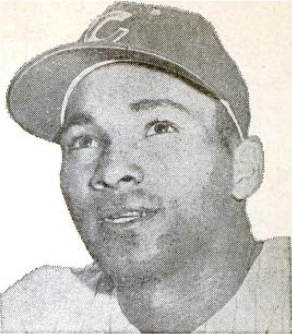
Billy Williams is an American baseball outfielder. Born June 15, 1938, in Whistler. Teams include Fort Worth Cats, Chicago Cubs and Athletics.
Facts
9 facts · 1 confirmed by two sources · 2 cited · 6 from one source
Where this comes from
Papalocal keeps its own record. It started from these sources; what each one said is kept here as it was copied, so a change on their side never changes this page by itself. Tap one to read its version.
What Wikidata says · copied November 19, 2026 · revision 2569465071
- Described as
- American baseball outfielder (born 1938)
- Other names
- Billy Leo Williams
- Born
- June 15, 1938 · 1 reference
- Born in
- Whistler
- Name at birth
- Billy Leo Williams
- Citizen of
- United States
- Occupation
- baseball player · 1 reference
- Teams
- Fort Worth Cats; Chicago Cubs; Athletics
- Sport
- baseball · 1 reference
- Wikipedias with a page
- 12
Wikidata item Q4913471 (wikidata.org/wiki/Q4913471), public domain (CC0). Copied November 19, 2026.
What Wikipedia says · copied November 19, 2026 · revision 1374971945
Billy Leo Williams (born June 15, 1938) is an American former left fielder and coach in Major League Baseball (MLB) who played from 1959 to 1976, almost entirely for the Chicago Cubs. A six-time All-Star, Williams was named the 1961 National League (NL) Rookie of the Year after hitting 25 home runs with 86 runs batted in (RBI). A model of consistent production, he went on to provide the Cubs with at least 20 home runs and 80 RBI every year through 1973, batting over .300, hitting 30 home runs and scoring 100 runs five times each. Along with Ernie Banks and Ron Santo, Williams was one of the central figures in improving the Cubs' fortunes in the late 1960s after the club had spent 20 years in the bottom half of the league standings. His 853 RBI and 2,799 total bases in the 1960s were the most by any left-handed hitter in the major leagues.
In 1970, Williams was the runner-up in voting for the NL Most Valuable Player Award (MVP) after leading the major leagues with 137 runs, 205 hits and 373 total bases, also hitting 42 home runs with 129 RBI, all career highs; excepting his run and home runs totals, each remains the single season team record for left-handed hitters. In 1972, he was again the runner-up in MVP voting after winning the NL batting title with a .333 average, adding 37 home runs and 122 RBI while leading the major leagues in total bases and slugging percentage; in both years, he lost the award to Johnny Bench of the Cincinnati Reds. Williams played 1,117 consecutive games between September 1963 and September 1970, holding the NL record from 1969 to 1983. He was traded to the Oakland Athletics after the 1974 season, becoming a designated hitter in the American League (AL), and contributed 23 home runs and 81 RBI to finally reach the postseason as the team won their fifth consecutive division title.
When he retired, Williams' 426 career home runs and 4,599 total bases each ranked eighth in major league history among left-handed hitters; his 302 home runs as a left fielder trailed only Ralph Kiner in NL history. His 392 home runs, 2,510 hits, 1,353 RBI and 4,262 total bases with the Cubs are all team records for left-handed hitters, as were his 402 doubles until Mark Grace passed him in 1999. He led NL left fielders in assists and double plays four times each, and in putouts and fielding percentage three times each; at the end of his career, he ranked fifth in NL history in games in left field (1,737), and fourth in fielding percentage (.974), sixth in putouts (2,811) and total chances (3,005), and ninth in assists (116) in the NL after 1900. He later became a coach with the Cubs for nearly two decades. Williams was inducted into the National Baseball Hall of Fame in 1987, and was selected as a member of the Cubs All-Century Team in 1999.
- Born, in its opening lines
- June 15, 1938
From the Wikipedia article “Billy Williams” (en.wikipedia.org/wiki/Billy_Williams), by its contributors, under CC BY-SA 4.0 (creativecommons.org/licenses/by-sa/4.0/). Copied November 19, 2026; not changed.
Confirmed Two sources agree. Cited One source, and it names where it got it. One source One source, without a reference of its own. Sources disagree The sources disagree. We show the best-supported value and keep theirs below.
