
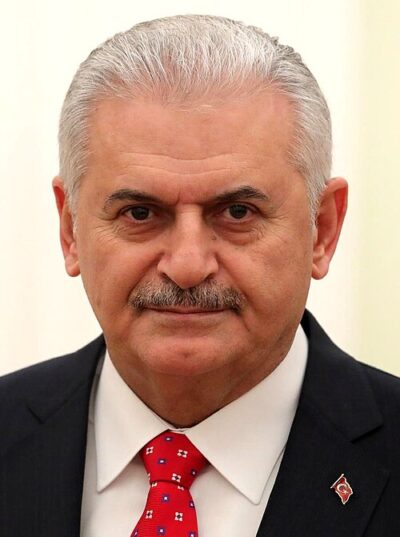
Binali Yıldırım
Binali Yıldırım is a Prime Minister of Turkey. Born December 20, 1955, in Sivas Province. Positions held include Prime Minister of Turkey (2016–2018), member of the Grand National Assembly of Turkey (2002–) and Speaker of the Grand National Assembly of Turkey (2018–2019). Educated at Istanbul Technical University. Awards include State Medal of Honour of the Republic of Turkey.
Facts
18 facts · 1 confirmed by two sources · 3 cited · 14 from one source
Where this comes from
Papalocal keeps its own record. It started from these sources; what each one said is kept here as it was copied, so a change on their side never changes this page by itself. Tap one to read its version.
What Wikidata says · copied November 16, 2026 · revision 2562783227
- Described as
- Prime Minister of Turkey (born 1955)
- Other names
- Binali Yildirim
- Born
- December 20, 1955 · 1 reference
- Born in
- Sivas Province · 1 reference
- Citizen of
- Turkey
- Occupation
- politician · 1 reference; marine engineer; engineer · 1 reference
- Positions held
- Prime Minister of Turkey (2016–2018); member of the Grand National Assembly of Turkey (2002–); Speaker of the Grand National Assembly of Turkey (2018–2019); minister of Transport and Infrastructure (2 times) (2002–2016) · 1 reference
- Political party
- Justice and Development Party
- Education
- Istanbul Technical University
- Awards
- State Medal of Honour of the Republic of Turkey
- Children
- Erkam Yıldırım; Bülent Yıldırım
- Religion
- Islam; Alevism
- Website
- http://www.binaliyildirim.com.tr/
- Wikipedias with a page
- 74
Wikidata item Q863496 (wikidata.org/wiki/Q863496), public domain (CC0). Copied November 16, 2026.
What Wikipedia says · copied November 16, 2026 · revision 1383449146
Binali Yıldırım (born 20 December 1955) is a Turkish politician who served as the 27th and last prime minister of Turkey from 2016 to 2018 and Speaker of the Grand National Assembly from 2018 to 2019. He was leader of the Justice and Development Party (AKP) from 2016 to 2017, then becoming parliamentary leader until 2018.
Yıldırım served as chairman of the board of Directors of Istanbul Fast Ferries Company (İDO) from 1994 to 2000 before being elected as an AKP member of Parliament for Istanbul's first electoral district during the 2002 general election. He was appointed as Minister of Transport by Prime Minister Abdullah Gül and continued in office after Erdoğan became prime minister in 2003. As Transport Minister, he presided over numerous projects such as Marmaray, high-speed rail lines and an expansion in the country's airport and road facilities, though received heavy criticism and calls for his resignation following the Pamukova train derailment in 2004. In 2011, the portfolios of Maritime and Communications were merged with the Ministry of Transport, with Yıldırım becoming the Minister of Transport, Maritime and Communication.
Leaving office in a cabinet reshuffle in 2013, Yıldırım ran as the AKP candidate for Mayor of İzmir in the 2014 local elections but lost to the incumbent Republican People's Party (CHP) candidate Aziz Kocaoğlu. He was appointed as special advisor to Erdoğan in June 2014 and left Parliament in the June 2015 general election due to the AKP's three-term rule for its sitting MPs. He was re-appointed as Transport Minister by Prime Minister Ahmet Davutoğlu after being reelected to Parliament in the November 2015 general election. Following Davutoğlu's resignation as party leader due to a breakdown in relations with President Erdoğan on 5 May 2016, Yıldırım was officially announced as the AKP's next leader by the Central Executive Committee on 19 May and was elected unopposed during the party's 2nd Extraordinary Congress on 22 May 2016. He formed the country's 65th government and became prime minister on 24 May 2016. Factions of the Turkish Army in discontent with his policies attempted to oust him in a failed military coup d'état attempt on 15 July 2016.
As a staunch supporter of Erdoğan, Yıldırım was referred to as a 'low-profile' Prime Minister and expected to spearhead a transition from a parliamentary system of government to an executive presidency, which would delegate greater powers to Erdoğan and the presidency. Following the declared victory of the 'Yes' vote in the 2017 constitutional referendum despite electoral irregularities, Yıldırım resigned as AKP Leader in place of Erdoğan, who was elected as his successor during the 3rd AKP extraordinary Congress on 21 May 2017. Yıldırım was subsequently elected as the AKP's parliamentary leader by 300 votes on 24 May. The office of Prime Minister of Turkey was abolished as a result of the 2017 constitutional referendum.
In 2013, Yıldırım was implicated in a government corruption scandal, with the financial and social activities of his family members also coming under scrutiny. He has caused controversy over his defence of greater government surveillance and comments favouring sex segregation. He was the AKP nominee for Mayor of Istanbul in both the March 2019 and June 2019 Istanbul mayoral elections (the latter of which occurred after the Supreme Election Council annulled the March election), losing both to CHP nominee Ekrem İmamoğlu, to whom he conceded defeat and congratulated following the June 2019 election.
- Born, in its opening lines
- December 20, 1955
From the Wikipedia article “Binali Yıldırım” (en.wikipedia.org/wiki/Binali_Yıldırım), by its contributors, under CC BY-SA 4.0 (creativecommons.org/licenses/by-sa/4.0/). Copied November 16, 2026; not changed.
Confirmed Two sources agree. Cited One source, and it names where it got it. One source One source, without a reference of its own. Sources disagree The sources disagree. We show the best-supported value and keep theirs below.
