
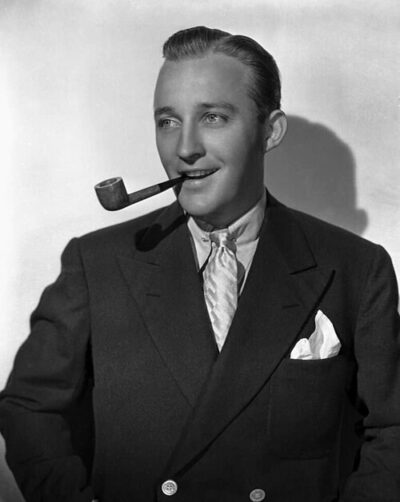
Bing Crosby
Bing Crosby was an American singer and actor. Born May 3, 1903, in Tacoma. Died October 14, 1977, in Alcobendas. Known for White Christmas. Educated at Gonzaga Preparatory School and Gonzaga University. Awards include Peabody Awards, Grammy Lifetime Achievement Award and Academy Award for Best Actor.
Facts
56 facts · 2 confirmed by two sources · 9 cited · 44 from one source · 1 where the sources disagree
What’s different
- Cause of death: we show myocardial infarction (Sources disagree). Wikidata also lists cardioplegia
Where this comes from
Papalocal keeps its own record. It started from these sources; what each one said is kept here as it was copied, so a change on their side never changes this page by itself. Tap one to read its version.
What Wikidata says · copied November 13, 2026 · revision 2565539113
- Described as
- American singer and actor (1903–1977)
- Other names
- Harry Lillis Crosby, Harry Lillis Crosby Jr., Harry Crosby Jr., Harry Crosby
- Born
- May 3, 1903 · 6 references
- Died
- October 14, 1977 · 11 references
- Born in
- Tacoma · 1 reference
- Died in
- Alcobendas · 1 reference
- Buried in
- Holy Cross Cemetery
- Cause of death
- myocardial infarction; cardioplegia
- Name at birth
- Harry Lillis Crosby
- Citizen of
- United States · 1 reference
- Occupation
- singer · 1 reference; actor · 1 reference; television personality; radio personality; film actor · 1 reference; baseball player; television producer; stage actor
- Education
- Gonzaga Preparatory School · 1 reference; Gonzaga University; North Central High School
- Genre
- traditional pop; jazz; easy listening; western music; Western swing; country music
- Instrument
- voice
- Record label
- Decca; Columbia Records; Brunswick Records · 1 reference; RCA Records · 1 reference; RCA Victor; Reprise Records
- Known for
- White Christmas
- Awards
- Peabody Awards; Grammy Lifetime Achievement Award (1962); Academy Award for Best Actor (1945); American Music Award of Merit (1974); World Golf Hall of Fame; Golden Globe Cecil B. DeMille Award (1960); star on Hollywood Walk of Fame · 1 reference
- Spouse
- Kathryn Crosby (1957–1977); Dixie Lee (1930–1952)
- Children
- Lindsay Crosby; Mary Crosby; Nathaniel Crosby; Phillip Crosby; Dennis Crosby; Harry Crosby; Gary Crosby · 1 reference
- Father
- Harry Lowe Crosby · 1 reference
- Mother
- Catherine Helen Harrigan · 1 reference
- Siblings
- Larry Crosby; Bob Crosby
- Nickname
- Bing
- Height
- 1.70 m (5 ft 7 in)
- Website
- https://bingcrosby.com/
- Wikipedias with a page
- 123
Wikidata item Q72984 (wikidata.org/wiki/Q72984), public domain (CC0). Copied November 13, 2026.
What Wikipedia says · copied November 13, 2026 · revision 1384323561
Harry Lillis "Bing" Crosby Jr. (May 3, 1903 – October 14, 1977) was an American singer and actor. One of the first multimedia stars, he was one of the most popular and influential musical artists of the 20th century worldwide. Crosby was a leader in record sales, network radio ratings, and motion picture grosses from 1926 to 1977. He was one of the first global cultural icons. Crosby made over 70 feature films and recorded more than 1,600 songs.
Crosby's early career coincided with recording innovations that allowed him to develop an intimate singing style that influenced many male singers who followed, such as Frank Sinatra, Perry Como, Russ Columbo, Dick Todd, Elvis Presley, and John Lennon. Yank magazine said that Crosby was "the person who had done the most for the morale of overseas servicemen" during World War II. In 1948, American polls declared him the "most admired man alive", ahead of Jackie Robinson and Pope Pius XII. In 1948, Music Digest estimated that Crosby's recordings filled more than half of the 80,000 weekly hours allocated to recorded radio music in North America.
Crosby won the Academy Award for Best Actor for his performance in Going My Way (1944) and was nominated for its sequel, The Bells of St. Mary's (1945), opposite Ingrid Bergman, becoming the first of six actors to be nominated twice for playing the same character. Crosby was the number one box office attraction for five consecutive years from 1944 to 1948. At his screen apex in 1946, Crosby starred in three of the year's five highest-grossing films: The Bells of St. Mary's, Blue Skies, and Road to Utopia. In 1963, he received the first Grammy Global Achievement Award. Crosby is one of 33 people to have three stars on the Hollywood Walk of Fame, in the categories of motion pictures, radio, and audio recording. He was also known for his collaborations with his friend Bob Hope, starring in the Road to ... films from 1940 to 1962. Crosby has been associated with the Christmas season since he starred in Irving Berlin's musical film Holiday Inn and also sang "White Christmas" in the film of the same name.
Crosby influenced the development of the post–World War II recording industry. After seeing a demonstration of a German broadcast quality reel-to-reel tape recorder brought to the United States by John T. Mullin, Crosby invested $50,000 in the California electronics company Ampex to build copies. He then persuaded ABC to allow him to tape his shows and became the first performer to prerecord his radio shows and master his commercial recordings onto magnetic tape. Through audio recordings, Crosby produced his radio programs with the same directorial tools and craftsmanship (editing, retaking, rehearsal, time shifting) used in motion picture production, a practice that became the industry standard. In addition to his work with early audio tape recording, Crosby helped finance the development of videotape, bought television stations, bred racehorses, and co-owned the Pittsburgh Pirates baseball team, during which time the team won the World Series twice (1960 and 1971).
- Born, in its opening lines
- May 3, 1903
- Died, in its opening lines
- October 14, 1977
From the Wikipedia article “Bing Crosby” (en.wikipedia.org/wiki/Bing_Crosby), by its contributors, under CC BY-SA 4.0 (creativecommons.org/licenses/by-sa/4.0/). Copied November 13, 2026; not changed.
Confirmed Two sources agree. Cited One source, and it names where it got it. One source One source, without a reference of its own. Sources disagree The sources disagree. We show the best-supported value and keep theirs below.
