
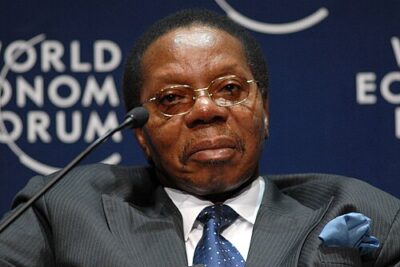
Bingu wa Mutharika
Bingu wa Mutharika was a Malawi politician and economist. Born February 24, 1934, in Thyolo. Died April 5, 2012, in Lilongwe. Positions held include President of Malawi (2004–2012) and Chairperson of the African Union (2010–2011). Educated at University of Delhi and California Miramar University. Awards include Order of the Lion.
Facts
21 facts · 2 confirmed by two sources · 7 cited · 12 from one source
Where this comes from
Papalocal keeps its own record. It started from these sources; what each one said is kept here as it was copied, so a change on their side never changes this page by itself. Tap one to read its version.
What Wikidata says · copied November 16, 2026 · revision 2567960532
- Described as
- Malawi politician and economist (1934-2012)
- Other names
- Bingu Wa Mutharika, Brightson Webster Ryson Thom Mutharika, Bingu Mutharika
- Born
- February 24, 1934 · 1 reference
- Died
- April 5, 2012 · 3 references
- Born in
- Thyolo
- Died in
- Lilongwe · 1 reference
- Cause of death
- myocardial infarction
- Citizen of
- Malawi · 2 references
- Occupation
- economist · 1 reference; politician · 1 reference; minister · 1 reference
- Positions held
- President of Malawi (2004–2012); Chairperson of the African Union (2010–2011)
- Political party
- United Democratic Front
- Worked for
- United Nations
- Education
- University of Delhi; California Miramar University; Delhi School of Economics; Dedza Secondary School · 1 reference
- Awards
- Order of the Lion
- Spouse
- Callista Chimombo
- Siblings
- Peter Mutharika · 1 reference
- Religion
- Catholicism
- Wikipedias with a page
- 60
Wikidata item Q181586 (wikidata.org/wiki/Q181586), public domain (CC0). Copied November 16, 2026.
What Wikipedia says · copied November 16, 2026 · revision 1379344638
Bingu wa Mutharika ( moot-ə-REE-kə; born Brightson Webster Ryson Thom; 24 February 1934 – 5 April 2012) was a Malawian politician and economist who served as the third president of Malawi from 2004 until his death in 2012 and brother of Malawian President Peter Mutharika. A member of the Democratic Progressive Party (DPP), he served as the party's president from 2005 to 2012, and was also the eighth chairperson of the African Union from 2010 to 2011.
Born in Thyolo District, Mutharika was educated in India and the United States in the 1960s, graduating from the University of Delhi with a master of Arts degree in economics. Mutherika later joined the civil service where he served as an administrative officer in the Governments of Malawi and Zambia, and also worked at the World Bank as a Loans Officer and at the United Nations Economic Commission of Africa, as Director of Trade and Development Finance and as Secretary General of the Common Market for Eastern and Southern Africa (COMESA). In 2004, President Bakili Muluzi nominated Mutherika for the presidency as the candidate for the United Democratic Front (UDF) in the 2004 presidential election, where Mutherika subsequently won and was elected president, defeating John Tembo of the Malawi Congress Party (MCP).
During Mutharika's first term, Malawi's economy experienced steady growth, inflation fell, and the poverty rate declined. In 2005, Mutharika left the UDF following a dispute and founded the Democratic Progressive Party (DPP). A fertiliser subsidy program was also introduced that significantly boosted maize production and improved food security. Democratic governance also increased during this time. All of this won Mutharika public support, especially in the rural areas, and by 2009, he became one of Africa's most popular presidents. In 2009, Mutharika was re-elected president, defeating John Tembo again.
Mutharika's second term was marked by democratic backsliding, declining popularity, economic mismanagement, and increased political infighting. While the economic growth of Mutharika's first term continued early on, the economy started to stagnate and eventually decline. The cost of living in the country started rising, as well as shortages of fuel, electricity, water, and foreign exchange, along with increasing tension with international donors. Mutharika also faced criticism for increasingly authoritarian governance and behaviour. Tensions in the DPP also grew between Mutharika and some party members, most notably his vice president, Joyce Banda, whom Mutharika tried firing many times from 2010, which eventually grew after she refused to endorse Mutharika's brother, Peter, to succeed him. Banda was eventually kicked out of the party and she founded the People's Party. In 2011, public discontent with the government grew and protests occurred due to the cost of living crisis, which Mutharika used security forces to crack down, allegedly killing 19 and injuring 58.
In April 2012, Mutharika died after a short illness, thus becoming the first Malawian head of state to die in office. After his death, Banda was sworn in as president with the support of the military according to the law. While Mutharika is praised for strengthening democratic governance and growing the economy earlier in his presidency, he is also criticised for his increasing authoritarian style of governance, suppressing of dissents and for the economic crisis later on.
- Born, in its opening lines
- February 24, 1934
- Died, in its opening lines
- April 5, 2012
From the Wikipedia article “Bingu wa Mutharika” (en.wikipedia.org/wiki/Bingu_wa_Mutharika), by its contributors, under CC BY-SA 4.0 (creativecommons.org/licenses/by-sa/4.0/). Copied November 16, 2026; not changed.
Confirmed Two sources agree. Cited One source, and it names where it got it. One source One source, without a reference of its own. Sources disagree The sources disagree. We show the best-supported value and keep theirs below.
