
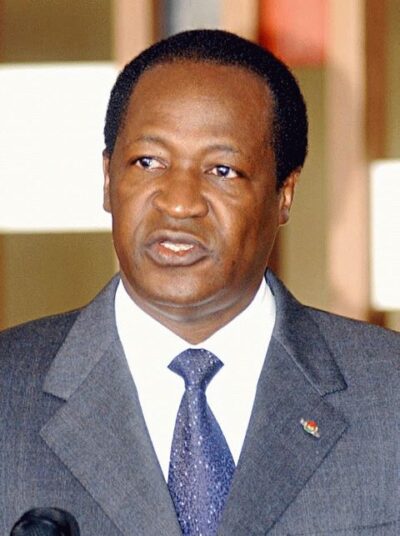
Blaise Compaoré
Blaise Compaoré is a President of Burkina Faso from 1987 to 2014. Born February 3, 1951, in Ouagadougou. Positions held include chairperson of the Organisation of African Unity (1998–1999), president of Burkina Faso (1987–2014) and Minister of National Defence of Bukina Faso (2011–2014). Awards include National Order of Burkina Faso, National Order of Merit and Gold Olympic Order.
Facts
21 facts · 1 confirmed by two sources · 11 cited · 9 from one source
Where this comes from
Papalocal keeps its own record. It started from these sources; what each one said is kept here as it was copied, so a change on their side never changes this page by itself. Tap one to read its version.
What Wikidata says · copied November 16, 2026 · revision 2563056853
- Described as
- President of Burkina Faso from 1987 to 2014
- Other names
- Blaise Compaore
- Born
- February 3, 1951 · 3 references
- Born in
- Ouagadougou · 1 reference
- Citizen of
- Republic of Upper Volta · 1 reference; Burkina Faso · 9 references; Ivory Coast · 6 references
- Occupation
- politician · 1 reference; statesperson · 2 references
- Positions held
- chairperson of the Organisation of African Unity (1998–1999) · 2 references; president of Burkina Faso (1987–2014) · 2 references; Minister of National Defence of Bukina Faso (2011–2014); Chairperson of ECOWAS (2 times) (1990–2008)
- Political party
- Congress for Democracy and Progress (1996–); Union of Burkinabé Communists (1984–1989) · 2 references; Organization for Popular Democracy – Labour Movement (1989–1996) · 1 reference
- Member of
- Académie des sciences d'outre-mer
- Awards
- National Order of Burkina Faso; National Order of Merit; Gold Olympic Order (1997)
- Spouse
- Chantal Compaoré
- Religion
- Catholicism
- Military rank
- captain · 2 references
- Wikipedias with a page
- 66
Wikidata item Q57324 (wikidata.org/wiki/Q57324), public domain (CC0). Copied November 16, 2026.
What Wikipedia says · copied November 16, 2026 · revision 1378593796
Blaise Compaoré (French: [blɛz kɔ̃paɔʁe]; born 3 February 1951) is a Burkinabé politician and former military officer who served as the second president of Burkina Faso from 1987 until his government was overthrown in 2014. The longest-serving president in Burkinabé history, Compaoré previously served as the Minister of Justice from 1985 to 1987.
Born and raised in Ziniaré, Compaoré joined the Burkina Faso Armed Forces (then known as Upper Voltan Armed Forces) at the age of 20 in 1971 where he rose through the ranks. Compaoré was a close associate of his predecessor and the country's first President, Thomas Sankara, who appointed Compaoré as Minister of Justice in 1985. The pair were seen as close allies until Compaoré led a coup d'état during which Sankara was killed two years later in 1987. Aged 36 when assuming office, Compaoré was the third youngest Burkinabé president, after Ibrahim Traoré and Sankara.
After taking office, he introduced a policy of 'rectification', overturning the leftist policies pursued by Sankara. In 1989, he founded the Organization for Popular Democracy – Labour Movement (ODP–MT), which merged with twelve other political parties to create the Congress for Democracy and Progress (CDP) in 1996. Compaoré won elections that were not considered free and fair in 1991, 1998, 2005, and 2010. Compaoré's attempt to amend the constitution to extend his 27-year term led to the 2014 Burkinabé uprising, leaving him to resign and flee to the Ivory Coast. In April 2022, he was sentenced in absentia to life imprisonment after being found guilty of complicity in Sankara’s murder.
Compaoré's legacy is complex, with some crediting him with stability and development, while others criticize his records on human rights, corruption and wealth inequality.
- Born, in its opening lines
- February 3, 1951
From the Wikipedia article “Blaise Compaoré” (en.wikipedia.org/wiki/Blaise_Compaoré), by its contributors, under CC BY-SA 4.0 (creativecommons.org/licenses/by-sa/4.0/). Copied November 16, 2026; not changed.
Confirmed Two sources agree. Cited One source, and it names where it got it. One source One source, without a reference of its own. Sources disagree The sources disagree. We show the best-supported value and keep theirs below.
