
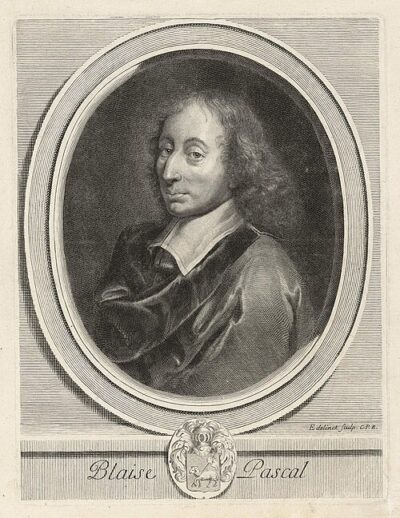
Blaise Pascal
Blaise Pascal was a French mathematician, physicist, inventor, writer, and Christian philosopher. Born June 19, 1623, in birth house of Blaise Pascal. Died August 19, 1662, in Paris. Known for Pensées, Lettres provinciales and Traité des Sinus du Quart de Cercle.
Facts
37 facts · 2 confirmed by two sources · 22 cited · 13 from one source
Where this comes from
Papalocal keeps its own record. It started from these sources; what each one said is kept here as it was copied, so a change on their side never changes this page by itself. Tap one to read its version.
What Wikidata says · copied November 16, 2026 · revision 2569138331
- Described as
- French mathematician, physicist, inventor, writer, and Christian philosopher (1623–1662)
- Other names
- Amos Dettonville, Paskal Blez, Dettonville, Pascal, Louis de Montalte
- Born
- June 19, 1623 · 14 references
- Died
- August 19, 1662 · 10 references
- Born in
- birth house of Blaise Pascal · 1 reference
- Died in
- Paris · 4 references
- Buried in
- Saint-Étienne-du-Mont · 2 references
- Citizen of
- Kingdom of France · 1 reference
- Occupation
- mathematician · 4 references; philosopher · 4 references; theologian · 2 references; physicist · 3 references; writer · 4 references; moralist · 1 reference; statistician · 1 reference
- Member of
- Académie Le Pailleur
- Known for
- Pensées; Lettres provinciales; Traité des Sinus du Quart de Cercle; Récit de la grande expérience de l'équilibre des liqueurs 1648; Écrits sur la grâce; Traité du triangle arithmétique; New experiments with the vacuum; Pascal's pyramid; Pascal's Wager; triangle of Pascal
- Field
- probability theory · 1 reference; mathematics · 1 reference; literature · 1 reference; physics · 1 reference
- Father
- Étienne Pascal · 1 reference
- Mother
- Antoinette Begon · 1 reference
- Siblings
- Jacqueline Pascal · 1 reference; Gilberte Périer · 1 reference
- Religion
- Catholicism; Jansenism · 1 reference
- Lived in
- Clermont-Ferrand (1623–1631) · 1 reference; Paris (2 times) (1631–1662) · 1 reference; Rouen (1640–1647) · 1 reference
- Wikipedias with a page
- 196
Wikidata item Q1290 (wikidata.org/wiki/Q1290), public domain (CC0). Copied November 16, 2026.
What Wikipedia says · copied November 16, 2026 · revision 1385048641
Blaise Pascal (19 June 1623 – 19 August 1662) was a French mathematician, physicist, inventor, philosopher, and Catholic writer.
Pascal was a child prodigy who was educated by his father Étienne Pascal, a tax collector in Rouen. His earliest mathematical work was on projective geometry; he wrote a significant treatise on the subject of conic sections at the age of 16. He later corresponded with Pierre de Fermat on probability theory, strongly influencing the development of modern economics and social science. In 1642, he started some pioneering work on calculating machines (called Pascal's calculators and later Pascalines), establishing him as one of the first two inventors of the mechanical calculator.
Like his contemporary René Descartes, Pascal was also a pioneer in the natural and applied sciences. Pascal wrote in defence of the scientific method and produced several controversial results. He made important contributions to the study of fluids, and clarified the concepts of pressure and vacuum by generalising the work of Evangelista Torricelli. The SI unit for pressure is named for Pascal. Following Torricelli and Galileo Galilei, in 1647, he rebutted the likes of Aristotle and Descartes who insisted that nature abhors a vacuum.
He is also credited as the inventor of modern public transportation, having established the carrosses à cinq sols, the first modern public transport service, shortly before his death in 1662.
In 1646, he and his sister Jacqueline identified with the religious movement within Catholicism known by its detractors as Jansenism. Following a religious experience in late 1654, he began writing influential works on philosophy and theology. His two most famous works date from this period: the Lettres provinciales and the Pensées, the former set in the conflict between Jansenists and Jesuits. The latter contains Pascal's wager, known in the original as the Discourse on the Machine, a fideistic probabilistic argument for why one should believe in God. In that year, he also wrote an important treatise on the arithmetical triangle. Between 1658 and 1659, he wrote on the cycloid and its use in calculating the volume of solids. Following several years of illness, Pascal died in Paris at the age of 39.
- Born, in its opening lines
- June 19, 1623
- Died, in its opening lines
- August 19, 1662
From the Wikipedia article “Blaise Pascal” (en.wikipedia.org/wiki/Blaise_Pascal), by its contributors, under CC BY-SA 4.0 (creativecommons.org/licenses/by-sa/4.0/). Copied November 16, 2026; not changed.
Confirmed Two sources agree. Cited One source, and it names where it got it. One source One source, without a reference of its own. Sources disagree The sources disagree. We show the best-supported value and keep theirs below.
