
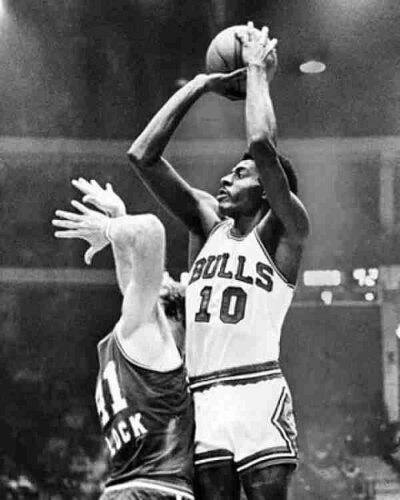
Bob Love
Bob Love was an American basketball player. Born December 8, 1942, in Bastrop. Died November 18, 2024, in Chicago. Teams include Brooklyn Nets (1976–1977), Milwaukee Bucks (–1968) and Seattle SuperSonics (–1977). Educated at Southern University.
Facts
17 facts · 2 confirmed by two sources · 4 cited · 11 from one source
Where this comes from
Papalocal keeps its own record. It started from these sources; what each one said is kept here as it was copied, so a change on their side never changes this page by itself. Tap one to read its version.
What Wikidata says · copied November 16, 2026 · revision 2544741162
- Described as
- American basketball player (1942–2024)
- Other names
- Robert Love
- Born
- December 8, 1942 · 1 reference
- Died
- November 18, 2024 · 1 reference
- Born in
- Bastrop
- Died in
- Chicago
- Cause of death
- cancer · 1 reference
- Name at birth
- Robert Earl Love
- Citizen of
- United States
- Occupation
- basketball player · 2 references; motivational speaker
- Education
- Southern University · 1 reference
- Teams
- Brooklyn Nets (1976–1977); Milwaukee Bucks (–1968); Seattle SuperSonics (–1977); Chicago Bulls (1968–1976); Cincinnati Royals (1966–1968)
- Sport
- basketball · 2 references
- Height
- 2.03 m (6 ft 8 in) · 1 reference
- Wikipedias with a page
- 21
Wikidata item Q616049 (wikidata.org/wiki/Q616049), public domain (CC0). Copied November 16, 2026.
What Wikipedia says · copied November 16, 2026 · revision 1385707639
Robert Earl Love (December 8, 1942 – November 18, 2024) was an American professional basketball player who spent the prime of his career with the National Basketball Association's (NBA) Chicago Bulls. He is also remembered for his efforts in striving to overcome a severe stutter that had plagued him for decades; taking him from jobs as a dishwasher and busboy after retiring from the NBA, to ultimately becoming an executive with the Bulls (as a community affairs director and good will ambassador) and Nordstrom (managing health and sanitation for a 70-restaurant chain); and being a motivational speaker to thousands of children.
Love did not become a starter in the NBA until he was 27-years old, with the 1969–70 Chicago Bulls. Over a seven-season period with the Bulls from 1969 to 1976, the ambidextrous Love averaged over 21 points per game in six consecutive seasons, led the Bulls in scoring in six consecutive seasons, was an NBA All-Star three times, second-team All-NBA twice, and a second-team NBA All-Defensive Team selection three times. Love averaged between six and 8.7 rebounds per game during that same time period. He led the Bulls in minutes played in multiple seasons, and is in the top-five Bulls players all-time in career minutes played per game and scoring average. In 47 playoff games with Bulls, Love averaged nearly 44 minutes and 23 points per game. He was a member of the Chicago Bulls Ring of Honor's inaugural class in 2023. He was the second Bulls player to have his number retired.
Love attended Southern University, where he played four years of varsity basketball. He averaged double-doubles as a sophomore (22.6 points and 12.3 rebounds per game), junior (25.6 points and 18 rebounds per game), and as a senior (30.6 points and 18.2 rebounds per game). He was an NAIA All-American as a junior (third-team) and senior (first-team), and was first team All-Southwestern Athletic Conference (SWAC) for three consecutive seasons. He was the selected as the SWAC's most valuable player in 1965. Southern retired his number in 2012.
Love was nicknamed "Butterbean" because of his fondness for the legume in childhood, and the name went with him throughout his life.
- Born, in its opening lines
- December 8, 1942
- Died, in its opening lines
- November 18, 2024
From the Wikipedia article “Bob Love” (en.wikipedia.org/wiki/Bob_Love), by its contributors, under CC BY-SA 4.0 (creativecommons.org/licenses/by-sa/4.0/). Copied November 16, 2026; not changed.
Confirmed Two sources agree. Cited One source, and it names where it got it. One source One source, without a reference of its own. Sources disagree The sources disagree. We show the best-supported value and keep theirs below.
