
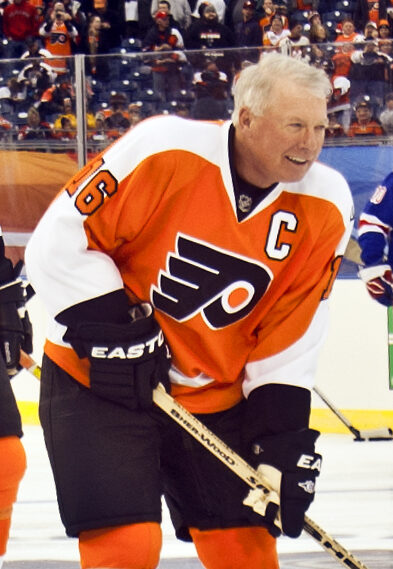
Bobby Clarke
Bobby Clarke is a Canadian ice hockey player. Born August 13, 1949, in Flin Flon. Teams include Philadelphia Flyers. Awards include Officer of the Order of Canada, Hart Memorial Trophy (3 times) and Bill Masterton Memorial Trophy.
Facts
15 facts · 1 confirmed by two sources · 7 cited · 7 from one source
Where this comes from
Papalocal keeps its own record. It started from these sources; what each one said is kept here as it was copied, so a change on their side never changes this page by itself. Tap one to read its version.
What Wikidata says · copied November 16, 2026 · revision 2529083644
- Described as
- Canadian ice hockey player
- Other names
- Bob Clarke, Robert Earle Clarke
- Born
- August 13, 1949
- Born in
- Flin Flon
- Citizen of
- Canada
- Occupation
- ice hockey player · 1 reference
- Teams
- Philadelphia Flyers
- Sport
- ice hockey · 1 reference
- Awards
- Officer of the Order of Canada; Hart Memorial Trophy (3 times) (1973, 1975, 1976) · 1 reference; Bill Masterton Memorial Trophy (1972) · 2 references; Frank J. Selke Trophy (1983) · 2 references; Lester B. Pearson Award (1973) · 2 references; Canada's Sports Hall of Fame; Hockey Hall of Fame; Lester Patrick Trophy (1980) · 1 reference
- Height
- 1.79 m (5 ft 10 in)
- Wikipedias with a page
- 20
Wikidata item Q888504 (wikidata.org/wiki/Q888504), public domain (CC0). Copied November 16, 2026.
What Wikipedia says · copied November 16, 2026 · revision 1380807648
Robert Earle Clarke (born August 13, 1949) is a Canadian former professional ice hockey centre who played his entire 15-year National Hockey League (NHL) career with the Philadelphia Flyers and is currently an executive with the team. Clarke is acknowledged by some as being one of the greatest hockey players and captains of all time. He was captain of the Flyers from 1973 to 1979, winning the Stanley Cup with them in both 1974 and 1975. He was again captain of the Flyers from 1982 to 1984 before retiring. Clarke had three 100-point seasons, twice leading the league in assists, and was selected to play in nine NHL All-Star Games. He also won the Frank J. Selke Trophy in 1983, as the league's best defensive forward. A three-time Hart Trophy winner and 1987 Hockey Hall of Fame inductee, Clarke was rated number 24 on The Hockey News' list of The Top 100 NHL Players of All-Time in 1998. In 2017, Clarke was named one of the "100 Greatest NHL Players" in history.
Upon retiring at the end of the 1983–84 season with 358 goals and 852 assists for a total of 1,210 points in 1,144 career games, he immediately became general manager of the Flyers. He spent 19 of the following 23 seasons as a general manager of the Flyers, also briefly serving as general manager of the Minnesota North Stars and Florida Panthers, reaching the Stanley Cup Final three times with the Flyers and once with Minnesota. His time as an NHL general manager had its share of controversy, perhaps none greater than the rift between him and star player Eric Lindros during the late 1990s and early 2000s. He resigned from the general manager position less than a month into the 2006–07 season and is currently the Flyers' senior vice president.
- Born, in its opening lines
- August 13, 1949
From the Wikipedia article “Bobby Clarke” (en.wikipedia.org/wiki/Bobby_Clarke), by its contributors, under CC BY-SA 4.0 (creativecommons.org/licenses/by-sa/4.0/). Copied November 16, 2026; not changed.
Confirmed Two sources agree. Cited One source, and it names where it got it. One source One source, without a reference of its own. Sources disagree The sources disagree. We show the best-supported value and keep theirs below.
