
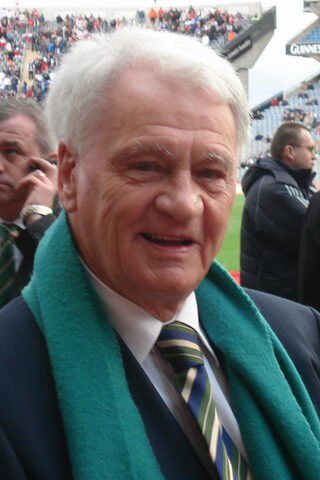
Bobby Robson
Bobby Robson was an English association football player and manager. Born February 18, 1933, in Sacriston. Died July 31, 2009, in Beamish. Teams include Fulham F.C. (2 times) (1950–1967), England men's national association football team (1957–1962) and West Bromwich Albion F.C. (1956–1962). Awards include Commander of the Order of the British Empire and Knight Bachelor.
Facts
18 facts · 2 confirmed by two sources · 1 cited · 15 from one source
Where this comes from
Papalocal keeps its own record. It started from these sources; what each one said is kept here as it was copied, so a change on their side never changes this page by itself. Tap one to read its version.
What Wikidata says · copied November 16, 2026 · revision 2555278620
- Described as
- English association football player and manager (1933-2009)
- Other names
- Robert William Robson
- Born
- February 18, 1933 · 3 references
- Died
- July 31, 2009 · 2 references
- Born in
- Sacriston
- Died in
- Beamish
- Cause of death
- lung cancer
- Name at birth
- Robert William Robson
- Citizen of
- United Kingdom
- Occupation
- association football player; autobiographer; association football coach · 2 references
- Teams
- Fulham F.C. (2 times) (1950–1967); England men's national association football team (1957–1962); West Bromwich Albion F.C. (1956–1962); Vancouver Royals (1967–1968)
- Sport
- association football
- Awards
- Commander of the Order of the British Empire; Knight Bachelor
- Field
- association football
- Wikipedias with a page
- 62
Wikidata item Q189587 (wikidata.org/wiki/Q189587), public domain (CC0). Copied November 16, 2026.
What Wikipedia says · copied November 16, 2026 · revision 1383305008
Sir Robert William Robson (18 February 1933 – 31 July 2009) was an English football player and coach. His career included periods playing for and later managing the England national team and being a UEFA Cup-winning manager at Ipswich Town.
Robson's professional playing career as an inside forward spanned nearly 20 years, during which he played for three clubs: Fulham, West Bromwich Albion, and, briefly, Vancouver Royals. He also made 20 appearances for England, scoring four goals. After his playing career, he found success as both a club and international manager, winning league championships in both the Netherlands and Portugal, earning trophies in England and Spain, and taking England to the semi-finals of the 1990 FIFA World Cup, which remained the national team's best run in a World Cup since 1966 until they reached the semi-finals of the 2018 FIFA World Cup. His last management role was as a mentor to the manager of the Republic of Ireland national team, while his final official club job was at boyhood club Newcastle United, which he left in 2004. He held several managerial positions outside of England, most notably one year at Barcelona in 1996–97, as well as stints at PSV, Sporting CP and Porto. He was the last English manager to win a European competition in 1997.
Robson was created a Knight Bachelor in 2002, was inducted as a member of the English Football Hall of Fame in 2003, and was the honorary president of Ipswich Town. From 1991 onwards, he had recurrent medical problems with cancer, and in March 2008, put his name and efforts into the Sir Bobby Robson Foundation, a cancer research charity which had raised over £12 million as of March 2018. In August 2008, his lung cancer was confirmed to be terminal; he said, "My condition is described as static and has not altered since my last bout of chemotherapy... I am going to die sooner rather than later. But then everyone has to go sometime and I have enjoyed every minute." He died just under a year later, in July 2009.
- Born, in its opening lines
- February 18, 1933
- Died, in its opening lines
- July 31, 2009
From the Wikipedia article “Bobby Robson” (en.wikipedia.org/wiki/Bobby_Robson), by its contributors, under CC BY-SA 4.0 (creativecommons.org/licenses/by-sa/4.0/). Copied November 16, 2026; not changed.
Confirmed Two sources agree. Cited One source, and it names where it got it. One source One source, without a reference of its own. Sources disagree The sources disagree. We show the best-supported value and keep theirs below.
