
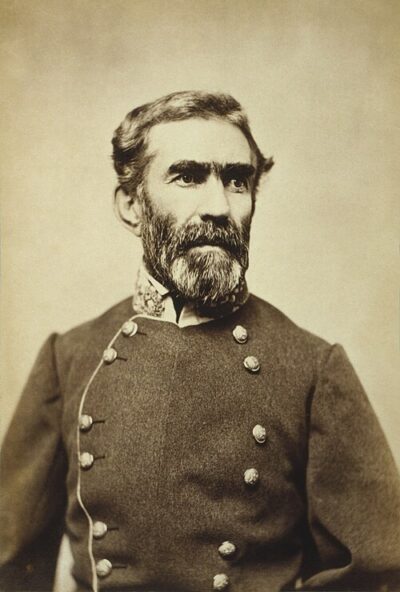
Braxton Bragg
Braxton Bragg was a Confederate Army general. Born March 22, 1817, in Warrenton. Died September 27, 1876, in Galveston. Educated at United States Military Academy.
Facts
14 facts · 2 confirmed by two sources · 2 cited · 10 from one source
Where this comes from
Papalocal keeps its own record. It started from these sources; what each one said is kept here as it was copied, so a change on their side never changes this page by itself. Tap one to read its version.
What Wikidata says · copied November 15, 2026 · revision 2548152940
- Described as
- Confederate Army general (1817–1876)
- Born
- March 22, 1817 · 4 references
- Died
- September 27, 1876 · 4 references
- Born in
- Warrenton
- Died in
- Galveston
- Buried in
- Magnolia Cemetery
- Citizen of
- United States
- Occupation
- army officer; military officer · 1 reference; soldier · 1 reference
- Education
- United States Military Academy
- Siblings
- Thomas Bragg
- Military branch
- United States Army · 1 reference; Confederate States Army
- Military rank
- general
- Wikipedias with a page
- 31
Wikidata item Q380562 (wikidata.org/wiki/Q380562), public domain (CC0). Copied November 15, 2026.
What Wikipedia says · copied November 15, 2026 · revision 1380665849
Braxton Bragg (March 22, 1817 – September 27, 1876) was an American military officer during the Second Seminole War and Mexican–American War. He later served as a Confederate general in the American Civil War, seeing action in the western theater. His most important role was as the commander of the Army of Mississippi, later renamed the Army of Tennessee, from June 1862 until December 1863.
Bragg, a native of Warrenton, North Carolina, was educated at West Point and became an artillery officer. He served in Florida and then received three brevet promotions for distinguished service in the Mexican–American War, most notably the Battle of Buena Vista. He resigned from the U.S. Army in 1856 to become a sugar plantation owner in Louisiana. At the start of the Civil War, Bragg trained soldiers in the Gulf Coast region. He was a corps commander at the Battle of Shiloh, where he launched several costly and unsuccessful frontal assaults but nonetheless was commended for his conduct and bravery.
In June 1862, Bragg was elevated to command the Army of Mississippi (later known as the Army of Tennessee). He and Brigadier General Edmund Kirby Smith attempted an invasion of Kentucky in 1862, but Bragg retreated following a minor tactical victory at the Battle of Perryville in October. In December, at Murfreesboro, Tennessee, he fought the Battle of Stones River against the Army of the Cumberland under Major General William Rosecrans. This bloody and inconclusive battle ended with his retreat. After months without significant fighting, Bragg was outmaneuvered by Rosecrans in the Tullahoma campaign in June 1863, causing him to surrender Middle Tennessee to the Union. Bragg retreated to Chattanooga but evacuated it in September as Rosecrans' troops entered Georgia. Later that month, with the assistance of Confederate forces from the eastern theater under James Longstreet, Bragg was able to defeat Rosecrans at the Battle of Chickamauga, the bloodiest battle in the western theater, and the only significant Confederate victory therein. Bragg forced Rosecrans back into Tennessee, but was criticized for the heavy casualties his army suffered and for not mounting an effective pursuit. In November, Bragg's army was routed by Major General Ulysses S. Grant in the Battles for Chattanooga and pushed back to Georgia. Confederate president Jefferson Davis subsequently relieved Bragg of command, recalling him to Richmond as his chief military advisor. Bragg briefly returned to the field as a corps commander near the war's end during the Carolinas campaign.
Bragg is generally considered among the worst generals of the Civil War. Most of the battles he engaged in ended in defeat. Bragg was extremely unpopular with both the officers and ordinary men under his command, who criticized him for numerous perceived faults, including poor battlefield strategy, a quick temper, and overzealous discipline. Bragg has a generally poor reputation with historians, though some point towards the failures of Bragg's subordinates, especially Major General and former bishop Leonidas Polk—a close ally of Davis and known enemy of Bragg—as more significant factors in the many Confederate defeats under Bragg's command. The losses suffered by Bragg's forces are cited as highly consequential to the ultimate defeat of the Confederate States of America.
- Born, in its opening lines
- March 22, 1817
- Died, in its opening lines
- September 27, 1876
From the Wikipedia article “Braxton Bragg” (en.wikipedia.org/wiki/Braxton_Bragg), by its contributors, under CC BY-SA 4.0 (creativecommons.org/licenses/by-sa/4.0/). Copied November 15, 2026; not changed.
Confirmed Two sources agree. Cited One source, and it names where it got it. One source One source, without a reference of its own. Sources disagree The sources disagree. We show the best-supported value and keep theirs below.
