
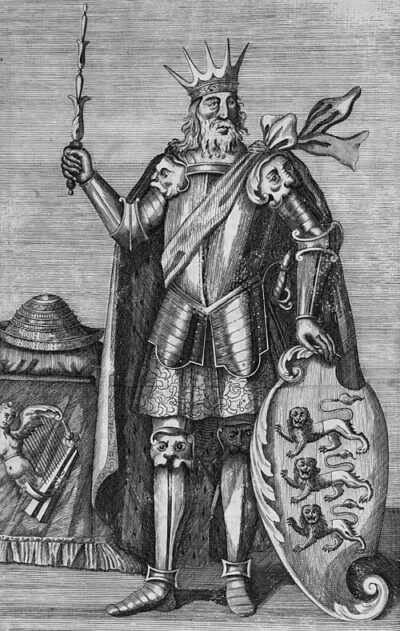
Brian Boru
Brian Boru was a High King of Ireland. Born 941, in Killaloe. Died April 23, 1014, in Clontarf. Positions held include High King of Ireland (1002–1014) and King of Munster (978–1014).
Facts
20 facts · 2 confirmed by two sources · 6 cited · 12 from one source
Where this comes from
Papalocal keeps its own record. It started from these sources; what each one said is kept here as it was copied, so a change on their side never changes this page by itself. Tap one to read its version.
What Wikidata says · copied November 16, 2026 · revision 2557822685
- Described as
- High King of Ireland
- Other names
- Brian Bóruma, Brian Bóruma mac Cennetig, High King of Ireland, Brian Boroihme
- Born
- 941 · 1 reference
- Died
- April 23, 1014
- Born in
- Killaloe
- Died in
- Clontarf
- Buried in
- St Patrick's Cathedral, Armagh
- Citizen of
- Kingdom of Munster
- Positions held
- High King of Ireland (1002–1014); King of Munster (978–1014)
- Spouse
- Gormflaith ingen Murchada · 1 reference; Mor (?) · 1 reference; Echrad (?) · 1 reference; Dub Chablaigh ingen Cathal · 1 reference
- Children
- Donnchad mac Briain · 1 reference; Tadc mac Briain · 1 reference; Sláine ingen Briain; Murchad mac Briain · 1 reference; Dearbforgail (?) · 1 reference
- Father
- Cennétig mac Lorcáin · 1 reference
- Mother
- Bé Binn inion Urchadh · 1 reference
- Religion
- Catholicism
- Wikipedias with a page
- 41
Wikidata item Q272498 (wikidata.org/wiki/Q272498), public domain (CC0). Copied November 16, 2026.
What Wikipedia says · copied November 16, 2026 · revision 1384095586
Brian Boru (Middle Irish: Brian Bóruma mac Cennétig; modern Irish: Brian Bóramha; c. 941 – 23 April 1014) was the High King of Ireland from 1002 to 1014. He ended the domination of the High Kingship of Ireland by the Uí Néill dynasty and is responsible for ending Viking invasions of Ireland. Brian Boru is mentioned in the Annals of Inisfallen and in Chronicon Scotorum as "Brian mac Cennétig" (Brian, son of Cennétig). The name Brian of Bóruma or Brian Boru was given to him posthumously. Brian built on the achievements of his father, Cennétig mac Lorcain, and especially his elder brother, Mathgamain. Brian first made himself king of Munster, then subjugated Leinster, eventually becoming High King of Ireland. He was the founder of the O'Brien dynasty, and is widely regarded as one of the most successful and unifying monarchs in medieval Ireland.
With a population of under 500,000 people, Ireland had over 150 kings, with greater or lesser domains. The Uí Néill king Máel Sechnaill mac Domnaill, abandoned by his northern kinsmen of the Cenél nEógain and Cenél Conaill, acknowledged Brian as High King at Athlone in 1002. In the decade that followed, Brian campaigned against the northern Uí Néill, who refused to accept his claims; against Leinster, where resistance was frequent; and against the Norse-Gaelic Kingdom of Dublin. Brian was described in the Annals of Ulster as ardrí Gaidhel Erenn & Gall & Bretan, August iartair tuaiscirt Eorpa uile (High King of the Gaels of Ireland and the Norse foreigners and the Britons, Augustus of all north-western Europe), the only Irish king to receive that distinction in the annals.
Brian's hard-won authority was seriously challenged in 1013 when his ally Máel Sechnaill was attacked by the Cenél nEógain king Flaithbertach Ua Néill, with the Ulstermen as his allies. This was followed by further attacks on Máel Sechnaill by the Germanic Norsemen of Dublin under their Norse king Sigtrygg Silkbeard and the Leinstermen led by Máel Mórda mac Murchada. Brian campaigned against these enemies in 1013. In 1014, his armies confronted the armies of Leinster and Dublin. In the resulting Battle of Clontarf Brian was killed; nonetheless, his army was victorious against the Leinstermen and Norsemen. The battle is widely lauded as a pivotal moment in Irish history, and is well known in popular memory.
Brian was well regarded by contemporary chroniclers. The Norse-Gaels and Scandinavians also produced works mentioning Brian, including Njal's Saga, the Orkneyinga Saga, and the now-lost Brian's Saga. Brian's war against Máel Mórda and Sigtrygg was to be inextricably connected with his complicated marital relations, in particular his marriage to Gormlaith, Máel Mórda's sister and Sigtrygg's mother, who had been in turn the wife of Amlaíb Cuarán, king of Dublin and York, then of Máel Sechnaill, and finally of Brian himself.
- Born, in its opening lines
- c. 941
- Died, in its opening lines
- April 23, 1014
From the Wikipedia article “Brian Boru” (en.wikipedia.org/wiki/Brian_Boru), by its contributors, under CC BY-SA 4.0 (creativecommons.org/licenses/by-sa/4.0/). Copied November 16, 2026; not changed.
Confirmed Two sources agree. Cited One source, and it names where it got it. One source One source, without a reference of its own. Sources disagree The sources disagree. We show the best-supported value and keep theirs below.
