
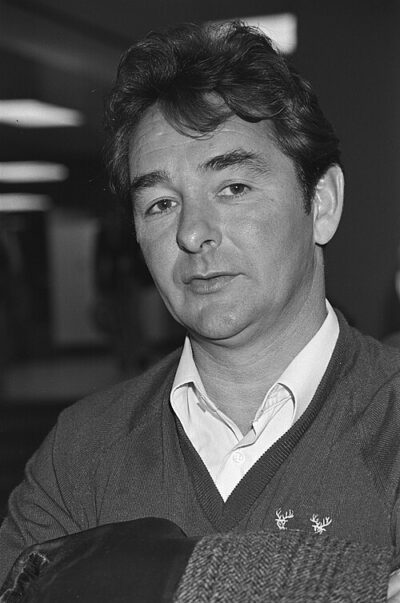
Brian Clough
Brian Clough was an English football player and manager. Born March 21, 1935, in Middlesbrough. Died September 20, 2004, in Derby. Teams include Middlesbrough F.C. (1955–1961), Sunderland A.F.C. (1961–1964) and England national under-21 association football team (1957–1958). Awards include Officer of the Order of the British Empire.
Facts
20 facts · 2 confirmed by two sources · 2 cited · 16 from one source
Where this comes from
Papalocal keeps its own record. It started from these sources; what each one said is kept here as it was copied, so a change on their side never changes this page by itself. Tap one to read its version.
What Wikidata says · copied November 16, 2026 · revision 2556313500
- Described as
- English football player and manager (1935–2004)
- Other names
- Brian Howard Clough
- Born
- March 21, 1935 · 1 reference
- Died
- September 20, 2004 · 1 reference
- Born in
- Middlesbrough
- Died in
- Derby
- Cause of death
- stomach cancer
- Name at birth
- Brian Howard Clough · 1 reference
- Citizen of
- United Kingdom
- Occupation
- association football player; autobiographer; association football coach · 2 references
- Teams
- Middlesbrough F.C. (1955–1961); Sunderland A.F.C. (1961–1964); England national under-21 association football team (1957–1958); England national association football B team (1957); England men's national association football team (1959)
- Sport
- association football
- Awards
- Officer of the Order of the British Empire
- Children
- Nigel Clough
- Military branch
- Royal Air Force
- Height
- 1.78 m (5 ft 10 in)
- Wikipedias with a page
- 48
Wikidata item Q207658 (wikidata.org/wiki/Q207658), public domain (CC0). Copied November 16, 2026.
What Wikipedia says · copied November 16, 2026 · revision 1385415396
Brian Howard Clough ( KLUF; 21 March 1935 – 20 September 2004) was an English football player and manager, primarily known for his successes as a manager with Derby County and Nottingham Forest. He won the European Cup twice with Nottingham Forest and is one of four managers to have won the English league with two different clubs. He is widely regarded as one of the greatest managers of all time. Charismatic, outspoken and often controversial, his achievements with Derby and Forest, two clubs with little prior history of success, are rated among the greatest in football history. His teams were also noted for playing attractive football and for their good sportsmanship. Despite applying several times and being a popular choice for the job, he was never appointed England manager and has been dubbed the "greatest manager England never had".
Clough played as a striker for Middlesbrough and Sunderland, scoring 251 league goals in 274 matches; he remains one of the Football League's highest goalscorers. He won two England caps. He entered management after his playing career was ended by a serious injury at the age of 29. As a manager, Clough was closely associated with Peter Taylor, who served as his assistant manager at several clubs in the 1960s, 1970s and 1980s. He is also remembered for giving frequent radio and television interviews in which he made controversial remarks about players, other managers and the overall state of the game. In 1965, he took the manager's job at Fourth Division Hartlepools United and appointed Peter Taylor as his assistant, the start of an enduring partnership that would bring them success at several clubs over the next two decades. In 1967, the duo moved on to Second Division Derby County who, in 1968–69, were promoted as Second Division champions and, three years later, crowned champions of England for the first time in the club's history. In 1973, they reached the semi-finals of the European Cup. By this point, Clough's relationship with chairman Sam Longson had deteriorated; he and Taylor resigned.
An eight-month spell in charge of Third Division club Brighton & Hove Albion followed, before Clough (without Taylor) returned north in the summer of 1974 to become manager of Leeds United. This was widely regarded as a surprise appointment, given his previous outspoken criticism of the Leeds players and their manager Don Revie. He was sacked after just 44 days in the job, but within months, he had joined Second Division Nottingham Forest, where he was re-united with Taylor in the summer of 1976. In 1977, Forest were promoted to the top flight and the following season won the league title (the first and so far only in the club's history), making Clough one of only four managers to have won the English league with two clubs. Forest also won two consecutive European Cups (in 1979 and 1980) and two League Cups (1978 and 1979), before Taylor retired in 1982. Clough stayed on as Forest manager for another decade, winning two more League Cups (1989 and 1990) and reaching the FA Cup final in 1991, but could not emulate his earlier successes. Forest were relegated from the Premier League in 1993, after which Clough retired from football. In 2002, Clough was among the six managers who were inaugural inductees into the English Football Hall of Fame.
- Born, in its opening lines
- March 21, 1935
- Died, in its opening lines
- September 20, 2004
From the Wikipedia article “Brian Clough” (en.wikipedia.org/wiki/Brian_Clough), by its contributors, under CC BY-SA 4.0 (creativecommons.org/licenses/by-sa/4.0/). Copied November 16, 2026; not changed.
Confirmed Two sources agree. Cited One source, and it names where it got it. One source One source, without a reference of its own. Sources disagree The sources disagree. We show the best-supported value and keep theirs below.
