
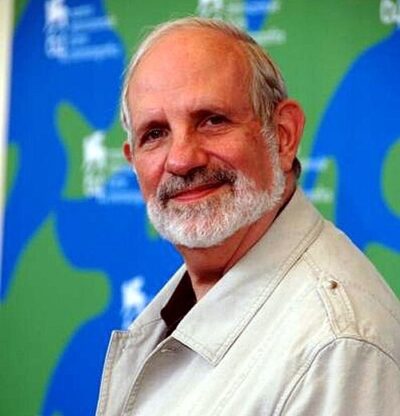
Brian De Palma
Brian De Palma is an American filmmaker. Born September 11, 1940, in Newark. Known for The Untouchables, Scarface and Dressed to Kill. Educated at Columbia University and Sarah Lawrence College. Awards include John Jay Award.
Facts
41 facts · 1 confirmed by two sources · 3 cited · 37 from one source
Where this comes from
Papalocal keeps its own record. It started from these sources; what each one said is kept here as it was copied, so a change on their side never changes this page by itself. Tap one to read its version.
What Wikidata says · copied November 13, 2026 · revision 2567193702
- Described as
- American filmmaker
- Other names
- Brian Russell De Palma, Brian DePalma, Brian Russell DePalma, DePalma, De Palma
- Born
- September 11, 1940 · 10 references
- Born in
- Newark · 1 reference
- Citizen of
- United States
- Occupation
- film director · 1 reference; screenwriter; producer; film editor; actor · 1 reference; film screenwriter; film producer; writer
- Education
- Columbia University; Sarah Lawrence College; Friends' Central School
- Member of
- Writers Guild of America East
- Genre
- horror film; thriller film; gangster film; drama film; crime film; psychological thriller film
- Known for
- The Untouchables; Scarface; Dressed to Kill; Body Double; Carlito's Way; Mission: Impossible; Wise Guys; Phantom of the Paradise; Carrie; Hi, Mom!
- Awards
- John Jay Award
- Field
- film
- Spouse
- Nancy Allen (1979–1983); Gale Anne Hurd (1991–1993); Darnell Gregorio-De Palma (1995–1997)
- Children
- Piper De Palma; Lolita de Palma
- Father
- Anthony F. DePalma
- Lived in
- Manhattan
- Height
- 1.80 m (5 ft 11 in)
- Wikipedias with a page
- 68
Wikidata item Q189526 (wikidata.org/wiki/Q189526), public domain (CC0). Copied November 13, 2026.
What Wikipedia says · copied November 13, 2026 · revision 1382829607
Brian Russell De Palma ([de ˈpalma]; born September 11, 1940) is an American filmmaker. A major figure of the New Hollywood generation, he is best known for his work in the suspense, crime, and psychological thriller genres in a career spanning more than five decades.
De Palma became enraptured with filmmaking after seeing Orson Welles' Citizen Kane (1941) and Alfred Hitchcock's Vertigo (1958). After enrolling at Columbia University, he enrolled at the newly coed Sarah Lawrence College; once there, influences as various impressed upon De Palma the many styles and themes that would shape his work in the coming decades. Several of his first films have become cult classics. He made his breakthrough with Carrie (1976), which was an adaptation of Stephen King's novel of the same name, and gained him prominence as a young filmmaker. De Palma has since enjoyed commercial success with The Fury (1978), Dressed to Kill (1980), The Untouchables (1987), and Mission: Impossible (1996), and made cult classics such as Scarface (1983), Carlito's Way (1992), and Femme Fatale (2002).
As a young director, De Palma dreamed of being the "American Jean-Luc Godard". His style is allusive: he paid homage to Alfred Hitchcock in Obsession (1976), Dressed to Kill, and Body Double (1984); Blow Out (1981) is based on Michelangelo Antonioni's Blowup (1966); and Scarface, his remake of Howard Hawks' 1932 film, is dedicated to Hawks and Ben Hecht. De Palma's work has been criticized for its violence and sexual content but has also been championed by American critics such as Roger Ebert and Pauline Kael. Carrie has been inducted into the National Film Registry by the Library of Congress. In 2015, he was interviewed about his work in a well-received documentary by Noah Baumbach.
- Born, in its opening lines
- September 11, 1940
From the Wikipedia article “Brian De Palma” (en.wikipedia.org/wiki/Brian_De_Palma), by its contributors, under CC BY-SA 4.0 (creativecommons.org/licenses/by-sa/4.0/). Copied November 13, 2026; not changed.
Confirmed Two sources agree. Cited One source, and it names where it got it. One source One source, without a reference of its own. Sources disagree The sources disagree. We show the best-supported value and keep theirs below.
