
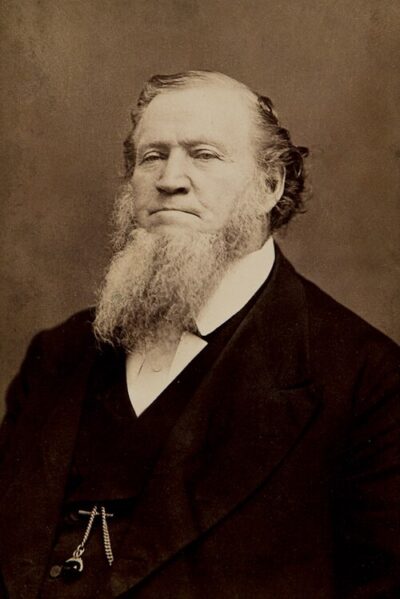
Brigham Young
Brigham Young was an American religious leader, second president of the LDS Church, and governor of Utah Territory. Born June 1, 1801, in Whitingham. Died August 29, 1877, in Salt Lake City. Positions held include Governor of the Territory of Utah (1851–1858).

Facts
39 facts · 2 confirmed by two sources · 7 cited · 30 from one source
Where this comes from
Papalocal keeps its own record. It started from these sources; what each one said is kept here as it was copied, so a change on their side never changes this page by itself. Tap one to read its version.
What Wikidata says · copied November 13, 2026 · revision 2565601328
- Described as
- American religious leader, second president of the LDS Church, and governor of Utah Territory (1801–1877)
- Other names
- President B. Young, President Brigham Young
- Born
- June 1, 1801 · 7 references
- Died
- August 29, 1877 · 7 references
- Born in
- Whitingham · 2 references
- Died in
- Salt Lake City · 1 reference
- Buried in
- Mormon Pioneer Memorial Monument
- Cause of death
- peritonitis
- Citizen of
- United States
- Occupation
- theologian; carpenter; prophet; politician · 1 reference; governor · 1 reference
- Positions held
- Governor of the Territory of Utah (1851–1858)
- Field
- colonization · 1 reference
- Spouse
- Miriam Angeline Works Young (1824–1832); Mary Ann Angell (1834–) · 1 reference; Lucy Ann Young; Harriet Elizabeth Young; Emily Dow Partridge (1844–) · 1 reference; Clarissa Ann Young
- Children
- Susa Young Gates; Zina P. Young Card; Maria Young Dougall; B. Morris Young; Brigham Young, Jr.; Joseph Don Carlos Young; John Willard Young; Joseph Angell Young; Oscar Brigham Young; Mahonri Moriancumer Young; Ernest Irving Young, Sr.; Emily Augusta Young
- Father
- John Young · 1 reference
- Mother
- Abigail Nabby Howe
- Siblings
- Phineas Young; Joseph Young; Lorenzo Dow Young
- Religion
- The Church of Jesus Christ of Latter-day Saints · 1 reference; Mormonism
- Wikipedias with a page
- 58
Wikidata item Q203559 (wikidata.org/wiki/Q203559), public domain (CC0). Copied November 13, 2026.
What Wikipedia says · copied November 13, 2026 · revision 1385348074
Brigham Young ( BRIG-əm; June 1, 1801 – August 29, 1877) was an American religious leader and politician. He was the second president of the Church of Jesus Christ of Latter-day Saints (LDS Church) from 1847 until his death in 1877. He also served as the first governor of the Utah Territory from 1851 until his resignation in 1858.
Young was born in 1801 in Whitingham, Vermont, and raised in Upstate New York. After working as a painter and carpenter, he became a full-time LDS Church leader in 1835. Following a short period of service as a missionary, he moved to Missouri in 1838. Later that year, Missouri governor Lilburn Boggs signed the Mormon Extermination Order, and Young organized the migration of the Latter Day Saints from Missouri to Illinois, where he became an inaugural member of the Council of Fifty. In 1844, while he was traveling to gain support for Joseph Smith's presidential campaign, Smith was killed by a mob, igniting the Illinois Mormon War and triggering a succession crisis in the Latter Day Saint movement. After negotiating a ceasefire, Young was unanimously elected as the church's second president in 1847. During the Mormon exodus, Young led his followers west from Nauvoo, Illinois, via the Mormon Trail to the Salt Lake Valley. Once settled in Utah, he ordered the construction of numerous temples, including the Salt Lake Temple. He also formalized the prohibition of black men attaining priesthood and directed the Mormon Reformation. An advocate for education, Young sought to establish the higher education institutions that would later become the University of Utah and Brigham Young University.
After arriving in Utah, Young founded Salt Lake City and established the State of Deseret before being appointed Utah's first territorial governor by President Millard Fillmore in 1850. As governor, Young allowed polygamy, supported slavery and its expansion into Utah, and led the efforts to legalize and regulate slavery in the 1852 Act in Relation to Service, based on his beliefs on slavery. He exerted considerable power over the territory through his theocratic political system, theodemocracy. After President James Buchanan appointed a new governor of the territory, Young declared martial law and re-activated the Nauvoo Legion, beginning the Utah War. During the conflict, the Utah Territorial Militia committed a series of attacks that resulted in the mass murder of at least 120 members of the Baker–Fancher immigrant wagon train, known as the Mountain Meadows Massacre. The following month, the Aiken massacre was perpetrated on Young's orders. In 1858, the war ended when Young surrendered, agreeing to resign as governor and allow federal troops to enter the Utah Territory in exchange for a pardon granted to Mormon settlers from President Buchanan.
A polygamist, Young had 56 wives and 57 children. His teachings are contained in the 19 volumes of transcribed and edited sermons in the Journal of Discourses. His legacy and impact are seen throughout the American West, including numerous memorials, temples, and schools named in his honor. In 2016, Young was estimated to have around 30,000 descendants.
- Born, in its opening lines
- June 1, 1801
- Died, in its opening lines
- August 29, 1877
From the Wikipedia article “Brigham Young” (en.wikipedia.org/wiki/Brigham_Young), by its contributors, under CC BY-SA 4.0 (creativecommons.org/licenses/by-sa/4.0/). Copied November 13, 2026; not changed.
Confirmed Two sources agree. Cited One source, and it names where it got it. One source One source, without a reference of its own. Sources disagree The sources disagree. We show the best-supported value and keep theirs below.
