
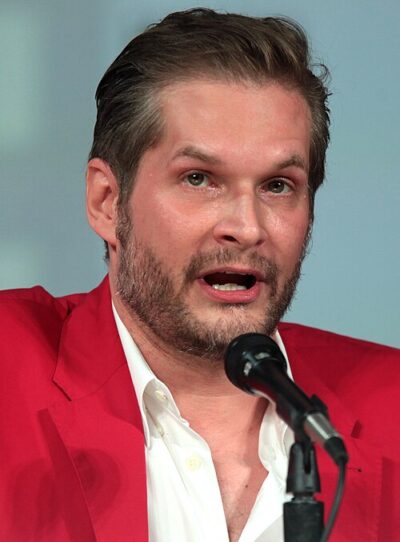
Bryan Fuller
Bryan Fuller is an American screenwriter and television producer. Born July 27, 1969, in Lewiston. Known for Hannibal and Star Trek: Voyager. Educated at USC School of Cinematic Arts and Lewis–Clark State College.
Facts
15 facts · 1 confirmed by two sources · 5 cited · 9 from one source
Where this comes from
Papalocal keeps its own record. It started from these sources; what each one said is kept here as it was copied, so a change on their side never changes this page by itself. Tap one to read its version.
What Wikidata says · copied November 15, 2026 · revision 2569976615
- Described as
- American screenwriter and television producer
- Born
- July 27, 1969 · 1 reference
- Born in
- Lewiston
- Citizen of
- United States
- Occupation
- screenwriter; television producer; executive producer; film producer · 2 references; film director · 1 reference; television director · 1 reference; television actor · 1 reference
- Education
- USC School of Cinematic Arts; Lewis–Clark State College · 1 reference
- Known for
- Hannibal; Star Trek: Voyager
- Field
- television · 1 reference
- Wikipedias with a page
- 24
Wikidata item Q995026 (wikidata.org/wiki/Q995026), public domain (CC0). Copied November 15, 2026.
What Wikipedia says · copied November 15, 2026 · revision 1382293724
Bryan Fuller (born July 27, 1969) is an American writer, TV producer, and film director, best known for creating the television series Pushing Daisies (2007–2009) and Hannibal (2013–2015). Fuller is also known for his work as a showrunner for the first season of the show American Gods (2017–2021), as a writer on the Star Trek television series Voyager (1997–2001) and Deep Space Nine (1997), and as the co-creator of Star Trek: Discovery (2017–2024).
He made his feature film directorial debut with Dust Bunny (2025).
- Born, in its opening lines
- July 27, 1969
From the Wikipedia article “Bryan Fuller” (en.wikipedia.org/wiki/Bryan_Fuller), by its contributors, under CC BY-SA 4.0 (creativecommons.org/licenses/by-sa/4.0/). Copied November 15, 2026; not changed.
Confirmed Two sources agree. Cited One source, and it names where it got it. One source One source, without a reference of its own. Sources disagree The sources disagree. We show the best-supported value and keep theirs below.
