
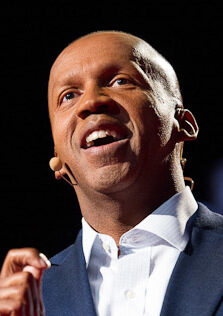
Bryan Stevenson
Bryan Stevenson is an American lawyer, social reformer and academic. Born November 14, 1959, in Milton. Known for Just Mercy. Educated at John F. Kennedy School of Government and Harvard Law School. Awards include MacArthur Fellows Program, Olof Palme Prize and Four Freedoms Award – Freedom from Fear.
Facts
35 facts · 1 confirmed by two sources · 21 cited · 13 from one source
Where this comes from
Papalocal keeps its own record. It started from these sources; what each one said is kept here as it was copied, so a change on their side never changes this page by itself. Tap one to read its version.
What Wikidata says · copied November 16, 2026 · revision 2554211688
- Described as
- American lawyer, social reformer and academic
- Other names
- Stevenson
- Born
- November 14, 1959 · 1 reference
- Born in
- Milton · 1 reference
- Citizen of
- United States
- Occupation
- jurist; lawyer · 2 references; writer; founder · 2 references; social reformer · 1 reference; academic · 1 reference; university teacher · 1 reference
- Worked for
- University of Michigan; New York University School of Law · 3 references; Southern Center for Human Rights · 1 reference
- Education
- John F. Kennedy School of Government; Harvard Law School · 1 reference; Eastern University · 1 reference; Cape Henlopen High School · 1 reference
- Member of
- American Academy of Arts and Sciences
- Known for
- Just Mercy
- Awards
- MacArthur Fellows Program (1995) · 1 reference; Olof Palme Prize (2000) · 1 reference; Four Freedoms Award – Freedom from Fear; Gruber Prize for Justice (2009) · 1 reference; Reebok Human Rights Award (1989) · 1 reference; Lannan Cultural Freedom Prize (2014); honorary doctor of Harvard University (2015) · 1 reference; Right Livelihood Award (2020) · 1 reference; honorary doctor of the University of Miami (2019) · 1 reference; honorary doctorate from Princeton University; honorary degree from Spelman College (2018) · 1 reference; National Humanities Medal (2021) · 1 reference
- Field
- law · 1 reference; social justice · 1 reference
- Lived in
- Montgomery · 1 reference
- Website
- http://bryanstevenson.com/
- Wikipedias with a page
- 23
Wikidata item Q2698978 (wikidata.org/wiki/Q2698978), public domain (CC0). Copied November 16, 2026.
What Wikipedia says · copied November 16, 2026 · revision 1378041551
Bryan Allen Stevenson (born November 14, 1959) is an American lawyer, social justice activist, and law professor at New York University School of Law. He is also the founder and executive director of the Equal Justice Initiative. Based in Montgomery, Alabama, he has challenged bias against the poor and minorities in the criminal justice system, especially children. He has helped achieve United States Supreme Court decisions that prohibit sentencing juvenile offenders to death or to mandatory life terms without parole.
Stevenson was depicted in the 2019 legal drama film Just Mercy, based on his 2014 memoir Just Mercy: A Story of Justice and Redemption. In the memoir, he recounts his work defending Walter McMillian, who had been unjustly convicted and sentenced to death.
Stevenson initiated the National Memorial for Peace and Justice in Montgomery, which honors the names of more than 4,000 African Americans lynched in the twelve states of the South from 1877 to 1950. He argues that the history of slavery and lynchings has influenced the subsequent high rate of death sentences in the South, where it has been disproportionately applied to minorities. A related museum, The Legacy Museum: From Enslavement to Mass Incarceration, offers interpretations to show the connection between the post-Reconstruction period of lynchings and the high rate of incarceration and executions of people of color in the United States.
- Born, in its opening lines
- November 14, 1959
From the Wikipedia article “Bryan Stevenson” (en.wikipedia.org/wiki/Bryan_Stevenson), by its contributors, under CC BY-SA 4.0 (creativecommons.org/licenses/by-sa/4.0/). Copied November 16, 2026; not changed.
Confirmed Two sources agree. Cited One source, and it names where it got it. One source One source, without a reference of its own. Sources disagree The sources disagree. We show the best-supported value and keep theirs below.
