
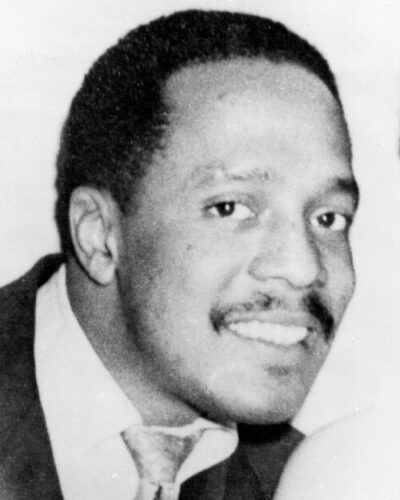
Bud Powell
Bud Powell was an American jazz pianist and composer. Born September 27, 1924, in Harlem. Died July 31, 1966, in New York City. Educated at DeWitt Clinton High School.
Facts
19 facts · 2 confirmed by two sources · 7 cited · 10 from one source
Where this comes from
Papalocal keeps its own record. It started from these sources; what each one said is kept here as it was copied, so a change on their side never changes this page by itself. Tap one to read its version.
What Wikidata says · copied November 15, 2026 · revision 2567821512
- Described as
- American jazz pianist and composer (1924–1966)
- Other names
- Earl Powell
- Born
- September 27, 1924 · 7 references
- Died
- July 31, 1966 · 2 references
- Born in
- Harlem · 1 reference
- Died in
- New York City · 2 references
- Buried in
- Fairview Cemetery · 1 reference
- Cause of death
- tuberculosis
- Citizen of
- United States · 1 reference
- Occupation
- pianist · 1 reference; jazz musician · 1 reference; composer · 1 reference; recording artist; musician · 1 reference
- Education
- DeWitt Clinton High School · 1 reference
- Member of
- Bud Powell Trio
- Genre
- jazz
- Instrument
- piano
- Record label
- Blue Note; ESP-Disk; Roost Records
- Wikipedias with a page
- 35
Wikidata item Q312692 (wikidata.org/wiki/Q312692), public domain (CC0). Copied November 15, 2026.
What Wikipedia says · copied November 15, 2026 · revision 1377196131
Earl Rudolph "Bud" Powell (September 27, 1924 – July 31, 1966) was an American jazz pianist and composer. A pioneer in the development of bebop and its associated contributions to jazz theory, Powell's application of complex phrasing to the piano influenced both his contemporaries and later pianists including Walter Davis Jr., Toshiko Akiyoshi, and Barry Harris.
Born in the midst of the Harlem Renaissance to a musical family, Powell, during the 1930s, developed an attacking, right-handed approach to the piano, which marked a break from the left-handed approach of stride and ragtime that had been prevalent. Upon joining trumpeter Cootie Williams's band in 1943, he received attention from the broader musical community for his fluency and advanced technique. In 1945, he suffered a severe beating by police, followed by several years of intermittent institutionalizations. His recordings and live performances with Charlie Parker, Sonny Stitt, and Max Roach during the late 1940s and early 1950s played an important role in the development of modern jazz piano technique.
Following the release of his guardianship and a partial health recovery in the mid- to late 1950s, Powell's relocation to Paris, France, in 1959, contributed to the community of African-American expatriates fleeing racism and barriers to a higher standard of living. He returned to a regular recording schedule, toured across Northern and Central Europe, and made records, before becoming ill with tuberculosis in 1963.
Despite the friendship and protection of French jazz aficionado Francis Paudras, ill health and an alcohol addiction following a troubled return to New York hastened Powell's death in 1966 at the age of 41. The decades following his death saw his career and life story become the inspiration for films and written works, including Bertrand Tavernier's Round Midnight. Many Powell compositions, including "Un Poco Loco", "Bouncing with Bud", and "Parisian Thoroughfare" have become jazz standards.
- Born, in its opening lines
- September 27, 1924
- Died, in its opening lines
- July 31, 1966
From the Wikipedia article “Bud Powell” (en.wikipedia.org/wiki/Bud_Powell), by its contributors, under CC BY-SA 4.0 (creativecommons.org/licenses/by-sa/4.0/). Copied November 15, 2026; not changed.
Confirmed Two sources agree. Cited One source, and it names where it got it. One source One source, without a reference of its own. Sources disagree The sources disagree. We show the best-supported value and keep theirs below.
