
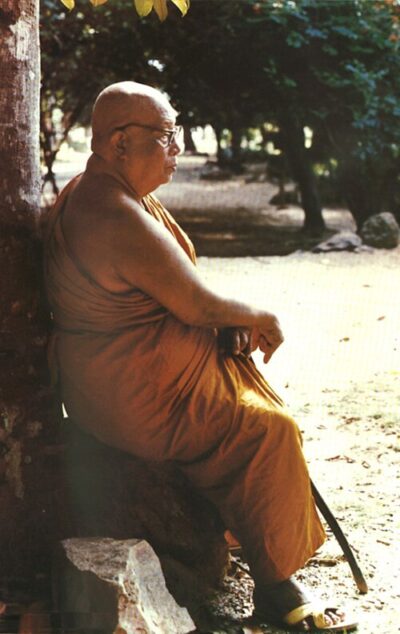
Buddhadāsa was a Thai Buddhist monk. Born May 27, 1906, in Phum Riang. Died May 25, 1993, in Talat Chaiya.
Facts
11 facts · 2 confirmed by two sources · 2 cited · 7 from one source
Where this comes from
Papalocal keeps its own record. It started from these sources; what each one said is kept here as it was copied, so a change on their side never changes this page by itself. Tap one to read its version.
What Wikidata says · copied November 17, 2026 · revision 2566054638
- Described as
- Thai Buddhist monk (1906–1993)
- Other names
- Ajahn Buddhadāsa, Indapañño Bhikkhu, Indapañña Bhikkhu, Indapañño
- Born
- May 27, 1906 · 2 references
- Died
- May 25, 1993
- Born in
- Phum Riang
- Died in
- Talat Chaiya · 1 reference
- Cause of death
- cerebral hemorrhage
- Citizen of
- Thailand
- Occupation
- Buddhist monk; writer
- Field
- antiphilosophy · 1 reference
- Siblings
- Thammathāt Phānit · 1 reference
- Religion
- Buddhism
- Wikipedias with a page
- 25
Wikidata item Q714446 (wikidata.org/wiki/Q714446), public domain (CC0). Copied November 17, 2026.
What Wikipedia says · copied November 17, 2026 · revision 1359217674
Buddhadasa (27 May 1906 – 25 May 1993) was a Thai Buddhist monk. Known as an innovative reinterpreter of Buddhist doctrine and Thai folk beliefs, he fostered a reformation in conventional religious perceptions in his home country, Thailand, as well as abroad. He developed a personal view that those who have penetrated the essential nature of religions consider "all religions to be inwardly the same", while those who have the highest understanding of dhamma feel "there is no religion". Buddhadasa was also known for his political engagement and developed a form of Buddhist socialism he called "Dhammic socialism".
- Born, in its opening lines
- May 27, 1906
- Died, in its opening lines
- May 25, 1993
From the Wikipedia article “Ajahn Buddhadasa” (en.wikipedia.org/wiki/Ajahn_Buddhadasa), by its contributors, under CC BY-SA 4.0 (creativecommons.org/licenses/by-sa/4.0/). Copied November 17, 2026; not changed.
Confirmed Two sources agree. Cited One source, and it names where it got it. One source One source, without a reference of its own. Sources disagree The sources disagree. We show the best-supported value and keep theirs below.
