
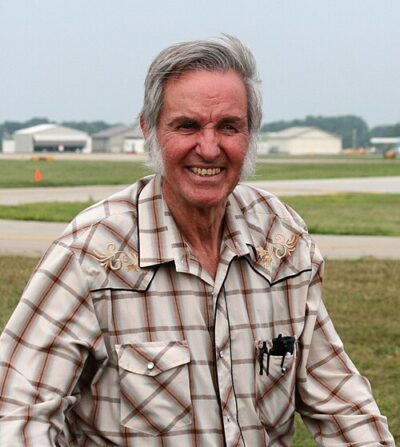
Burt Rutan
Burt Rutan is an American aerospace engineer. Born June 17, 1943, in Estacada. Educated at California Polytechnic State University. Awards include Presidential Citizens Medal, Daniel Guggenheim Medal and National Aviation Hall of Fame.
Facts
21 facts · 1 confirmed by two sources · 7 cited · 13 from one source
Where this comes from
Papalocal keeps its own record. It started from these sources; what each one said is kept here as it was copied, so a change on their side never changes this page by itself. Tap one to read its version.
What Wikidata says · copied November 15, 2026 · revision 2565439494
- Described as
- American aerospace engineer (born 1943)
- Other names
- Elbert Leander "Burt" Rutan, Elbert Leander Rutan
- Born
- June 17, 1943 · 3 references
- Born in
- Estacada · 1 reference
- Name at birth
- Elbert Leander Rutan · 1 reference
- Citizen of
- United States
- Occupation
- military flight engineer; inventor; aircraft pilot; entrepreneur; engineer · 1 reference
- Education
- California Polytechnic State University
- Awards
- Presidential Citizens Medal; Daniel Guggenheim Medal (2011) · 1 reference; National Aviation Hall of Fame (1995) · 1 reference; honorary doctorate of the Vrije Universiteit Brussel (2007) · 1 reference; J. C. Hunsaker Award in Aeronautical Engineering (2005) · 1 reference; NSS Wernher Von Braun Memorial Award (2007); Wright Brothers Memorial Trophy (2015)
- Field
- aeronautics
- Siblings
- Dick Rutan · 1 reference
- Lived in
- Coeur d'Alene
- Website
- http://www.burtrutan.com/
- Wikipedias with a page
- 26
Wikidata item Q453046 (wikidata.org/wiki/Q453046), public domain (CC0). Copied November 15, 2026.
What Wikipedia says · copied November 15, 2026 · revision 1383143925
Elbert Leander "Burt" Rutan (; born June 17, 1943) is an American retired aerospace engineer and entrepreneur noted for his originality in designing light, strong, unusual-looking, and energy-efficient air and space craft. He designed the record-breaking Voyager, which in 1986 was the first plane to fly around the world without stopping or refueling. He also designed the Virgin Atlantic GlobalFlyer, which in 2006 set the world record for the fastest (342 mph/551 km/h in 67 hours) and longest (25,766 miles/41,466 km) nonstop non-refueled circumnavigation flight in history. In 2004, Rutan's sub-orbital spaceplane design SpaceShipOne became the first privately funded spacecraft to enter the realm of space, winning the Ansari X-Prize that year for achieving the feat twice within a two-week period.
With his VariEze and Long-EZ designs, which first flew in 1975 and 1979 respectively, Rutan is responsible for helping popularize both the canard configuration and the use of moldless composite construction in the homebuilt aircraft industry, the latter a technique that was adopted in several production and commercial aircraft in the following decades. He is the founder or co-founder of multiple aerospace companies, including the Rutan Aircraft Factory, Scaled Composites, Mojave Aerospace Ventures, and The Spaceship Company.
Rutan has designed 46 aircraft throughout his career, been included in the Time 100 Most Influential People in the World list for the year 2004, been the co-recipient of both the Collier and National Air and Space Museum trophies on two occasions (each for his accomplishments with Voyager in 1986 and SpaceShipOne in 2004), received six honorary doctoral degrees, and has won over 100 different awards for aerospace design and development. In 1995, he was inducted into the National Aviation Hall of Fame. Rutan has five aircraft on display in the Smithsonian Institution's National Air and Space Museum: the VariEze, Quickie, Voyager, SpaceShipOne, and the Virgin Atlantic GlobalFlyer. He is the younger brother of test pilot and United States Air Force fighter pilot Dick Rutan, who piloted many of Burt's earlier original designs on class record-breaking flights.
- Born, in its opening lines
- June 17, 1943
From the Wikipedia article “Burt Rutan” (en.wikipedia.org/wiki/Burt_Rutan), by its contributors, under CC BY-SA 4.0 (creativecommons.org/licenses/by-sa/4.0/). Copied November 15, 2026; not changed.
Confirmed Two sources agree. Cited One source, and it names where it got it. One source One source, without a reference of its own. Sources disagree The sources disagree. We show the best-supported value and keep theirs below.
