
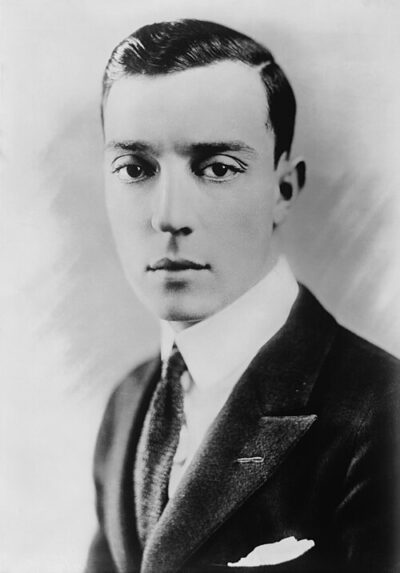
Buster Keaton
Buster Keaton was an American actor, comedian and filmmaker. Born October 4, 1895, in Piqua. Died February 1, 1966, in Woodland Hills. Known for Sherlock, Jr., The General and Steamboat Bill Jr.. Awards include Academy Honorary Award and star on Hollywood Walk of Fame.
Facts
41 facts · 2 confirmed by two sources · 6 cited · 33 from one source
Where this comes from
Papalocal keeps its own record. It started from these sources; what each one said is kept here as it was copied, so a change on their side never changes this page by itself. Tap one to read its version.
What Wikidata says · copied November 13, 2026 · revision 2566710799
- Described as
- American actor, comedian and filmmaker
- Other names
- The Great Stone Face, Joseph Keaton, Frigo, Joseph Frank Keaton, Joseph Francis Keaton
- Born
- October 4, 1895 · 13 references
- Died
- February 1, 1966 · 15 references
- Born in
- Piqua · 2 references
- Died in
- Woodland Hills · 2 references
- Buried in
- Forest Lawn Memorial Park
- Cause of death
- lung cancer
- Name at birth
- Joseph Frank Keaton · 1 reference
- Citizen of
- United States
- Occupation
- comedian; film producer; writer; film editor; military personnel; stunt performer; television actor; stage actor
- Genre
- comedy film; silent film; drama film; independent film; adventure film; action film
- Known for
- Sherlock, Jr.; The General; Steamboat Bill Jr.; The Cameraman
- Awards
- Academy Honorary Award (1959); star on Hollywood Walk of Fame · 1 reference
- Spouse
- Natalie Talmadge (1921–1932) · 1 reference; Eleanor Keaton (1940–1966)
- Children
- Joseph Talmadge Keaton · 1 reference; Robert Talmadge Keaton
- Father
- Joe Keaton
- Mother
- Myra Keaton
- Military branch
- United States Army; 40th Infantry Division (1918–) · 1 reference
- Lived in
- Beverly Hills
- Nickname
- Buster; The Great Stone Face
- Height
- 1.65 m (5 ft 5 in)
- Website
- http://www.busterkeaton.com
- Wikipedias with a page
- 100
Wikidata item Q103949 (wikidata.org/wiki/Q103949), public domain (CC0). Copied November 13, 2026.
What Wikipedia says · copied November 13, 2026 · revision 1385403727
Joseph Frank "Buster" Keaton (1895 – February 1, 1966) was an American actor, comedian and filmmaker. He is best known for his silent films, in which he performed physical comedy and inventive stunts. He maintained a stoic, deadpan facial expression that became his trademark and earned him the nickname "The Great Stone Face".
Keaton was a child vaudeville star, performing as part of his family's traveling act. As an adult, he began working with independent producer Joseph M. Schenck and filmmaker Edward F. Cline, with whom he made successful two-reel comedies in the early 1920s, including One Week (1920), The Playhouse (1921) and The Electric House (1922). He moved to feature-length films, including Our Hospitality (1923), Sherlock Jr. (1924), The General (1926) and Steamboat Bill, Jr. (1928). Orson Welles called The General "the greatest comedy ever made...and perhaps the greatest film ever made".
Keaton's career declined after 1928, when he signed with Metro-Goldwyn-Mayer and lost his artistic independence. His first wife divorced him, and he descended into alcoholism. He was fired from MGM in 1933, ending his career as a leading man in feature films. He recovered in the 1940s, marrying Eleanor Norris and working as an honored comic performer until the end of his life. During this period, he made cameos in Billy Wilder's Sunset Boulevard (1950) and Charlie Chaplin's Limelight (1952).
Roger Ebert wrote of Keaton's "extraordinary period from 1920 to 1929" making him "the greatest actor-director in the history of the movies". In 1996, Entertainment Weekly recognized Keaton as the seventh-greatest film director, writing "his films offer belly laughs of mind-boggling physical invention and a spacey determination that nears philosophical grandeur." The American Film Institute included The General, Sherlock Jr. and The Navigator on their AFI's 100 Years...100 Laughs list. He is the subject of Kevin Brownlow's Buster Keaton: A Hard Act to Follow (1987) and Peter Bogdanovich's The Great Buster: A Celebration (2018).
- Born, in its opening lines
- 1895
- Died, in its opening lines
- February 1, 1966
From the Wikipedia article “Buster Keaton” (en.wikipedia.org/wiki/Buster_Keaton), by its contributors, under CC BY-SA 4.0 (creativecommons.org/licenses/by-sa/4.0/). Copied November 13, 2026; not changed.
Confirmed Two sources agree. Cited One source, and it names where it got it. One source One source, without a reference of its own. Sources disagree The sources disagree. We show the best-supported value and keep theirs below.
