
Cædmon
Cædmon was an ancient English poet. Known for Cædmon's Hymn.
Facts
6 facts · 0 confirmed by two sources · 1 cited · 5 from one source
Where this comes from
Papalocal keeps its own record. It started from these sources; what each one said is kept here as it was copied, so a change on their side never changes this page by itself. Tap one to read its version.
What Wikidata says · copied November 16, 2026 · revision 2563190295
- Described as
- ancient English poet
- Other names
- Caedmon
- Born in
- Kingdom of Northumbria
- Died in
- Whitby Abbey · 1 reference
- Citizen of
- Kingdom of Northumbria
- Occupation
- poet; writer · 1 reference
- Known for
- Cædmon's Hymn
- Wikipedias with a page
- 39
Wikidata item Q381292 (wikidata.org/wiki/Q381292), public domain (CC0). Copied November 16, 2026.
What Wikipedia says · copied November 16, 2026 · revision 1371937693
Cædmon, OSB (; fl. c. 657–684) was a Benedictine monk and the earliest English poet whose name is known. He was a Northumbrian cowherd who cared for the animals at the double monastery of Streonæshalch (now known as Whitby Abbey) during the abbacy of Hilda. He was originally ignorant of "the art of song" but learned to compose one night in the course of a dream, according to the 8th-century Christian historian Bede. He is venerated as a saint in the Eastern Orthodox Church, Catholic Church and Anglicanism, with a feast day on 11 February.
Cædmon is one of twelve Anglo-Saxon poets identified in medieval sources, and one of three of these for whom both roughly contemporary biographical information and examples of literary output have survived. His story is related in the Historia ecclesiastica gentis Anglorum ("Ecclesiastical History of the English People") by Bede, who wrote, "[t]here was in the Monastery of this Abbess a certain brother particularly remarkable for the Grace of God, who was wont to make religious verses, so that whatever was interpreted to him out of scripture, he soon after put the same into poetical expressions of much sweetness and humility in Old English, which was his native language. By his verse the minds of many were often excited to despise the world, and to aspire to heaven."
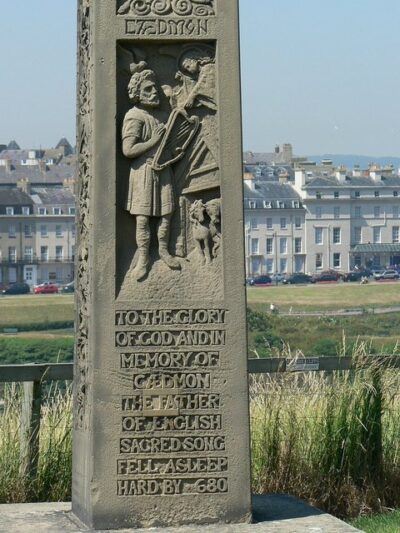
Cædmon's only known surviving work is Cædmon's Hymn, a nine-line alliterative vernacular praise poem in honour of God. The poem is one of the early attested examples of Old English and is, with the runic Ruthwell Cross and Franks Casket inscriptions, one of three candidates for the earliest attested example of Old English poetry. It is also one of the early recorded examples of sustained poetry in a Germanic language. In 1898, Cædmon's Cross was erected in his honour in the graveyard of St Mary's Church in Whitby.
- Born, in its opening lines
- 657
- Died, in its opening lines
- 684
From the Wikipedia article “Cædmon” (en.wikipedia.org/wiki/Cædmon), by its contributors, under CC BY-SA 4.0 (creativecommons.org/licenses/by-sa/4.0/). Copied November 16, 2026; not changed.
Confirmed Two sources agree. Cited One source, and it names where it got it. One source One source, without a reference of its own. Sources disagree The sources disagree. We show the best-supported value and keep theirs below.
