
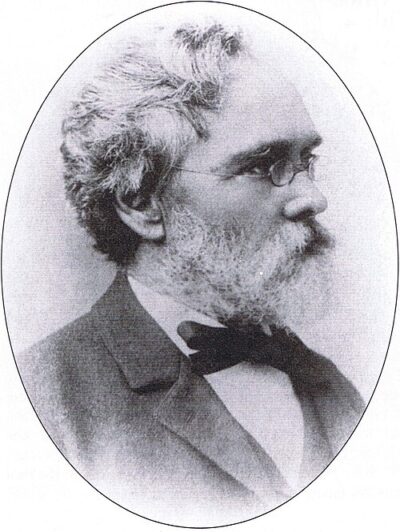
Calvert Vaux
Calvert Vaux was an Anglo-American architect. Born December 20, 1824, in London. Died November 19, 1895, in Brooklyn. Known for Central Park. Educated at Merchant Taylors' School.
Facts
12 facts · 2 confirmed by two sources · 6 cited · 4 from one source
Where this comes from
Papalocal keeps its own record. It started from these sources; what each one said is kept here as it was copied, so a change on their side never changes this page by itself. Tap one to read its version.
What Wikidata says · copied November 18, 2026 · revision 2533462937
- Described as
- Anglo-American architect (1824-1895)
- Born
- December 20, 1824 · 5 references
- Died
- November 19, 1895 · 4 references
- Born in
- London · 1 reference
- Died in
- Brooklyn
- Buried in
- Montrepose Cemetery · 1 reference
- Cause of death
- drowning
- Citizen of
- United States
- Occupation
- architect · 1 reference; landscape architect · 1 reference
- Education
- Merchant Taylors' School · 1 reference
- Known for
- Central Park · 1 reference
- Children
- Downing Vaux · 1 reference
- Wikipedias with a page
- 19
Wikidata item Q2577471 (wikidata.org/wiki/Q2577471), public domain (CC0). Copied November 18, 2026.
What Wikipedia says · copied November 18, 2026 · revision 1384291592
Calvert Vaux FAIA (; December 20, 1824 – November 19, 1895) was an English-American architect and landscape designer. He and his professional partner Frederick Law Olmsted designed parks such as Central Park and Prospect Park in New York City and the Delaware Park–Front Park System in Buffalo, New York.
Vaux, on his own and in various partnerships, designed and created dozens of parks across the northeastern United States, most famously in Manhattan, Brooklyn, and Buffalo in New York. He introduced new ideas about the significance of public parks in America during a hectic time of urbanization. This industrialization of the cityscape inspired Vaux to focus on the integration of buildings, bridges, and other forms of architecture into their natural surroundings. He favored naturalistic and curvilinear lines in his designs.
In addition to landscape architecture, Vaux was a highly-sought after architect until the 1870s, when his modes of design could not endure the country's return to classical forms. His partnership with Andrew Jackson Downing, a major figure in horticulture, landscape design, and domestic architecture, brought him from London to Newburgh, New York, in 1850. There, Downing's praise of Gothic Revival and Italianate architecture contributed to Vaux's personal growth as a designer of homes and landscapes. After Downing's sudden death in 1852, Vaux was left with their assistant Frederick Clarke Withers to continue Downing's legacy. He left Newburgh in 1856 to grow his practice in New York City, where he began, received and completed commissions with Olmsted, Withers, and Jacob Wrey Mould. As a result, Vaux's name was frequently overshadowed by other designers, such as Olmsted, yet the contemporary American public still recognized his talents.
- Born, in its opening lines
- December 20, 1824
- Died, in its opening lines
- November 19, 1895
From the Wikipedia article “Calvert Vaux” (en.wikipedia.org/wiki/Calvert_Vaux), by its contributors, under CC BY-SA 4.0 (creativecommons.org/licenses/by-sa/4.0/). Copied November 18, 2026; not changed.
Confirmed Two sources agree. Cited One source, and it names where it got it. One source One source, without a reference of its own. Sources disagree The sources disagree. We show the best-supported value and keep theirs below.
