
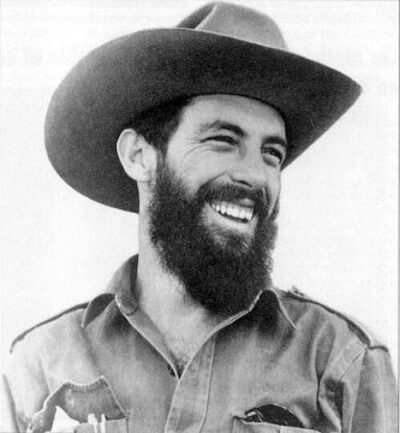
Camilo Cienfuegos
Camilo Cienfuegos was a Cuban revolutionary fighter and guerilla. Born February 6, 1932, in Havana. Died October 28, 1959, in Atlantic Ocean.
Facts
14 facts · 2 confirmed by two sources · 2 cited · 10 from one source
Where this comes from
Papalocal keeps its own record. It started from these sources; what each one said is kept here as it was copied, so a change on their side never changes this page by itself. Tap one to read its version.
What Wikidata says · copied November 16, 2026 · revision 2568860115
- Described as
- Cuban revolutionary fighter and guerilla (1932–1959)
- Other names
- Camilo Cienfuegos Gorriarán, Camilo Cienfuegos Gorriaran, El Héroe De Yaguajay
- Born
- February 6, 1932 · 2 references
- Died
- October 28, 1959 · 3 references
- Born in
- Havana · 1 reference
- Died in
- Atlantic Ocean
- Cause of death
- aircraft crash
- Citizen of
- Cuba; Spain
- Occupation
- politician; revolutionary · 1 reference; military officer
- Political party
- 26th of July Movement · 1 reference
- Member of
- 26th of July Movement
- Siblings
- Osmany Cienfuegos Gorriarán
- Military rank
- army general
- Wikipedias with a page
- 49
Wikidata item Q26853 (wikidata.org/wiki/Q26853), public domain (CC0). Copied November 16, 2026.
What Wikipedia says · copied November 16, 2026 · revision 1383048879
Camilo Cienfuegos Gorriarán (Spanish: [kaˈmilo sjeɱˈfweɣos ɣorjaˈɾan]; 6 February 1932 – 28 October 1959) was a Cuban revolutionary. One of the major figures of the Cuban Revolution, he was considered second only to Fidel Castro among the revolutionary leadership.
The son of Spanish anarchists, Cienfuegos engaged with left-wing politics from an early age, going on to join the opposition movement against the dictatorship of Fulgencio Batista. He joined Castro's 26th of July Movement on its expedition to Cuba and was one of the few survivors of the Landing of the Granma. He quickly distinguished himself as one of the top commanders of the Cuban Revolutionary Armed Forces and a popular leading figure of the revolution, becoming close friends with Che Guevara during their guerrilla campaign in Las Villas. After winning the Battle of Yaguajay in December 1958, Cienfuegos led the capture of Matanzas and Havana, where he was appointed commander-in-chief of the armed forces by the new revolutionary government. He oversaw the reorganization of the armed forces, in order to purge leading figures of the Cuban National Army and replace them with guerrilla commanders more loyal to Fidel Castro.
When army commander Huber Matos objected to Castro's consolidation of power, Castro ordered a reluctant Cienfuegos to arrest him. While flying back from Matos' former headquarters at Camagüey, Cienfuegos' plane disappeared over the Straits of Florida. After a few days of an attempted search and rescue operation, he was presumed dead by the Cuban government. His disappearance quickly spawned a number of conspiracy theories, many of which speculated Fidel or Raúl Castro to have been responsible, but no proof of such has been discovered. Cienfuegos has since become known as a revolutionary martyr in Cuba, with a number of institutions being dedicated to his name, including a Military Schools System and an Order of Merit.
Cienfuegos was a popular figure in Cuba, due to his cheerful and carefree personality, which contrasted sharply with the strict austerity of his comrade Guevara. Although he was claimed by different factions to have been a communist, an anti-communist, or an anarchist, he never publicly expressed any political ideology. The soldiers who fought for him remembered him for his friendly and paternal leadership style, while the Cuban government upheld him as a loyal supporter of Fidel Castro. Every year on 28 October, Cuban children throw flowers into the rivers and seas, in tribute to him.
- Born, in its opening lines
- February 6, 1932
- Died, in its opening lines
- October 28, 1959
From the Wikipedia article “Camilo Cienfuegos” (en.wikipedia.org/wiki/Camilo_Cienfuegos), by its contributors, under CC BY-SA 4.0 (creativecommons.org/licenses/by-sa/4.0/). Copied November 16, 2026; not changed.
Confirmed Two sources agree. Cited One source, and it names where it got it. One source One source, without a reference of its own. Sources disagree The sources disagree. We show the best-supported value and keep theirs below.
