
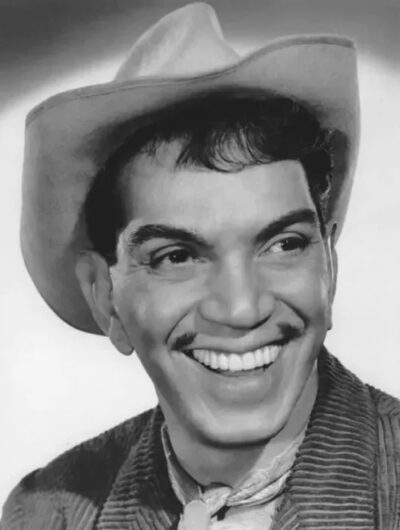
Cantinflas
Cantinflas was a Mexican comic film actor, producer, and screenwriter. Born August 12, 1911, in Mexico City. Died April 20, 1993, in Mexico City. Known for Around the World in 80 Days, Pepe and You're Missing the Point. Educated at Chapingo Autonomous University. Awards include Golden Globe Award for Best Actor – Motion Picture Musical or Comedy and star on Hollywood Walk of Fame.
Facts
26 facts · 2 confirmed by two sources · 5 cited · 19 from one source
Where this comes from
Papalocal keeps its own record. It started from these sources; what each one said is kept here as it was copied, so a change on their side never changes this page by itself. Tap one to read its version.
What Wikidata says · copied November 16, 2026 · revision 2569270060
- Described as
- Mexican comic film actor, producer, and screenwriter (1911–1993)
- Other names
- Mario Fortino Alfonso Moreno Reyes
- Born
- August 12, 1911 · 6 references
- Died
- April 20, 1993 · 6 references
- Born in
- Mexico City · 1 reference
- Died in
- Mexico City · 1 reference
- Buried in
- Spanish Pantheon of Mexico · 1 reference
- Cause of death
- lung cancer
- Name at birth
- Mario Fortino Alfonso Moreno Reyes
- Citizen of
- Mexico
- Occupation
- comedian · 2 references; screenwriter; television actor; military personnel; stage actor; musician; writer; film actor · 1 reference
- Education
- Chapingo Autonomous University · 1 reference
- Member of
- Hermanos
- Instrument
- voice
- Known for
- Around the World in 80 Days; Pepe; You're Missing the Point; Neither Blood Nor Sand
- Awards
- Golden Globe Award for Best Actor – Motion Picture Musical or Comedy; star on Hollywood Walk of Fame · 1 reference
- Spouse
- Valentina Ivanova · 1 reference
- Wikipedias with a page
- 52
Wikidata item Q195371 (wikidata.org/wiki/Q195371), public domain (CC0). Copied November 16, 2026.
What Wikipedia says · copied November 16, 2026 · revision 1380055089
Mario Fortino Alfonso Moreno Reyes (12 August 1911 – 20 April 1993), known by the stage name Cantinflas (Spanish pronunciation: [kanˈtiɱflas]), was a Mexican comedian, actor, and filmmaker. He is considered to have been the most widely accomplished Mexican comedian and is well known throughout Latin America and Spain.
His humor, loaded with Mexican linguistic features of intonation, vocabulary, and syntax, is beloved in all the Spanish-speaking countries of Latin America and in Spain. His abilities gave rise to a range of expressions based on his stage name, including: cantinflear, cantinflada, cantinflesco, cantifleando and cantinflero.
He often portrayed impoverished farmers or peasants of pelado origin. The character allowed Cantinflas to establish a long, successful film career into Hollywood. Charlie Chaplin once commented that he was the best comedian alive, and Moreno has been referred to as the "Charlie Chaplin of Mexico".
To audiences in most of the world, he is best remembered as co-starring with David Niven in the Oscar-winning film Around the World in 80 Days, for which Moreno won a Golden Globe Award for Best Actor – Motion Picture Musical or Comedy.
As a pioneer of the cinema of Mexico, Moreno helped usher in its golden era. In addition to being a business leader, he also became involved in Mexico's complex labor politics. His reputation as a spokesperson for the working class gave his actions authenticity and became important in the early struggle against charrismo, the ruling PRI's practice of co-opting and controlling trade unions.
Moreover, his character Cantinflas, whose identity became enmeshed with his own, was examined by media critics, philosophers, and linguists, who saw him variously as a danger to Mexican society, a bourgeois puppet, a verbal innovator, and a picaresque underdog.
- Born, in its opening lines
- August 12, 1911
- Died, in its opening lines
- April 20, 1993
From the Wikipedia article “Cantinflas” (en.wikipedia.org/wiki/Cantinflas), by its contributors, under CC BY-SA 4.0 (creativecommons.org/licenses/by-sa/4.0/). Copied November 16, 2026; not changed.
Confirmed Two sources agree. Cited One source, and it names where it got it. One source One source, without a reference of its own. Sources disagree The sources disagree. We show the best-supported value and keep theirs below.
