
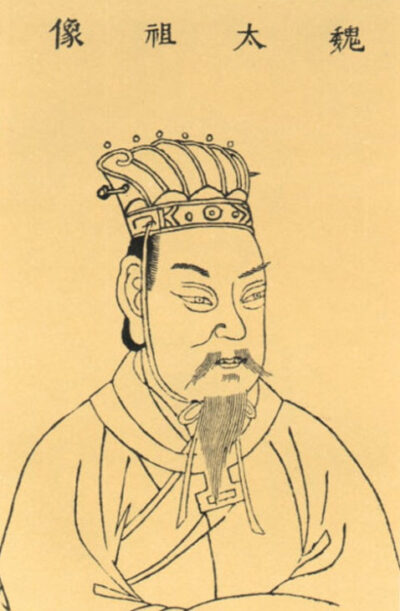
Cao Cao
Cao Cao was a Chinese warlord and statesman. Born 155, in Buzhou. Died 220, in Luoyang. Positions held include Chinese king (216–220).
Facts
36 facts · 2 confirmed by two sources · 11 cited · 23 from one source
Where this comes from
Papalocal keeps its own record. It started from these sources; what each one said is kept here as it was copied, so a change on their side never changes this page by itself. Tap one to read its version.
What Wikidata says · copied November 16, 2026 · revision 2565585971
- Described as
- Chinese warlord and statesman (155–220)
- Other names
- Tsao Tsao, Cho Cho, Mengde, Cao Mengde, Tsao Meng-te, Meng-te, Ts'ao Ts'ao, Ts'ao Meng-te, Taizu, Wei Taizu, T'ai-tsu, Tai-tsu
- Born
- 155 · 9 references
- Died
- 220 · 9 references
- Born in
- Buzhou
- Died in
- Luoyang
- Buried in
- Cao Cao Mausoleum
- Cause of death
- brain tumor
- Citizen of
- Eastern Han · 1 reference; Cao Wei · 1 reference
- Occupation
- politician; poet; writer; military leader · 1 reference
- Positions held
- Chinese king (216–220)
- Field
- military affairs · 1 reference; poetry · 1 reference
- Spouse
- Lady Ding; Empress Dowager Bian · 1 reference; Lady Liu; Du; Yin · 1 reference; Huan
- Children
- Cao Zhang · 1 reference; Cao Pi · 1 reference; Cao Zhi · 1 reference; Cao Xiong; Cao Ang; Cao Shuo · 1 reference; Cao Chong · 1 reference; Cao Ju; Cao Yu; Cao Lin; Cao Gun; Cao Xuan
- Father
- Cao Song · 1 reference
- Siblings
- Cao De
- Military rank
- general · 1 reference
- Wikipedias with a page
- 70
Wikidata item Q204077 (wikidata.org/wiki/Q204077), public domain (CC0). Copied November 16, 2026.
What Wikipedia says · copied November 16, 2026 · revision 1383522776
Cao Cao (; [tsʰǎʊ tsʰáʊ]; Chinese: 曹操; c. 155 – 15 March 220), courtesy name Mengde, was a Chinese statesman, warlord, and poet who rose to power during the end of the Han dynasty (c. 184–220 AD), ultimately taking effective control of the Han central government. He laid the foundation for the state of Cao Wei (220–265 AD), established by his son and successor Cao Pi, who ended the Eastern Han dynasty and inaugurated the Three Kingdoms period (220–280 AD). Beginning in his own lifetime, a corpus of legends developed around Cao Cao which built upon his talent, his cruelty, and his perceived eccentricities.
Cao Cao began his career as an official under the Han government and held various appointments including that of a district security chief in the capital and the chancellor of a principality. He rose to prominence in the 190s during which he recruited his own followers, formed his own army, and set up a base in Yan Province (covering parts of present-day Henan and Shandong). In 196 AD, he received Emperor Xian, the figurehead Han sovereign who was previously held hostage by other warlords such as Dong Zhuo, Li Jue, and Guo Si. After he established the new imperial capital in Xuchang, Emperor Xian and the central government came under his direct control, but he still paid nominal allegiance to the emperor. Throughout the 190s, Cao Cao actively waged wars in central China against rival warlords such as Lü Bu, Yuan Shu, and Zhang Xiu, eliminating all of them. Following his triumph over the warlord Yuan Shao at the Battle of Guandu in 200 AD, Cao Cao launched a series of campaigns against Yuan Shao's sons and allies over the following seven years, defeated them, and unified much of northern China under his control. In 208 AD, shortly after Emperor Xian appointed him as the Imperial Chancellor, he embarked on an expedition to gain a foothold in southern China, but was defeated by the allied forces of the warlords Sun Quan, Liu Bei, and Liu Qi at the decisive Battle of Red Cliffs.
His subsequent attempts over the following years to annex the lands south of the Yangtze River never proved successful. In 211 AD, he defeated a coalition of northwestern warlords led by Ma Chao and Han Sui at the Battle of Tong Pass. Five years later, he seized Hanzhong from the warlord Zhang Lu, but lost it to Liu Bei by 219. In the meantime, he also received many honours from Emperor Xian. In 213 AD, he was created Duke of Wei and granted a fief covering parts of present-day Hebei and Henan. In 216 AD, he was elevated to the status of a vassal king under the title "King of Wei" and awarded numerous ceremonial privileges, of which some used to be reserved exclusively for emperors. Cao Cao died in Luoyang in March 220 and was succeeded by his son Cao Pi who accepted the abdication of Emperor Xian in November 220 AD and established the state of Cao Wei to replace the Eastern Han dynasty— an event commonly seen as an usurpation. This marked the transition from the Eastern Han dynasty to the Six Dynasties period. After taking the throne, Cao Pi granted his father the posthumous title "Emperor Wu" ("Martial Emperor") and the temple name "Taizu" ("Grand Ancestor").
Apart from being lauded as a brilliant political and military leader, Cao Cao is celebrated for his poems. Opinions of him have remained divided from as early as the Jin dynasty (266–420 AD) that came immediately after the Three Kingdoms period. There were some who praised him for his achievements in poetry and his career, but there were also others who condemned him for his cruelty, cunning, and allegedly traitorous ways. In traditional Chinese culture, Cao Cao is stereotypically portrayed as a sly, power-hungry, and treacherous tyrant who serves as a nemesis to Liu Bei, often depicted in contraposition as a hero trying to revive the declining Han dynasty.
- Born, in its opening lines
- c. 155
- Died, in its opening lines
- March 15, 220
From the Wikipedia article “Cao Cao” (en.wikipedia.org/wiki/Cao_Cao), by its contributors, under CC BY-SA 4.0 (creativecommons.org/licenses/by-sa/4.0/). Copied November 16, 2026; not changed.
Confirmed Two sources agree. Cited One source, and it names where it got it. One source One source, without a reference of its own. Sources disagree The sources disagree. We show the best-supported value and keep theirs below.
